NURS 511 Epi Questions And Answers
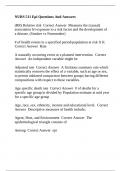
(RR) Relative risk Correct Answer Measures the (causal)
association b/t exposure to a risk factor and the development of
a disease. (Smoker vs Nonsmoker)
# of health events in a specified period/population at risk X K
Correct Answer Rate
A naturally occurring event or a planned intervention. Correct
Answer An independent variable might be
Adjusted rate Correct Answer A fictitious summary rate which
statistically removes the effect of a variable, such as age or sex,
to permit unbiased comparison between groups having different
compositions with respect to these variables.
Age specific death rate Correct Answer # of deaths for a
specific age group/yr divided by Population estimate at mid year
for a specific age group
Age, race, sex, ethnicity, income and educational level. Correct
Answer Descriptive measures of health include;
Agent, Host, and Environment Correct Answer The
epidemiological triangle consists of
Among Correct Answer epi
, Analytic epidemiology Correct Answer Seeks to identify
associations between a particular disease or health problem and
its etiology.
Analytic studies Correct Answer Generates or tests hypotheses
or seek to answer specific questions
Analyze disease development. Correct Answer The
epidemiological triangle is used to
Answers to the "how" and "why" of health and
disease to determine causality Correct Answer Analytic studies
are directed toward finding
BP screening for hypertension, audiometric testing for hearing
impairment, skin test for TB, and phenylalanine test for
phenylketonuria in infancy Correct Answer Examples of
secondary prevention include
Can be retrospective or prospective in design Correct Answer
Analytic studies
Can change (e.g. health status, knowledge, and behavior)
Correct Answer The dependent variable
Case control/Retrospective studies (B) Correct Answer Has
higher level of proof of causality than cross sectional studies.
Characteristics present in a group or population with a disease or
the absence of disease in unaffected groups or populations.
(RR) Relative risk Correct Answer Measures the (causal)
association b/t exposure to a risk factor and the development of
a disease. (Smoker vs Nonsmoker)
# of health events in a specified period/population at risk X K
Correct Answer Rate
A naturally occurring event or a planned intervention. Correct
Answer An independent variable might be
Adjusted rate Correct Answer A fictitious summary rate which
statistically removes the effect of a variable, such as age or sex,
to permit unbiased comparison between groups having different
compositions with respect to these variables.
Age specific death rate Correct Answer # of deaths for a
specific age group/yr divided by Population estimate at mid year
for a specific age group
Age, race, sex, ethnicity, income and educational level. Correct
Answer Descriptive measures of health include;
Agent, Host, and Environment Correct Answer The
epidemiological triangle consists of
Among Correct Answer epi
, Analytic epidemiology Correct Answer Seeks to identify
associations between a particular disease or health problem and
its etiology.
Analytic studies Correct Answer Generates or tests hypotheses
or seek to answer specific questions
Analyze disease development. Correct Answer The
epidemiological triangle is used to
Answers to the "how" and "why" of health and
disease to determine causality Correct Answer Analytic studies
are directed toward finding
BP screening for hypertension, audiometric testing for hearing
impairment, skin test for TB, and phenylalanine test for
phenylketonuria in infancy Correct Answer Examples of
secondary prevention include
Can be retrospective or prospective in design Correct Answer
Analytic studies
Can change (e.g. health status, knowledge, and behavior)
Correct Answer The dependent variable
Case control/Retrospective studies (B) Correct Answer Has
higher level of proof of causality than cross sectional studies.
Characteristics present in a group or population with a disease or
the absence of disease in unaffected groups or populations.