

JAVA
Anatomy of a Java Program:
Classes, Methods, and Variables
In Java, a program is made up of various building blocks such
as classes, methods, and variables. Understanding these
components is essential to writing any Java program.
Classes
A class is a blueprint for creating objects in Java. It defines a
set of properties (variables) and behaviors (methods) that an
object can have. A class can also contain constructors, which
are special methods for creating objects.
Here is an example of a simple class in Java:
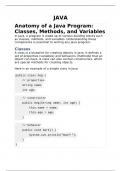
public class Dog {
// properties
String name;
int age;
// constructor
public Dog(String name, int age) {
this.name = name;
this.age = age;
}
// behavior
public void bark() {
System.out.println("Woof!");
}
}
, In this example, the Dog class has two
properties: name and age . It also has a constructor that takes
these two properties as parameters and assigns them to the
object. Additionally, it has a behavior, or method,
called bark() , which simply prints the string "Woof!" to the
console.
Methods
A method is a block of code that contains a series of
instructions. It is similar to a function in other programming
languages. Methods are defined within classes and can be used
to perform specific tasks.
Methods in Java can have several components, including:
Access modifier: specifies the accessibility of the method.
Examples include public , private , and protected .
Return type: specifies the data type of the value returned
by the method. It can be any data type, including a primitive
type or an object reference.
Method name: specifies the name of the method. It should
follow the same naming conventions as variables.
Parameters: specifies the input required by the method.
Parameters are optional and can be of any data type.
Body: contains a series of instructions that define what the
method does.
Here is an example of a method definition in Java:
public int addNumbers(int a, int b) {
int sum = a + b;
return sum;
}
In this example, the method addNumbers() takes two integer
parameters, a and b . It creates a new integer variable
Anatomy of a Java Program:
Classes, Methods, and Variables
In Java, a program is made up of various building blocks such
as classes, methods, and variables. Understanding these
components is essential to writing any Java program.
Classes
A class is a blueprint for creating objects in Java. It defines a
set of properties (variables) and behaviors (methods) that an
object can have. A class can also contain constructors, which
are special methods for creating objects.
Here is an example of a simple class in Java:
public class Dog {
// properties
String name;
int age;
// constructor
public Dog(String name, int age) {
this.name = name;
this.age = age;
}
// behavior
public void bark() {
System.out.println("Woof!");
}
}
, In this example, the Dog class has two
properties: name and age . It also has a constructor that takes
these two properties as parameters and assigns them to the
object. Additionally, it has a behavior, or method,
called bark() , which simply prints the string "Woof!" to the
console.
Methods
A method is a block of code that contains a series of
instructions. It is similar to a function in other programming
languages. Methods are defined within classes and can be used
to perform specific tasks.
Methods in Java can have several components, including:
Access modifier: specifies the accessibility of the method.
Examples include public , private , and protected .
Return type: specifies the data type of the value returned
by the method. It can be any data type, including a primitive
type or an object reference.
Method name: specifies the name of the method. It should
follow the same naming conventions as variables.
Parameters: specifies the input required by the method.
Parameters are optional and can be of any data type.
Body: contains a series of instructions that define what the
method does.
Here is an example of a method definition in Java:
public int addNumbers(int a, int b) {
int sum = a + b;
return sum;
}
In this example, the method addNumbers() takes two integer
parameters, a and b . It creates a new integer variable

