Lifespan Development Exam 1
Questions & Answers 100% Accurate!!
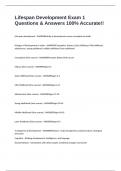
Life-span development - ANSWERSstudy of development across conception to death
8 Stages of Development in order - ANSWERSConception, Infancy, Early childhood, Mid-childhood,
adolescence, young adulthood, middle adulthood, later adulthood
Conception (time course) - ANSWERSPrenatal. Before birth occurs
Infancy (time course) - ANSWERSAge 0-2
Early Childhood (time course) - ANSWERSAges 2-6
Mid-Childhood (time course) - ANSWERSAges 6-11
Adolescence (time course) - ANSWERSAges 11-20
Young adulthood (time course) - ANSWERSAges 20-40
Middle Adulthood (time course) - ANSWERSAges 40-65
Later Adulthood (time course) - ANSWERSAges 65+
3 Categories of Development - ANSWERSPhysical - body development, physical nature, biological
processes
Cognitive - thinking development/ intelligence, and language
Socioemotional - interactions with other people, emotional changes/ personalit
, Case study - ANSWERSAn intensive study of one or a small number of individuals or families.
In depth look at a single individual. Performed by mental health professionals, when for either practical
or ethical reasons.Provides info. about one persons' experiences
Correlation Study - ANSWERSA study in which the researcher examines two or more variables to see if
they are linked in any way.
provides info that helps to predict how people will behave. Shows comparisons. Describe the strength of
the relation between two or more events or characteristics
Twin Study - ANSWERSThe behavioral similarities between identical twins (genetically identical) is
compared with the behavioral similarities between fraternal twins. If twins seprated, they will both have
same nature aspects.
A method for estimating heritability in which the degree of similarity in a trait that is observed among
identical twins is compared with that observed among fraternal twins.
Adoption Studies - ANSWERSA method for estimating heritability in which similarities between children
and their adoptive parents are compared with similarities between children and their biological parents.
Genotype - ANSWERSGenetic material makeup. Hh or HH or GGGg or GgGg homozygous, heterozygous
Phenotype - ANSWERSObservable physical characteristics (weight, height, eye color, hair color)
Mitosis - ANSWERSCell body division replication of 22 autosomes (non-sex chromosomal) Diploid cells
(2n)
The process through which all cells other than gametes reproduce, in which a cell divides and each
resulting cell receives a full copy of all 46 chromosomes.
Meiosis - ANSWERSCell division of gametes, sex cells egg and sperm, producing 23 unpaired
chromosomes. Haploid cells (n)
The process through which gametes (sperm and ova) are produced, in which each resulting gamete has
half of the genetic material of the parent cell.
Questions & Answers 100% Accurate!!
Life-span development - ANSWERSstudy of development across conception to death
8 Stages of Development in order - ANSWERSConception, Infancy, Early childhood, Mid-childhood,
adolescence, young adulthood, middle adulthood, later adulthood
Conception (time course) - ANSWERSPrenatal. Before birth occurs
Infancy (time course) - ANSWERSAge 0-2
Early Childhood (time course) - ANSWERSAges 2-6
Mid-Childhood (time course) - ANSWERSAges 6-11
Adolescence (time course) - ANSWERSAges 11-20
Young adulthood (time course) - ANSWERSAges 20-40
Middle Adulthood (time course) - ANSWERSAges 40-65
Later Adulthood (time course) - ANSWERSAges 65+
3 Categories of Development - ANSWERSPhysical - body development, physical nature, biological
processes
Cognitive - thinking development/ intelligence, and language
Socioemotional - interactions with other people, emotional changes/ personalit
, Case study - ANSWERSAn intensive study of one or a small number of individuals or families.
In depth look at a single individual. Performed by mental health professionals, when for either practical
or ethical reasons.Provides info. about one persons' experiences
Correlation Study - ANSWERSA study in which the researcher examines two or more variables to see if
they are linked in any way.
provides info that helps to predict how people will behave. Shows comparisons. Describe the strength of
the relation between two or more events or characteristics
Twin Study - ANSWERSThe behavioral similarities between identical twins (genetically identical) is
compared with the behavioral similarities between fraternal twins. If twins seprated, they will both have
same nature aspects.
A method for estimating heritability in which the degree of similarity in a trait that is observed among
identical twins is compared with that observed among fraternal twins.
Adoption Studies - ANSWERSA method for estimating heritability in which similarities between children
and their adoptive parents are compared with similarities between children and their biological parents.
Genotype - ANSWERSGenetic material makeup. Hh or HH or GGGg or GgGg homozygous, heterozygous
Phenotype - ANSWERSObservable physical characteristics (weight, height, eye color, hair color)
Mitosis - ANSWERSCell body division replication of 22 autosomes (non-sex chromosomal) Diploid cells
(2n)
The process through which all cells other than gametes reproduce, in which a cell divides and each
resulting cell receives a full copy of all 46 chromosomes.
Meiosis - ANSWERSCell division of gametes, sex cells egg and sperm, producing 23 unpaired
chromosomes. Haploid cells (n)
The process through which gametes (sperm and ova) are produced, in which each resulting gamete has
half of the genetic material of the parent cell.