

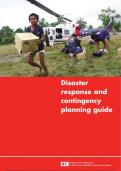
Disaster
response and
contingency
planning guide
, © International Federation of Red Cross
and Red Crescent Societies
The International Any part of this handbook may be cited, copied,
translated into other languages or adapted to meet
Federation’s Global local needs without prior permission from the
International Federation of Red Cross and Red Crescent
Societies, provided that the source is clearly stated.
Agenda (2006–2010) The maps used do not imply the expression of any
opinion on the part of the International Federation
of Red Cross and Red Crescent Societies or National
Over the next five years, the collective focus of Societies concerning the legal status of a territory
the Federation will be on achieving the following or of its authorities.
goals and priorities: Cover photo: Fredrik Barkenhammar/German Red
Cross
Our goals
Goal 1: Reduce the number of deaths, injuries
and impact from disasters.
Goal 2: Reduce the number of deaths, illnesses
and impact from diseases and public health
emergencies.
Goal 3: Increase local community, civil society
and Red Cross Red Crescent capacity to address
the most urgent situations of vulnerability.
Goal 4: Promote respect for diversity and human
dignity, and reduce intolerance, discrimination
and social exclusion.
Our priorities
Improving our local, regional and international
capacity to respond to disasters and public
health emergencies.
Scaling up our actions with vulnerable commu-
nities in health promotion, disease prevention
and disaster risk reduction.
Increasing significantly our HIV/AIDS pro-
gramming and advocacy.
Renewing our advocacy on priority humanitari-
an issues, especially fighting intolerance, stigma
and discrimination, and promoting disaster risk
2007
reduction.
International Federation of Red Cross and
Red Crescent Societies
P.O. Box 372
CH-1211 Geneva 19
Switzerland
Telephone: +41 22 730 4222
Telefax: +41 22 733 0395
E-mail:
Web site: www.ifrc.org
, Disaster response and contingency planning guide 1
Acknowledgements
These guidelines draw upon on a wide variety of documents already produced or in use by National
Societies, field delegations, partner organizations and disaster management professionals, as well as
on a two-year process of dialogue and collection of best practices and peer reviews from within the
International Red Cross and Red Crescent Movement. An external inter-agency working group, a
disaster management delegates’ working group, and a reference task force also inform these guide-
lines. The following is a list of the main documents consulted:
1 Preparation of Community Disaster Preparedness Plans in Community-Based Self Reliance - Disaster
Preparedness Manual: A Manual for Red Cross Instructors in the Pacific. International Federation of
Red Cross and Red Crescent Societies, Regional Delegation Suva.
2 Disaster Preparedness, 2nd edition. Randolph Kent for DHA Disaster Management Training
Programme, 1994. Prepared in collaboration with the University of Wisconsin-Disaster
Management Centre and InterWorks.
3 Guidelines for Disaster Response and Contingency Planning, International Federation of Red Cross
and Red Crescent Societies, Pan-American Disaster Response Unit (PADRU), 2006.
4 Preparedness Planning Module. International Federation of Red Cross and Red Crescent Societies,
Disaster Preparedness Training Programme. June, 2000.
5 Inter-Agency Contingency Planning Guidelines for Humanitarian Assistance. Inter-Agency Standing
Committee (IASC), November, 2001.
This publication was made possible by the generous financial support of the European Commission’s
Humanitarian Aid Department (ECHO), the United Kingdom’s Department for International
Development (DFID) and staff support from the American Red Cross.
This guide will serve as a working tool for disaster response staff from within National Red
Cross and Red Crescent Societies and the International Federation of Red Cross and Red
Crescent Societies (the International Federation) working at local, national, regional and glob-
al levels.
, 2 International Federation of Red Cross and Red Crescent Societies
Table of contents
Plans production
Chapter 1
Introduction ________________________________________________________ 4
How to use this guide___________________________________________________ 4
What is disaster response and contingency planning?________________________ 7
Response planning process ______________________________________________ 8
Why plan?____________________________________________________________ 8
What to plan for? ______________________________________________________ 9
Who to plan with? _____________________________________________________ 9
When to plan? ________________________________________________________ 10
Where to plan?________________________________________________________ 10
Chapter 2
Steps for developing disaster response
and contingency plans ____________________________________________ 12
Step 1: Institutional disaster planning______________________________________ 13
Step 2: Hazard, vulnerability, capacity and risk analyses _____________________ 14
Step 3: Resource identification and mobilization ____________________________ 19
Step 4: Early warning, alert systems and triggers____________________________ 20
Step 5: Linkages and communications _____________________________________ 21
Step 6: Sectoral responsibilities___________________________________________ 22
Support information
Chapter 3
Internal and external coordination ______________________________ 31
Internal coordination ___________________________________________________ 31
External coordination ___________________________________________________ 32
Chapter 4
Plan implementation and follow-up ______________________________ 36
Training and awareness of disaster response and contingency plans____________ 36
Exercises and simulations _______________________________________________ 37
Updating and evaluating the plan ________________________________________ 38
Chapter 5
Plan standards, accountability and linkages ____________________ 41
Standards and accountability ____________________________________________ 41
Linkages between national, regional and international tools (local to global) _____ 43
Appendices
Annexes _________________________________________________________________ 47
response and
contingency
planning guide
, © International Federation of Red Cross
and Red Crescent Societies
The International Any part of this handbook may be cited, copied,
translated into other languages or adapted to meet
Federation’s Global local needs without prior permission from the
International Federation of Red Cross and Red Crescent
Societies, provided that the source is clearly stated.
Agenda (2006–2010) The maps used do not imply the expression of any
opinion on the part of the International Federation
of Red Cross and Red Crescent Societies or National
Over the next five years, the collective focus of Societies concerning the legal status of a territory
the Federation will be on achieving the following or of its authorities.
goals and priorities: Cover photo: Fredrik Barkenhammar/German Red
Cross
Our goals
Goal 1: Reduce the number of deaths, injuries
and impact from disasters.
Goal 2: Reduce the number of deaths, illnesses
and impact from diseases and public health
emergencies.
Goal 3: Increase local community, civil society
and Red Cross Red Crescent capacity to address
the most urgent situations of vulnerability.
Goal 4: Promote respect for diversity and human
dignity, and reduce intolerance, discrimination
and social exclusion.
Our priorities
Improving our local, regional and international
capacity to respond to disasters and public
health emergencies.
Scaling up our actions with vulnerable commu-
nities in health promotion, disease prevention
and disaster risk reduction.
Increasing significantly our HIV/AIDS pro-
gramming and advocacy.
Renewing our advocacy on priority humanitari-
an issues, especially fighting intolerance, stigma
and discrimination, and promoting disaster risk
2007
reduction.
International Federation of Red Cross and
Red Crescent Societies
P.O. Box 372
CH-1211 Geneva 19
Switzerland
Telephone: +41 22 730 4222
Telefax: +41 22 733 0395
E-mail:
Web site: www.ifrc.org
, Disaster response and contingency planning guide 1
Acknowledgements
These guidelines draw upon on a wide variety of documents already produced or in use by National
Societies, field delegations, partner organizations and disaster management professionals, as well as
on a two-year process of dialogue and collection of best practices and peer reviews from within the
International Red Cross and Red Crescent Movement. An external inter-agency working group, a
disaster management delegates’ working group, and a reference task force also inform these guide-
lines. The following is a list of the main documents consulted:
1 Preparation of Community Disaster Preparedness Plans in Community-Based Self Reliance - Disaster
Preparedness Manual: A Manual for Red Cross Instructors in the Pacific. International Federation of
Red Cross and Red Crescent Societies, Regional Delegation Suva.
2 Disaster Preparedness, 2nd edition. Randolph Kent for DHA Disaster Management Training
Programme, 1994. Prepared in collaboration with the University of Wisconsin-Disaster
Management Centre and InterWorks.
3 Guidelines for Disaster Response and Contingency Planning, International Federation of Red Cross
and Red Crescent Societies, Pan-American Disaster Response Unit (PADRU), 2006.
4 Preparedness Planning Module. International Federation of Red Cross and Red Crescent Societies,
Disaster Preparedness Training Programme. June, 2000.
5 Inter-Agency Contingency Planning Guidelines for Humanitarian Assistance. Inter-Agency Standing
Committee (IASC), November, 2001.
This publication was made possible by the generous financial support of the European Commission’s
Humanitarian Aid Department (ECHO), the United Kingdom’s Department for International
Development (DFID) and staff support from the American Red Cross.
This guide will serve as a working tool for disaster response staff from within National Red
Cross and Red Crescent Societies and the International Federation of Red Cross and Red
Crescent Societies (the International Federation) working at local, national, regional and glob-
al levels.
, 2 International Federation of Red Cross and Red Crescent Societies
Table of contents
Plans production
Chapter 1
Introduction ________________________________________________________ 4
How to use this guide___________________________________________________ 4
What is disaster response and contingency planning?________________________ 7
Response planning process ______________________________________________ 8
Why plan?____________________________________________________________ 8
What to plan for? ______________________________________________________ 9
Who to plan with? _____________________________________________________ 9
When to plan? ________________________________________________________ 10
Where to plan?________________________________________________________ 10
Chapter 2
Steps for developing disaster response
and contingency plans ____________________________________________ 12
Step 1: Institutional disaster planning______________________________________ 13
Step 2: Hazard, vulnerability, capacity and risk analyses _____________________ 14
Step 3: Resource identification and mobilization ____________________________ 19
Step 4: Early warning, alert systems and triggers____________________________ 20
Step 5: Linkages and communications _____________________________________ 21
Step 6: Sectoral responsibilities___________________________________________ 22
Support information
Chapter 3
Internal and external coordination ______________________________ 31
Internal coordination ___________________________________________________ 31
External coordination ___________________________________________________ 32
Chapter 4
Plan implementation and follow-up ______________________________ 36
Training and awareness of disaster response and contingency plans____________ 36
Exercises and simulations _______________________________________________ 37
Updating and evaluating the plan ________________________________________ 38
Chapter 5
Plan standards, accountability and linkages ____________________ 41
Standards and accountability ____________________________________________ 41
Linkages between national, regional and international tools (local to global) _____ 43
Appendices
Annexes _________________________________________________________________ 47


