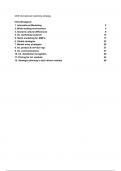
CE8 International marketing strategy
Inhoudsopgave:
1. International Marketing 2
2. World trading environment 5
3. Social & cultural differences 8
4. Int. marketing research 13
5. Niche marketing for SME’s 17
6. Global strategies 22
7. Market entry strategies 26
8. Int. product & service mgt 31
9. Int. communications 37
10. Int. distribution & logistics 40
11. Pricing for int. markets 44
12. Strategic planning in tech driven markets 49
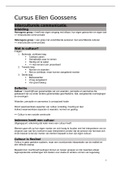
,1. International Marketing
What is international marketing?
“Marketing is defined as the management process responsible for identifying, anticipating
and satisfying customer requirements profitably.” Thus, marketing involves:
Marketing involves:
• Focusing on the needs and wants of customers
• Identifying the best method of satisfying those needs and
wants
• Orienting the company towards the process of providing
that satisfaction
• Meeting organizational objectives
Export marketing: marketing of goods/services across national boundaries, without
adaptations to the goods/services
International marketing: marketing activities in >1 country, control of marketing activities
from outside the country where the product will be sold
Global marketing: organization focuses on selection and exploitation of global marketing
opportunities, objective is achieving global competitive advantage
Theories of internationalization:
Economic model = motivated by transaction costs, Volvo
Behavioural model = motivated by culture, religions, geography, Doppelmayr (Ski-lift)
Network or relationship model = motivated by long term relationships, ASML
Born global model = motivated by global customers, AIRBNB
Factors influencing international markets
1. Cultural Factors:
Coca-Cola:
2 liter bottles too big for Spanish fridges
Pronunciation in China – Kooke Koula
‘A thirsty mouthful of candle wax’
McDonald’s:
The white face of ‘Ronald McDonald’
A white face is seen as a death mask in Japan
2. Legal factors:
3 dimensions in the legal environment:
- domestic laws in the home country:
export controls, plus duty to abide by national laws in all activities
- local domestic law:
different in every country
, - international law:
Issues include piracy, treaties, patents etc
3. Economic
- Developed Triad Economies
Account for 80% of world trade
- Emerging Economies
Huge and growing consumer demand
Government directed economic reforms
‘dual economy’
- Less Developed Countries (LDCs)
Low Gross domestic product (GDP) zelfde als BBP, limited manufacturing base
Infrastructure weaknesses
Heavy reliance on one product/one trading partner
4. Political
Political factors may cause risks due to “a sudden or gradual change in a local political
environment that is disadvantageous or counter productive to foreign firms and markets’
Political factors
Government actions may constitute potential risk for the firm:
- Operational restrictions
eg. exchange controls or employment policies
- Discriminatory restrictions
e.g. special taxes and tariffs
- Physical actions
e.g nationalization, riots and war
5. Technological
Impact of technological advances:
• Ability to gather data on markets
• Management control capabilities
• Operational practicalities of electronic communication
Global access to the World Wide Web
• 7 day a week
• 24 hours a day
• Importance of English language for web users
6. Sustainability factors
Things such as the sustainable development goals and the Netherlands trying to reduce
CO2 emissions.
, - Differences between international and domestic marketing
Culture, Often diverse and multicultural
Markets, Widespread and sometimes fragmented
Data, Difficult to obtain and sometimes expensive
Politics, Regimes vary in stability, political risk becomes an important variable
Governments, Can be a strong influence in regulating importers and
foreign business ventures
Economies, Varying levels of development
Finance, Many differing finance systems and regulatory bodies
Stakeholders, Commercial, home country and host country
Business, Diverse rules, culturally influenced
Control, Difficult to control and coordinate across markets
- Differences between international and domestic marketing
Failure arises from:
- Inability to find right market niches
- Unwilling to adapt and update products to local needs
- Products not perceived as sufficiently unique
- Vacillating commitment
- Assigning the wrong people
- Picking the wrong partners
- Inability to manage local stakeholders
- Mutual distrust/lack of respect between HQ & management
- Inability to leverage ideas to all countries
When going international firms must:
1. Have a clear international competitive focus
2. Develop effective relationship strategies
3. Be committed to providing quality products and services worldwide
4. Have a well-managed organization with a culture for learning
Inhoudsopgave:
1. International Marketing 2
2. World trading environment 5
3. Social & cultural differences 8
4. Int. marketing research 13
5. Niche marketing for SME’s 17
6. Global strategies 22
7. Market entry strategies 26
8. Int. product & service mgt 31
9. Int. communications 37
10. Int. distribution & logistics 40
11. Pricing for int. markets 44
12. Strategic planning in tech driven markets 49
,1. International Marketing
What is international marketing?
“Marketing is defined as the management process responsible for identifying, anticipating
and satisfying customer requirements profitably.” Thus, marketing involves:
Marketing involves:
• Focusing on the needs and wants of customers
• Identifying the best method of satisfying those needs and
wants
• Orienting the company towards the process of providing
that satisfaction
• Meeting organizational objectives
Export marketing: marketing of goods/services across national boundaries, without
adaptations to the goods/services
International marketing: marketing activities in >1 country, control of marketing activities
from outside the country where the product will be sold
Global marketing: organization focuses on selection and exploitation of global marketing
opportunities, objective is achieving global competitive advantage
Theories of internationalization:
Economic model = motivated by transaction costs, Volvo
Behavioural model = motivated by culture, religions, geography, Doppelmayr (Ski-lift)
Network or relationship model = motivated by long term relationships, ASML
Born global model = motivated by global customers, AIRBNB
Factors influencing international markets
1. Cultural Factors:
Coca-Cola:
2 liter bottles too big for Spanish fridges
Pronunciation in China – Kooke Koula
‘A thirsty mouthful of candle wax’
McDonald’s:
The white face of ‘Ronald McDonald’
A white face is seen as a death mask in Japan
2. Legal factors:
3 dimensions in the legal environment:
- domestic laws in the home country:
export controls, plus duty to abide by national laws in all activities
- local domestic law:
different in every country
, - international law:
Issues include piracy, treaties, patents etc
3. Economic
- Developed Triad Economies
Account for 80% of world trade
- Emerging Economies
Huge and growing consumer demand
Government directed economic reforms
‘dual economy’
- Less Developed Countries (LDCs)
Low Gross domestic product (GDP) zelfde als BBP, limited manufacturing base
Infrastructure weaknesses
Heavy reliance on one product/one trading partner
4. Political
Political factors may cause risks due to “a sudden or gradual change in a local political
environment that is disadvantageous or counter productive to foreign firms and markets’
Political factors
Government actions may constitute potential risk for the firm:
- Operational restrictions
eg. exchange controls or employment policies
- Discriminatory restrictions
e.g. special taxes and tariffs
- Physical actions
e.g nationalization, riots and war
5. Technological
Impact of technological advances:
• Ability to gather data on markets
• Management control capabilities
• Operational practicalities of electronic communication
Global access to the World Wide Web
• 7 day a week
• 24 hours a day
• Importance of English language for web users
6. Sustainability factors
Things such as the sustainable development goals and the Netherlands trying to reduce
CO2 emissions.
, - Differences between international and domestic marketing
Culture, Often diverse and multicultural
Markets, Widespread and sometimes fragmented
Data, Difficult to obtain and sometimes expensive
Politics, Regimes vary in stability, political risk becomes an important variable
Governments, Can be a strong influence in regulating importers and
foreign business ventures
Economies, Varying levels of development
Finance, Many differing finance systems and regulatory bodies
Stakeholders, Commercial, home country and host country
Business, Diverse rules, culturally influenced
Control, Difficult to control and coordinate across markets
- Differences between international and domestic marketing
Failure arises from:
- Inability to find right market niches
- Unwilling to adapt and update products to local needs
- Products not perceived as sufficiently unique
- Vacillating commitment
- Assigning the wrong people
- Picking the wrong partners
- Inability to manage local stakeholders
- Mutual distrust/lack of respect between HQ & management
- Inability to leverage ideas to all countries
When going international firms must:
1. Have a clear international competitive focus
2. Develop effective relationship strategies
3. Be committed to providing quality products and services worldwide
4. Have a well-managed organization with a culture for learning