
Payroll Source - CPP Notes
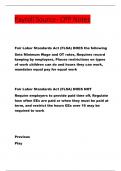
Fair Labor Standards Act (FLSA) DOES the following
Sets Minimum Wage and OT rates, Requires record
keeping by employers, Places restrictions on types
of work children can do and hours they can work,
mandates equal pay for equal work
Fair Labor Standards Act (FLSA) DOES NOT
Require employers to provide paid time off, Regulate
how often EEs are paid or when they must be paid at
term, and restrict the hours EEs over 16 may be
required to work
Previous
Play
,Next
Rewind 10 seconds
Move forward 10 seconds
Unmute
0:06
/
0:15
Full screen
Brainpower
Read More
Fair Labor Standards Act is Administered and
Enforced by
Wage and Hour Division of the Department of Labor
(DOL)
Equal Pay Provisions are Enforced by
Equal Employment Opportunity Commission (EEOC)
,What are the two types of coverage under the FLSA?
Enterprise Coverage and Individual Employee
Coverage
What is Enterprise Coverage?
At least 2 EEs of the business are employed in jobs
closely related and directly essential to interstate
commerce or the production of goods for interstate
commerce. Also the business has annual gross sales
of at least $500k
What businesses and all EEs are covered by FLSA
regardless of annual sales volume?
Hospitals, Nursing Homes, Schools an Colleges, and
Public (Government) Agencies
What is Individual Employee Coverage?
An EE is covered by the FLSA if he/she is engaged in
interstate commerce or in the production of goods
, for interstate commerce. It doesn't matter if the
business is not a covered enterprise
What is White Collar Exemption?
Employees not covered by minimum wage, OT, and
certain recordkeeping requirements of the law
What is the salary test for white collar exemption?
EE has to earn at least $684/wk ($35,568/yr), EEs
paid more than $107,432/yr have to meet only one
prong of the revamped duties test to qualify as
exempt.
What are the determinations of being exempt?
Depends on EE's primary duty, EE's level of
discretionary authority, and whether a minimum
salary requirement is met
Fair Labor Standards Act (FLSA) DOES the following
Sets Minimum Wage and OT rates, Requires record
keeping by employers, Places restrictions on types
of work children can do and hours they can work,
mandates equal pay for equal work
Fair Labor Standards Act (FLSA) DOES NOT
Require employers to provide paid time off, Regulate
how often EEs are paid or when they must be paid at
term, and restrict the hours EEs over 16 may be
required to work
Previous
Play
,Next
Rewind 10 seconds
Move forward 10 seconds
Unmute
0:06
/
0:15
Full screen
Brainpower
Read More
Fair Labor Standards Act is Administered and
Enforced by
Wage and Hour Division of the Department of Labor
(DOL)
Equal Pay Provisions are Enforced by
Equal Employment Opportunity Commission (EEOC)
,What are the two types of coverage under the FLSA?
Enterprise Coverage and Individual Employee
Coverage
What is Enterprise Coverage?
At least 2 EEs of the business are employed in jobs
closely related and directly essential to interstate
commerce or the production of goods for interstate
commerce. Also the business has annual gross sales
of at least $500k
What businesses and all EEs are covered by FLSA
regardless of annual sales volume?
Hospitals, Nursing Homes, Schools an Colleges, and
Public (Government) Agencies
What is Individual Employee Coverage?
An EE is covered by the FLSA if he/she is engaged in
interstate commerce or in the production of goods
, for interstate commerce. It doesn't matter if the
business is not a covered enterprise
What is White Collar Exemption?
Employees not covered by minimum wage, OT, and
certain recordkeeping requirements of the law
What is the salary test for white collar exemption?
EE has to earn at least $684/wk ($35,568/yr), EEs
paid more than $107,432/yr have to meet only one
prong of the revamped duties test to qualify as
exempt.
What are the determinations of being exempt?
Depends on EE's primary duty, EE's level of
discretionary authority, and whether a minimum
salary requirement is met


