

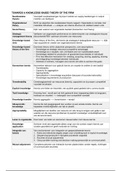
TOWARDS A KNOWLEDGE-BASED THEORY OF THE FIRM
Neoklassieke Voorspelt koopbeslissingen bij input markten en supply beslissingen in output
theorie markten van bedrijven
Organizational Richt op aspecten die neoklassieke theorie negeert. Organisatie is complex met
theory meerdere individuen —> analyse van interne structuur en relaties tussen units
Social theory Kijkt naar waarom een organisatie bestaat (transaction cost theory)
Strategic Verklaren van organisatie performance en determinanten van strategische keuzes
management theory (bijvoorbeeld RBV: optimaal uitvoeren van resources)
Knowledge-based Geen theory of the firm, ziet kennis als strategisch belangrijkste resource —> kijkt
view naar acquisitie en creatie van organisatorische kennis
Knowledge-based Dominant theory within objectivist perspective, core assumptions:
theory of the firm - Knowledge as strategic resource (competitive advantage)
- Knowledge as a valuable, rare, inimitable and non-substitutable asset
- Knowledge needed for production of goods/services (resides in individual)
- Firm has effective mechanism for creating, acquiring, storing, applying, sharing
and integrating knowledge between individuals
- Interests of workers, managers and owners are alike to achieve the goals
Kenmerken kennis Kenmerken relevant voor gebruik kennis om waarde te creëren in een bedrijf:
- Transferability
- Capacity for aggregation
- Appropriability
- Specialization in knowledge acquisition (because of bounded rationality)
- Knowledge requirements of production
Transferability Overdraagbaarheid van resources (kennis), capaciteit om duurzaam competitief
voordeel te behalen
Explicit knowledge Kennis over feiten en theorieën, een publiek goed gedeeld dmv communicatie
Tacit knowledge Knowing how’, wordt aan het licht gebracht door toepassing (delen is langzaam,
kostbaar en onzeker) —> belangrijk voor competitief voordeel
Knowledge transfer Kennis aggregatie —> transmission + receipt
Idiosyncratic Kennis die niet geaggregeerd kan worden op een enkele locatie. Kennis van
knowledge bepaalde omstandigheden van tijd en plaats.
Appropriability Mogelijkheid van bezitter van resource om iets terug te krijgen wat gelijk is aan
waarde van die resource (problemen bij explicit knowledge: onduidelijkheid over
wie de kennis bezit)
Leren in organisatie Door leren van leden en aannemen nieuwe leden met nieuwe kennis
Knowledge Schrijver vindt dat organisatie alleen zorgt voor de context waarin kennis can
application worden gecreëerd en geeft motivatie en richting
Integratie van Vier mechanismen voor integratie van gespecialiseerde kennis:
kennis 1. Rules and directives (regels zorgen voor omzetting tacit in explicit knowledge)
2. Sequencing (productie in tijd-gestructureerde volgorde)
3. Routines (mutual adjustment)
4. Group problem solving and decision making (persoonlijk en communicatief)
Mutual adjustment Complexe patronen van interactie kunnen plaatsvinden zonder regels, richtingen
of communicatie (routines)
, Common Elementen van kennis die gemeenschappelijk zijn met alle organisatorische leden,
knowledge intersectie van individuele knowledge sets. Verschillende soorten:
- Language (gezamenlijke taal, integratie via verbale communicatie)
- Other forms of symbolic communication (letters, cijfers, vertrouwen: software)
- Commonality of specialized knowledge (paradox: dan voegt integratie toch
geen waarde toe? Maar moet ook niet geheel anders zijn)
- Shared meaning (gedeeld begrip, beter voor overbrengen tacit knowledge)
- Recognition of individual knowledge domains (mutual adjustment)
Organizational Uitkomst van knowledge integratie: complexe, team-based productieve
capability activiteiten (cross-training en job rotatie)
Organizational Kennis-integrerende institutie heeft twee implicaties voor de interne structuur:
structure 1. Implicatie voor hiërarchie (hoger niveau besluitvorming afhankelijk van lager
niveau kennis, hiërarchie vermindert kwaliteit van hoger niveau besluitvorming)
2. Implication for distribution of decision-making authority in the firm
(besluitvormingsrechten aan degene geven die ownership over kennis hebben,
beslissingen gebaseerd op tacit knowledge decentraliseren en gebaseerd op
statistische kennis centraliseren)
Team-based Oplossing voor hiërarchie, coördinatie bereikt door direct betrekken van
structure specialisten en niet door managers van bovenaf (meer motivatie en efficiëntie).
Wel zorgen dat het ‘fluid’ is door alle specialistische kennis te geven die nodig is
Verticale Als kennis inefficiënt wordt overgebracht, worden verticale aangrenzende stages
boundaries van het product geïntegreerd in hetzelfde bedrijf zodat productie goed loopt (als
product B geen kennis nodig heeft van A kan het in aparte bedrijven bestaan)
Horizontale Als er gaten ontstaan tussen constellaties van producten en kennis (efficiënt
boundaries kennisgebruik vereist congruentie tussen kennis- en productdomein)
KNOWING WHAT YOU DON’T KNOW: DISCOURSES AND CONTRADICTIONS IN
KNOWLEDGE MANAGEMENT RESEARCH
Dualism - When is knowledge?
(epistemology) - Objectief
- Fenomeen gekoppeld aan activiteiten en structuren
- Epistemology of practice
- Either/or
Duality - What is knowledge?
(epistemology) - Geen dichotomies zoals subjectief/objectief
- Handig voor bestuderen paradoxen
- Epistemology of possession
- Both/and
Consensus (social Sociologie van regulatie, maatschappij neigt naar ideale staat van integratie,
order) evenwicht en order
Dissensus (social Sociologie van radicale verandering, krachten van overtuiging, conflict en
order) verandering dagen continu social order uit
Neo-functionalist - Dualisme
discourse - Social order (consensus)
- Angst is afbraak van sociaal geordende wereld
- Optimale allocatie van resources (effectiviteit)
- Ultieme perfectie
- Kennis is een asset (object dat kan worden bezeten)
- Kan worden gescheiden van persoon
Neoklassieke Voorspelt koopbeslissingen bij input markten en supply beslissingen in output
theorie markten van bedrijven
Organizational Richt op aspecten die neoklassieke theorie negeert. Organisatie is complex met
theory meerdere individuen —> analyse van interne structuur en relaties tussen units
Social theory Kijkt naar waarom een organisatie bestaat (transaction cost theory)
Strategic Verklaren van organisatie performance en determinanten van strategische keuzes
management theory (bijvoorbeeld RBV: optimaal uitvoeren van resources)
Knowledge-based Geen theory of the firm, ziet kennis als strategisch belangrijkste resource —> kijkt
view naar acquisitie en creatie van organisatorische kennis
Knowledge-based Dominant theory within objectivist perspective, core assumptions:
theory of the firm - Knowledge as strategic resource (competitive advantage)
- Knowledge as a valuable, rare, inimitable and non-substitutable asset
- Knowledge needed for production of goods/services (resides in individual)
- Firm has effective mechanism for creating, acquiring, storing, applying, sharing
and integrating knowledge between individuals
- Interests of workers, managers and owners are alike to achieve the goals
Kenmerken kennis Kenmerken relevant voor gebruik kennis om waarde te creëren in een bedrijf:
- Transferability
- Capacity for aggregation
- Appropriability
- Specialization in knowledge acquisition (because of bounded rationality)
- Knowledge requirements of production
Transferability Overdraagbaarheid van resources (kennis), capaciteit om duurzaam competitief
voordeel te behalen
Explicit knowledge Kennis over feiten en theorieën, een publiek goed gedeeld dmv communicatie
Tacit knowledge Knowing how’, wordt aan het licht gebracht door toepassing (delen is langzaam,
kostbaar en onzeker) —> belangrijk voor competitief voordeel
Knowledge transfer Kennis aggregatie —> transmission + receipt
Idiosyncratic Kennis die niet geaggregeerd kan worden op een enkele locatie. Kennis van
knowledge bepaalde omstandigheden van tijd en plaats.
Appropriability Mogelijkheid van bezitter van resource om iets terug te krijgen wat gelijk is aan
waarde van die resource (problemen bij explicit knowledge: onduidelijkheid over
wie de kennis bezit)
Leren in organisatie Door leren van leden en aannemen nieuwe leden met nieuwe kennis
Knowledge Schrijver vindt dat organisatie alleen zorgt voor de context waarin kennis can
application worden gecreëerd en geeft motivatie en richting
Integratie van Vier mechanismen voor integratie van gespecialiseerde kennis:
kennis 1. Rules and directives (regels zorgen voor omzetting tacit in explicit knowledge)
2. Sequencing (productie in tijd-gestructureerde volgorde)
3. Routines (mutual adjustment)
4. Group problem solving and decision making (persoonlijk en communicatief)
Mutual adjustment Complexe patronen van interactie kunnen plaatsvinden zonder regels, richtingen
of communicatie (routines)
, Common Elementen van kennis die gemeenschappelijk zijn met alle organisatorische leden,
knowledge intersectie van individuele knowledge sets. Verschillende soorten:
- Language (gezamenlijke taal, integratie via verbale communicatie)
- Other forms of symbolic communication (letters, cijfers, vertrouwen: software)
- Commonality of specialized knowledge (paradox: dan voegt integratie toch
geen waarde toe? Maar moet ook niet geheel anders zijn)
- Shared meaning (gedeeld begrip, beter voor overbrengen tacit knowledge)
- Recognition of individual knowledge domains (mutual adjustment)
Organizational Uitkomst van knowledge integratie: complexe, team-based productieve
capability activiteiten (cross-training en job rotatie)
Organizational Kennis-integrerende institutie heeft twee implicaties voor de interne structuur:
structure 1. Implicatie voor hiërarchie (hoger niveau besluitvorming afhankelijk van lager
niveau kennis, hiërarchie vermindert kwaliteit van hoger niveau besluitvorming)
2. Implication for distribution of decision-making authority in the firm
(besluitvormingsrechten aan degene geven die ownership over kennis hebben,
beslissingen gebaseerd op tacit knowledge decentraliseren en gebaseerd op
statistische kennis centraliseren)
Team-based Oplossing voor hiërarchie, coördinatie bereikt door direct betrekken van
structure specialisten en niet door managers van bovenaf (meer motivatie en efficiëntie).
Wel zorgen dat het ‘fluid’ is door alle specialistische kennis te geven die nodig is
Verticale Als kennis inefficiënt wordt overgebracht, worden verticale aangrenzende stages
boundaries van het product geïntegreerd in hetzelfde bedrijf zodat productie goed loopt (als
product B geen kennis nodig heeft van A kan het in aparte bedrijven bestaan)
Horizontale Als er gaten ontstaan tussen constellaties van producten en kennis (efficiënt
boundaries kennisgebruik vereist congruentie tussen kennis- en productdomein)
KNOWING WHAT YOU DON’T KNOW: DISCOURSES AND CONTRADICTIONS IN
KNOWLEDGE MANAGEMENT RESEARCH
Dualism - When is knowledge?
(epistemology) - Objectief
- Fenomeen gekoppeld aan activiteiten en structuren
- Epistemology of practice
- Either/or
Duality - What is knowledge?
(epistemology) - Geen dichotomies zoals subjectief/objectief
- Handig voor bestuderen paradoxen
- Epistemology of possession
- Both/and
Consensus (social Sociologie van regulatie, maatschappij neigt naar ideale staat van integratie,
order) evenwicht en order
Dissensus (social Sociologie van radicale verandering, krachten van overtuiging, conflict en
order) verandering dagen continu social order uit
Neo-functionalist - Dualisme
discourse - Social order (consensus)
- Angst is afbraak van sociaal geordende wereld
- Optimale allocatie van resources (effectiviteit)
- Ultieme perfectie
- Kennis is een asset (object dat kan worden bezeten)
- Kan worden gescheiden van persoon


