NSG262 Week 2 Test
With Solution
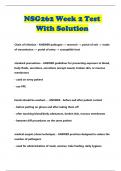
Chain of infection - ANSWER pathogen -> reservoir -> portal of exit -> mode
of transmission -> portal of entry -> susceptible host
standard precautions - ANSWER guidelines for preventing exposure to blood,
body fluids, secretions, excretions (except sweat), broken skin, or mucous
membranes
- used on every patient
- use PPE
hands should be washed... - ANSWER - before and after patient contact
- before putting on gloves and after taking them off
- after touching blood/body substances, broken skin, mucous membranes
- between diff procedures on the same patient
medical asepsis (clean technique) - ANSWER practices designed to reduce the
number of pathogens
- used for administration of meds, enemas, tube feeding, daily hygiene
, surgical asepsis (sterile technique) - ANSWER eliminates all pathogens
- used in dressing changes, catheterizations, surgical procedures
contact isolation - ANSWER prevents transmission of microorganisms by
direct/indirect contact with source
negative pressure room - ANSWER a room that is at a lower pressure than
the adjacent spaces so the flow of air is into the room
- protects against possible airborne pathogens
most frequent diseases requiring contact isolation - ANSWER - diapered or
incontinent (E. coli, rotavirus, salmonella, shigella, hep type A)
- diphtheria (cutaneous, pharyngeal)
- enteroviral infections
- herpes simplex (neonatal, mucocutaneous)
- lice (pediculosis)
- multidrug resistant organism infection (MRSA, VRE)
- scabies (mites)
droplet precautions - ANSWER in addition to standard precautions, clean
With Solution
Chain of infection - ANSWER pathogen -> reservoir -> portal of exit -> mode
of transmission -> portal of entry -> susceptible host
standard precautions - ANSWER guidelines for preventing exposure to blood,
body fluids, secretions, excretions (except sweat), broken skin, or mucous
membranes
- used on every patient
- use PPE
hands should be washed... - ANSWER - before and after patient contact
- before putting on gloves and after taking them off
- after touching blood/body substances, broken skin, mucous membranes
- between diff procedures on the same patient
medical asepsis (clean technique) - ANSWER practices designed to reduce the
number of pathogens
- used for administration of meds, enemas, tube feeding, daily hygiene
, surgical asepsis (sterile technique) - ANSWER eliminates all pathogens
- used in dressing changes, catheterizations, surgical procedures
contact isolation - ANSWER prevents transmission of microorganisms by
direct/indirect contact with source
negative pressure room - ANSWER a room that is at a lower pressure than
the adjacent spaces so the flow of air is into the room
- protects against possible airborne pathogens
most frequent diseases requiring contact isolation - ANSWER - diapered or
incontinent (E. coli, rotavirus, salmonella, shigella, hep type A)
- diphtheria (cutaneous, pharyngeal)
- enteroviral infections
- herpes simplex (neonatal, mucocutaneous)
- lice (pediculosis)
- multidrug resistant organism infection (MRSA, VRE)
- scabies (mites)
droplet precautions - ANSWER in addition to standard precautions, clean