
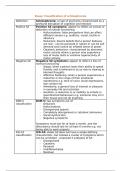
Essay: Classification of schizophrenia
Definition Schizophrenia: a type of psychosis characterised by a
profound disruption of cognition and emotion
Positive SZ Positive SZ symptoms: appear to reflect an excess or
distortion of normal functioning
- Hallucinations: false perceptions that can affect
different senses e.g. auditory, visual, tactile or
olfactory
- Delusions: bizarre beliefs that a person believes
are real – can be paranoid in nature or can be self
directed and involve an inflated sense of power
- Catatonic behaviour: characterised by abnormal
motor activity where a person may experience
loss of motor skills or extreme hyperactivity of
motor activity
Negative SZ Negative SZ symptoms: appear to reflect a loss of
normal functioning
- Alogia: when a person loses their ability to speak
fluently and is believed to occur due to slowing or
blocked thoughts
- Affective flattening: when a person experiences a
reduction in the range of their emotional
expressions e.g. tone of voice, facial expressions,
eye contact etc
- Anhedonia: a general loss of interest or pleasure
in everyday life and activities
- Avolition: a reduction in or inability to initiate in
goal-directed behaviours e.g. someone may sit in
their house and not do anything
DSM-5 DSM-5: two symptoms out of:
classification - Delusions
- Hallucinations
- Disorganised speech
- Completely disorganised or catatonic behaviour
- Social dysfunction,
- Negative symptoms
Symptoms must last for at least a month, and the
disturbance should last for at least 6 months e.g. not
being able to work properly
ICD-10 ICD-10: states SZ does not have a single defining
classification characteristic, but instead a cluster of symptoms which
can be unrelated – proposed 5 subtypes of SZ:
- Disorganised
- Catatonic
- Paranoid
- Undifferentiated
- Residual
, Essay: Reliability and validity in diagnosis and classification
AO1 Reliability: refers to the consistency of measurements,
where any measurement should produce the same data
successively - repeatable
- Cultural differences in diagnosis: culture is
found to have an influence on the SZ diagnostic
process e.g. Copeland asked UK and US
psychiatrists to diagnose a patient – 69% US
diagnosed as SZ while only 2% UK diagnosed as
SZ
Validity: refers to whether an observed effect is a
genuine one
- Gender bias: men have been diagnosed with SZ
more often than men (Longenecker), as female
patients are typically better at masking and
mentally healthy adult behaviour is based off
male behaviour
- Symptom overlap: the fact that symptoms of a
disorder may not be unique to that disorder -
most people diagnosed with SZ have sufficient
symptoms to be diagnosed with at least one other
disorder – strong links between SZ and bipolar
- Comorbidity: refers to the extent that two or
more conditions occur simultaneously
AO3 x 1 - Support for cultural differences in classification of
SZ (Copeland)
- A list of symptoms (patient X) were given to a
large sample of American and British psychiatrists
to be diagnosed
- 69% of American psychiatrists diagnosed patient
X as SZ, while only 2% diagnosed patient X as SZ
- Highlights inconsistencies (lack of reliability) in
diagnosis
AO3 x 2 - Support for gender bias (Loring and Powell)
- When psychiatrists were given a list of a patient’s
symptoms, when the patient was described as
male the diagnosis rate was 56%, but when the
patient was described as female the diagnosis
rate was 20%
- Demonstrates lack of equality in relation to
gender
AO3 x 3 - Support for comorbidity (Buckley et al)
- Found 50% of schizophrenics could also be
diagnosed with a disorder like depression, anxiety
or substance abuse
Definition Schizophrenia: a type of psychosis characterised by a
profound disruption of cognition and emotion
Positive SZ Positive SZ symptoms: appear to reflect an excess or
distortion of normal functioning
- Hallucinations: false perceptions that can affect
different senses e.g. auditory, visual, tactile or
olfactory
- Delusions: bizarre beliefs that a person believes
are real – can be paranoid in nature or can be self
directed and involve an inflated sense of power
- Catatonic behaviour: characterised by abnormal
motor activity where a person may experience
loss of motor skills or extreme hyperactivity of
motor activity
Negative SZ Negative SZ symptoms: appear to reflect a loss of
normal functioning
- Alogia: when a person loses their ability to speak
fluently and is believed to occur due to slowing or
blocked thoughts
- Affective flattening: when a person experiences a
reduction in the range of their emotional
expressions e.g. tone of voice, facial expressions,
eye contact etc
- Anhedonia: a general loss of interest or pleasure
in everyday life and activities
- Avolition: a reduction in or inability to initiate in
goal-directed behaviours e.g. someone may sit in
their house and not do anything
DSM-5 DSM-5: two symptoms out of:
classification - Delusions
- Hallucinations
- Disorganised speech
- Completely disorganised or catatonic behaviour
- Social dysfunction,
- Negative symptoms
Symptoms must last for at least a month, and the
disturbance should last for at least 6 months e.g. not
being able to work properly
ICD-10 ICD-10: states SZ does not have a single defining
classification characteristic, but instead a cluster of symptoms which
can be unrelated – proposed 5 subtypes of SZ:
- Disorganised
- Catatonic
- Paranoid
- Undifferentiated
- Residual
, Essay: Reliability and validity in diagnosis and classification
AO1 Reliability: refers to the consistency of measurements,
where any measurement should produce the same data
successively - repeatable
- Cultural differences in diagnosis: culture is
found to have an influence on the SZ diagnostic
process e.g. Copeland asked UK and US
psychiatrists to diagnose a patient – 69% US
diagnosed as SZ while only 2% UK diagnosed as
SZ
Validity: refers to whether an observed effect is a
genuine one
- Gender bias: men have been diagnosed with SZ
more often than men (Longenecker), as female
patients are typically better at masking and
mentally healthy adult behaviour is based off
male behaviour
- Symptom overlap: the fact that symptoms of a
disorder may not be unique to that disorder -
most people diagnosed with SZ have sufficient
symptoms to be diagnosed with at least one other
disorder – strong links between SZ and bipolar
- Comorbidity: refers to the extent that two or
more conditions occur simultaneously
AO3 x 1 - Support for cultural differences in classification of
SZ (Copeland)
- A list of symptoms (patient X) were given to a
large sample of American and British psychiatrists
to be diagnosed
- 69% of American psychiatrists diagnosed patient
X as SZ, while only 2% diagnosed patient X as SZ
- Highlights inconsistencies (lack of reliability) in
diagnosis
AO3 x 2 - Support for gender bias (Loring and Powell)
- When psychiatrists were given a list of a patient’s
symptoms, when the patient was described as
male the diagnosis rate was 56%, but when the
patient was described as female the diagnosis
rate was 20%
- Demonstrates lack of equality in relation to
gender
AO3 x 3 - Support for comorbidity (Buckley et al)
- Found 50% of schizophrenics could also be
diagnosed with a disorder like depression, anxiety
or substance abuse


