

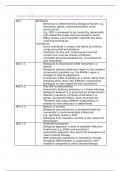
Essay: Outline and compare any two approaches in psychology
AO1 Biological
- Behaviour is determined by biological factors e.g.
hormones, genes, neurotransmitters, brain
structure etc.
- E.g. OCD is proposed to be caused by abnormally
high dopamine levels and low serotonin levels
- Often makes use of scientific methods like brain
scanning techniques
Humanistic
- Every individual is unique and wants to achieve
congruence/self-actualisation
- Emphasis on free will, meaning we have full
control over how we choose to behave
- Considers personal experiences, circumstances
and motivation
AO3 x 1 - Biological is reductionist while humanistic is
holistic
- Biological reduces behaviour down to the smallest
components possible e.g. the MAOA-L gene is
thought to lead to aggression
- Humanistic looks at people as a whole rather than
breaking them down into different components
- Biological is more objective than humanistic
AO3 x 2 - Free will vs determinism
- Humanistic believes behaviour is chosen whereas
biological believes it is governed by innate factors
- Maslow’s hierarchy of needs (motivation) vs
genes, neurotransmitters, brain structure etc
- Therefore they have different explanations in
relation to how behaviour is determined
AO3 x 3 - Nature vs nurture
- Biological says behaviour is predetermined but
humanistic is environmentally influenced
- E.g. serotonin levels in OCD
- Biological only considers nurture in the context of
phenotypes
AO3 x 4 - Treatment prospects
- Biological approach is able to establish effective
treatments e.g. SSRIs and anxiolytics
- Humanistic approach also led to the emergence of
client-centred therapy
- Both positively contribute to treatment, though
biological effectiveness is supported by more
research compared to client centred therapy
, Essay: Outline the behaviourist approach in psychology. Compare
the behaviourist approach with the social learning approach
AO1 - Operant conditioning: learning through positive
reinforcement, negative reinforcement and
punishment
- Positive reinforcement: rewarding a desired
behaviour with a positive stimulus
- Negative reinforcement: rewarding a desired
behaviour with the removal of a negative stimulus
- Skinner’s rats
- Classical conditioning: learning through repeated
association of a neutral stimulus, unconditioned
stimulus and an unconditioned response
- Pavlov’s dog
AO3 x 1 - Both take a nurture approach rather than a nature
approach
- E.g. Bandura’s bobo doll study – behaviour is
learned from the environment
- Neither approaches consider innate motivations
behind behaviour – mediational processes
- Social learning consider some cognitive processes
while behaviourism does not
AO3 x 2 - Both are environmentally deterministic
- Behaviourism = cause and effect
- SLT = cause, thought and effect
- Both approaches state the environment is directly
responsible for behaviour
AO3 x 3 - Both are relatively deterministic
- Experiments do not consider confounding
motivators for behaviour
- E.g. Pavlov and Bandura only study a cause and
effect relationship between a stimulus and a
behaviour
- Neither approaches entirely accommodate free
will though SLT is soft determinism rather than
hard
AO3 x 4 - Both contribute to psychology as a science
- Behaviourist and SLT methodology is often
replicable, falsifiable, systematic etc.
- Test hypotheses in a way which reflects features
of a science
- Therefore equally contribute to psychology as a
science where the methodology in the
psychodynamic approach for example does not
AO1 Biological
- Behaviour is determined by biological factors e.g.
hormones, genes, neurotransmitters, brain
structure etc.
- E.g. OCD is proposed to be caused by abnormally
high dopamine levels and low serotonin levels
- Often makes use of scientific methods like brain
scanning techniques
Humanistic
- Every individual is unique and wants to achieve
congruence/self-actualisation
- Emphasis on free will, meaning we have full
control over how we choose to behave
- Considers personal experiences, circumstances
and motivation
AO3 x 1 - Biological is reductionist while humanistic is
holistic
- Biological reduces behaviour down to the smallest
components possible e.g. the MAOA-L gene is
thought to lead to aggression
- Humanistic looks at people as a whole rather than
breaking them down into different components
- Biological is more objective than humanistic
AO3 x 2 - Free will vs determinism
- Humanistic believes behaviour is chosen whereas
biological believes it is governed by innate factors
- Maslow’s hierarchy of needs (motivation) vs
genes, neurotransmitters, brain structure etc
- Therefore they have different explanations in
relation to how behaviour is determined
AO3 x 3 - Nature vs nurture
- Biological says behaviour is predetermined but
humanistic is environmentally influenced
- E.g. serotonin levels in OCD
- Biological only considers nurture in the context of
phenotypes
AO3 x 4 - Treatment prospects
- Biological approach is able to establish effective
treatments e.g. SSRIs and anxiolytics
- Humanistic approach also led to the emergence of
client-centred therapy
- Both positively contribute to treatment, though
biological effectiveness is supported by more
research compared to client centred therapy
, Essay: Outline the behaviourist approach in psychology. Compare
the behaviourist approach with the social learning approach
AO1 - Operant conditioning: learning through positive
reinforcement, negative reinforcement and
punishment
- Positive reinforcement: rewarding a desired
behaviour with a positive stimulus
- Negative reinforcement: rewarding a desired
behaviour with the removal of a negative stimulus
- Skinner’s rats
- Classical conditioning: learning through repeated
association of a neutral stimulus, unconditioned
stimulus and an unconditioned response
- Pavlov’s dog
AO3 x 1 - Both take a nurture approach rather than a nature
approach
- E.g. Bandura’s bobo doll study – behaviour is
learned from the environment
- Neither approaches consider innate motivations
behind behaviour – mediational processes
- Social learning consider some cognitive processes
while behaviourism does not
AO3 x 2 - Both are environmentally deterministic
- Behaviourism = cause and effect
- SLT = cause, thought and effect
- Both approaches state the environment is directly
responsible for behaviour
AO3 x 3 - Both are relatively deterministic
- Experiments do not consider confounding
motivators for behaviour
- E.g. Pavlov and Bandura only study a cause and
effect relationship between a stimulus and a
behaviour
- Neither approaches entirely accommodate free
will though SLT is soft determinism rather than
hard
AO3 x 4 - Both contribute to psychology as a science
- Behaviourist and SLT methodology is often
replicable, falsifiable, systematic etc.
- Test hypotheses in a way which reflects features
of a science
- Therefore equally contribute to psychology as a
science where the methodology in the
psychodynamic approach for example does not


