
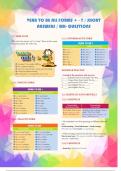
VERB TO BE ALL FORMS + - ? / SHORT
ANSWERS / WH- QUESTIONS
1.1. VERB TO BE
1.1.3. INTERROGATIVE FORM
The verb to be means “ser” or “estar”. Here we have some
important points for verb to be: VERB TO BE ?
INTERROGATIVE SHORT ANSWERS
• Am I ...? • Yes, I am. • No, I'm not.
Watch • Are You ...?
• Is He ...?
• Yes, You are.
• Yes, He is.
• No, You aren't.
• No, He isn't
out ! • Is She ...?
• Is It ...?
• Are We ...?
• Yes, She is.
• Yes, It is.
• Yes, We are.
• No, She isn't
• No, It isn't
• No, We aren't.
• Use capital /. I'm a student. NOT i'm. • Are They ...? • Yes, They are. • No, They aren't.
• You = singular and plural.
• Use he for a man, she for a woman, and it for a thing.
• Use they for people and things. GRAMMAR PRACTICE
• In contractions' = a missing letter, e.g. 'm = am.
• Complete the questions and answers.
1._____Rolando and Cesar friends? No, they_____.
2._____Vargas Llosa from Lima? No, he___.
1.1.1. POSITIVE FORM 3._____you from thr USA. No, I_____.
4._____you English? No, we_____.
4._____you English? No, we_____.
VERB TO BE +
FULL FORM CONTRACTION
1.2. FAREWELLS AND FAREWELLS
• I am your friend. • I'm your friend.
• You are 17 year sold. • You're 17 years old.
1.2.2. FAREWELLS
• He is Peter. • He's Peter.
• She is Mary. • She's Mary.
• It is a pen. • It's a pen. Conversation Conversation
• We are students. • We're students. Neutral to formal Less formal
• You are in Class 5. • You're in Class 5. A: Hi./Hello. How are you? A: Hi/Hey. How are things? / How's it
• They are teachers. • They're teachers. B: Fine, thank you. /Fine, going? / How're you doing?
thanks. How about you? B: Pretty good./ OK./ All right. / I'm
good ... How about you?
1.1.2. NEGATIVE FORM
• We sometimes use these greetings at different times of
day:
VERB TO BE - Good morning. / Good afternoon. / Good evening.
FULL FORM CONTRACTION (We don't use Good night as a greeting.)
• I am not your friend. • I'm not your friend.
• You are not17 year sold. • You're not 17 years old. • When meeting someone for the first time, we can say:
• He is not Peter. • He's not Peter. Nice to meet you. (The answer could be Nice to meet
• She is not Mary. • She's not Mary. you, too. / Same here.)
• It is not a pen. • It's not a pen.
• We are not students. • We're not students. 1.2.2. FAREWELLS
• You are not in Class 5. • You're not in Class 5.
• They are not teachers. • They're not teachers. • Good-bye (Neutral to formal)

