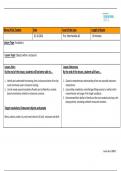
Name of the Teacher Date Level of the class Length of lesson
01.10.2024 Pre- intermediate A2 60 minutes
Lesson Type: Vocabulary
Lesson Topic: Objects within a restaurant
Lesson Aims: Lesson Outcomes:
By the end of the lesson, students will be better able to… By the end of the lesson, students will have…
1. Identify and understand the meaning, form, and pronunciation of ten key 1. Gained a comprehensive understanding of ten new essential restaurant-
words commonly used in restaurant settings. related terms.
2. Use the newly acquired vocabulary fluently and confidently in context- 2. Successfully completed a controlled gap-filling exercise to reinforce their
based conversations related to restaurants scenarios. comprehension and usage of the target vocabulary.
3. Demonstrated their ability to fluently use the new vocabulary during a role-
playing activity, simulating authentic restaurant situations.
Target vocabulary: Restaurant objects and people
Menu, waitress, waiter, tip, main meal, dessert, bill, dish, restaurant and drink
Lesson plan 150823
,Anticipated difficulties: Suggested solutions:
Include one relating to L1/age/level of the students and one for the 10
words (meaning, form, or pronunciation). 1. Provide simple sentence-building exercises where students can arrange the new
vocabulary into grammatically correct sentences, helping them understand English
1. L1 (Chinese): word order through practice. Provide bilingual support when introducing new
Chinese students may have difficulty with English word order and sentence concepts. Encourage comparisons between languages to enhance understanding.
structure, as it differs from Mandarin. For example, the placement of adjectives Provide explicit explanations and examples to address common pitfalls.
before nouns (e.g., "main meal") could be confusing.
Students may face challenges in transferring concepts and structures from their 2. Keep activities dynamic and engaging by incorporating games or movement-based
first language (Chinese) to English. tasks to maintain interest and energy levels. Break the lesson into shorter segments
and include frequent changes in activity type to prevent monotony and boredom.
2. Age (11-12):
At 11-12 years old, students may have shorter attention spans, especially during 3. Scaffold the role-play by providing sentence starters and key phrases. Model
activities that focus on vocabulary memorization or repetitive drills. Keeping them conversations first and gradually reduce support to encourage independent use of
focused and interested throughout the lesson duration may be challenging. the vocabulary.
3. Level of the student (A2): 4. Make use of a variety of activities for each word, using visual aids and real-life
As A2 learners, students may have limited experience with role-playing activities, examples to provide context. Simplify explanations and offer comparisons between
making it harder for them to initiate conversations or apply the new vocabulary in English and Chinese concepts to overcome language barriers. Encourage active
spontaneous ways or during the production activity. participation and provide opportunities for practice to reinforce comprehension.
4. Target Language (Meaning): 5. Introduce the concepts of countable and uncountable nouns through clear
Some English words may not have direct equivalents in Chinese, making it examples using the target vocabulary. Create activities where students classify the
challenging for students to grasp their meanings. For example, the concept of "tip" words into countable and uncountable categories and practice using them with
as a gratuity given to service staff is not common in Chinese culture, so students appropriate articles or quantifiers (e.g., "a dish," "some dessert").
may struggle to understand its significance.
6. Use phonetic breakdowns, exaggerated pronunciation drills, and physical cues (such
5. Target Language (Form): as pointing to the tongue for sounds) to help students master difficult words.
Students might have difficulty understanding the difference between countable Reinforce meaning through context-based activities, such as matching words to
and uncountable nouns, particularly with words like "dish" (countable) and pictures or short descriptions.
Lesson plan 150823
, "dessert" (which can be both countable and uncountable depending on usage).
This could lead to errors in using articles or quantifiers correctly (e.g., "a dessert"
vs. "some dessert").
6. Target Language (Pronunciation):
Some words, like "waitress" and "dessert," might be difficult for students to
pronounce due to unfamiliar sound combinations, leading to difficulty in accurately
articulating these words.
Language analysis:
Language Meaning of the How you will present meaning Concept Checking Questions Grammatical Pronunciation
Item item form Use the IPA
translator if needed
1. Menu A list of the food and Where do we find a menu? Noun /ˈmenjuː/
drinks that is available (Restaurant)
at a restaurant or to be Can we find a list of food in a
served at a meal. menu? (Yes)
Do we use it to order food? (Yes)
Lesson plan 150823
01.10.2024 Pre- intermediate A2 60 minutes
Lesson Type: Vocabulary
Lesson Topic: Objects within a restaurant
Lesson Aims: Lesson Outcomes:
By the end of the lesson, students will be better able to… By the end of the lesson, students will have…
1. Identify and understand the meaning, form, and pronunciation of ten key 1. Gained a comprehensive understanding of ten new essential restaurant-
words commonly used in restaurant settings. related terms.
2. Use the newly acquired vocabulary fluently and confidently in context- 2. Successfully completed a controlled gap-filling exercise to reinforce their
based conversations related to restaurants scenarios. comprehension and usage of the target vocabulary.
3. Demonstrated their ability to fluently use the new vocabulary during a role-
playing activity, simulating authentic restaurant situations.
Target vocabulary: Restaurant objects and people
Menu, waitress, waiter, tip, main meal, dessert, bill, dish, restaurant and drink
Lesson plan 150823
,Anticipated difficulties: Suggested solutions:
Include one relating to L1/age/level of the students and one for the 10
words (meaning, form, or pronunciation). 1. Provide simple sentence-building exercises where students can arrange the new
vocabulary into grammatically correct sentences, helping them understand English
1. L1 (Chinese): word order through practice. Provide bilingual support when introducing new
Chinese students may have difficulty with English word order and sentence concepts. Encourage comparisons between languages to enhance understanding.
structure, as it differs from Mandarin. For example, the placement of adjectives Provide explicit explanations and examples to address common pitfalls.
before nouns (e.g., "main meal") could be confusing.
Students may face challenges in transferring concepts and structures from their 2. Keep activities dynamic and engaging by incorporating games or movement-based
first language (Chinese) to English. tasks to maintain interest and energy levels. Break the lesson into shorter segments
and include frequent changes in activity type to prevent monotony and boredom.
2. Age (11-12):
At 11-12 years old, students may have shorter attention spans, especially during 3. Scaffold the role-play by providing sentence starters and key phrases. Model
activities that focus on vocabulary memorization or repetitive drills. Keeping them conversations first and gradually reduce support to encourage independent use of
focused and interested throughout the lesson duration may be challenging. the vocabulary.
3. Level of the student (A2): 4. Make use of a variety of activities for each word, using visual aids and real-life
As A2 learners, students may have limited experience with role-playing activities, examples to provide context. Simplify explanations and offer comparisons between
making it harder for them to initiate conversations or apply the new vocabulary in English and Chinese concepts to overcome language barriers. Encourage active
spontaneous ways or during the production activity. participation and provide opportunities for practice to reinforce comprehension.
4. Target Language (Meaning): 5. Introduce the concepts of countable and uncountable nouns through clear
Some English words may not have direct equivalents in Chinese, making it examples using the target vocabulary. Create activities where students classify the
challenging for students to grasp their meanings. For example, the concept of "tip" words into countable and uncountable categories and practice using them with
as a gratuity given to service staff is not common in Chinese culture, so students appropriate articles or quantifiers (e.g., "a dish," "some dessert").
may struggle to understand its significance.
6. Use phonetic breakdowns, exaggerated pronunciation drills, and physical cues (such
5. Target Language (Form): as pointing to the tongue for sounds) to help students master difficult words.
Students might have difficulty understanding the difference between countable Reinforce meaning through context-based activities, such as matching words to
and uncountable nouns, particularly with words like "dish" (countable) and pictures or short descriptions.
Lesson plan 150823
, "dessert" (which can be both countable and uncountable depending on usage).
This could lead to errors in using articles or quantifiers correctly (e.g., "a dessert"
vs. "some dessert").
6. Target Language (Pronunciation):
Some words, like "waitress" and "dessert," might be difficult for students to
pronounce due to unfamiliar sound combinations, leading to difficulty in accurately
articulating these words.
Language analysis:
Language Meaning of the How you will present meaning Concept Checking Questions Grammatical Pronunciation
Item item form Use the IPA
translator if needed
1. Menu A list of the food and Where do we find a menu? Noun /ˈmenjuː/
drinks that is available (Restaurant)
at a restaurant or to be Can we find a list of food in a
served at a meal. menu? (Yes)
Do we use it to order food? (Yes)
Lesson plan 150823