ATI Med Surg Exam 2 Study Guide
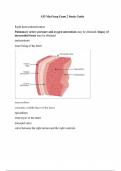
Right heart catheterization Pulmonary artery pressure and oxygen saturations may be obtained; biopsy of myocardial tissue may be obtained endocardium inner lining of the heart myocardium muscular, middle layer of the heart epicardium outer layer of the heart tricuspid valve valve between the right atrium and the right ventricle mitral valve valve between the left atrium and the left ventricle; bicuspid valve aortic valve The semilunar valve separating the aorta from the left ventricle that prevents blood from flowing back into the left ventricle. pulmonic valve right semilunar valve separating the right ventricle and pulmonary artery Coronary arteries blood vessels that branch from the aorta and carry oxygen-rich blood to the heart muscle Cardiac hemodynamics describes the pumping forces or pressures required by the heart to maintain blood flow throughout the cardiovascular system Depolarization electrical activation of cell caused by influx of sodium into cell while potassium exits cell Repolarization return of cell to resting state caused by reentry of potassium into cell while sodium exits Refractory periods o Effective refractory period: phase in which cells are incapable of depolarizing o Relative refractory period: phase in which cells require stronger-than-normal stimulus to depolarize Cardiac action potential cycle Phase 0: rapid depolarization. Phase 1: rapid repolarization phase 2: plateau. Phase 3: final repolarization. Phase 4: resting Ejection fraction percent of end diastolic volume ejected with each heart beat (left ventricle) Cardiac output (CO) Amount of blood pumped by ventricle in liters per minute Stroke volume (SV) Amount of blood ejected with each heartbeat Preload/Afterload Preload- degree of stretch of cardiac muscle fibers at end of diastole Afterload- is the systemic resistance after leaving the heart. Contractility ability of cardiac muscle to shorten in response to electrical impulse Frank-Starling Law the stroke volume of the left ventricle will increase as the left ventricular volume increases due to the myocyte stretch causing a more forceful systolic contraction. Relative refractory period phase in which cells require stronger-than-normal stimulus to depolarize Effective refractory period phase in which cells are incapable of depolarizing Normal CVP (central venous pressure) 2-6 mmHg CVP is a measurement of the pressure in the vena cava or right atrium. Left sided heart failure Pulmonary congestion, crackles S3 or “ventricular gallop” Dyspnea on exertion(DOE) Low O2 sat Dry, nonproductive cough initially Oliguria Angiotensin-converting enzyme (ACE) inhibitors management of HF caused by systolic dysfunction vasodilation; diuresis; decreases afterload; monitor for hypotension, hyperkalemia, and altered renal function; cough Angiotensin II receptor blockers Losartan "Sartans" Blocking action of angiotensin II; results in vasodilation Heart failure, HTN, MI, diabetic retinopathy Side effects: angioedema, GI upset, hypotension Beta-blockers decrease heart rate and dilate arteries by blocking beta receptors prescribed in addition to ACE inhibitors; may be several weeks before effects seen; use with caution in patients with asthma Ivabradine hyperpolarization-activated cyclic nucleotide-gated (HCN) channel blockers. It works by slowing the heart rate so the heart can pump more blood through the body each time it beats decreases rate of conduction through the SA node; observe for decrease HR and BP Hydralazine and isosorbide dinitrate Isosorbide dinitrate belongs to the group of medicines called nitrates Hydralazine is in a class of medications called vasodilators. Digitalis strengthens the contraction of the heart muscle, slows the heart rate, and helps eliminate fluid from body tissues -dec. HR by prolonging QR interval monitor for digitalis toxicity especially if patient is hypokalemic The critical care nurse is caring for a patient who has had an MI. The nurse should expect to assist with establishing what hemodynamic monitoring procedure to assess the patients left ventricular function? Pulmonary artery pressure monitoring (PAPM) Central venous pressure monitoring CVP is used to assess right ventricular function Systemic arterial pressure monitoring SAPM is used for continual assessment of BP. BNP (brain natriuretic peptide) -Trigger NA excretion and decrease in volume The level in the blood increases as the ventricular walls expand from increased pressure, making it a helpful diagnostic, monitoring, and prognostic tool in the setting of HF Heart Murmur grade 1 very faint and difficult to describe Heart Murmur grade 4 Loud and may be associated with a thrill sound similar to (a purring cat). Heart Murmur grade 6 Very loud, with thrill. May be heard with stethoscope entirely off the chest Heart Murmur grade 5 -very loud murmur heard w/ edge of stethoscope off chest. -thrill more obvious BUN levels, creatinine levels 6-20 mg/dl, 0.6-1.3mg/dl Magnesium levels Erb point Third ICS at the left sternal border Attached to the mitral and tricuspid valves are cordlike structures known as chordae tendineae Dipyridamole used to mimic the affects of exercise during stress test in patients unable to follow directions BNP (brain natriuretic peptide) level A BNP level greater than 51 pg/ml is commonly associated with mild heart failure. 100 suggest heart failure C reactive protein is an indicator of inflammation The PR interval 0.12-0.20 seconds The T wave depicts the relative refractory period, representing ventricular repolarization. Amiodarone is categorized as a Class III antiarrhythmic medication. It prolongs repolarization and treats and prevents ventricular arrhythmias. causes pulmonary toxicity, base pulmonary function tests should be completed before starting the medication. Atropine -Muscarinic antagonist -Used in bradycardia and for ophthalmic applications Dobutamine is used to treat heart failure and low cardiac output. A positive inotropic medication increases the force of the myocardial contraction. Lidocaine is used to treat ventricular ectopy, ventricular tachycardia, and ventricular fibrillation. QRS complexes The nurse is assessing a patient with a probable diagnosis of first-degree AV block. The nurse is aware that this dysrhythmia is evident on an ECG strip by what indication? Delayed conduction, producing a prolonged PR interval QT interval is usually 0.32 to 0.40 seconds in duration if the heart rate is 65 to 95 bpm. If the QT interval becomes prolonged, the client may be at risk for a lethal ventricular dysrhythmia, called torsades de pointes. Atrial flutter occurs in the atrium and creates impulses at a regular atrial rate between 250 and 400 times per minute. ventricular bigeminy cardiac rhythm beat follows each sinus beat, and the coupling interval between the ventricular premature beat and the previous sinus QRS complex is constant (fixed coupling interval). Which of the following medications does the nurse anticipate administering to a client preparing for cardioversion? Prior to cardioversion, cardiac medications are held, and the client is sedated with a medication such as diazepam A Holter monitor a portable electrocardiograph that is worn by an ambulatory patient to continuously monitor the heart rates and rhythms over a 24-hour period first-degree atrioventricular block A dysrhythmia in which there is a delay in conduction, usually at the level of the atrioventricular node. second degree atrioventricular block is classified as type I or type II, depending on the location of the block. A block above the bundle of His is considered type I (also known as Mobitz I or Wenckebach), and a block within or below the bundle of His is considered type II (or Mobitz II). First-degree and second-degree AV blocks are incomplete blocks. In second-degree AV block, types I and II, the ventricular rhythm (RR interval) is irregular. The heart's ejection fraction is measured using an echocardiogram or multiple gated acquisition scan Milrinone phosphodiesterase inhibitor; delays the release of calcium from intracellular reservoirs and prevents the uptake of extracellular calcium by the cells. This promotes vasodilation, resulting in decreased preload and afterload and reduced cardiac workload. Milrinone is administered intravenously to clients with severe HF, including those who are waiting for a heart transplant. -The major side effects are hypotension and increased ventricular dysrhythmias. Class I heart failure ordinary physical activity does not cause undue fatigue, palpitations, or dyspnea, and the client does not experience any limitation of activity. Class II Heart failure the client is comfortable at rest, but the ordinary physical activity of daily living results in fatigue, heart palpitations, or dyspnea; the client's activity is only slightly limited. Class III heart failure Symptoms with minimal exertion Class IV heart failure symptoms of cardiac insufficiency occur at rest, and discomfort increases if any physical activity is undertaken. Magnesium sulfate treats Magnesium sulfate is used for the client with torsade de pointes. Additional causes of Afib CHF Valvular dysfunction Hypoxemia Hyperthyroidism Medication given to treat SPVT Adenosine- patient in reverse trendelenburg for SPVT Amiodarone Sex post MI The physiologic demands are greatest during orgasm. The level of activity is equivalent to walking 3 to 4 miles per hour on a treadmill. Hepatojugular reflux a sign of right-sided heart failure, is assessed with the head of the bed at a 45- degree angle. As the right upper abdomen (the area over the liver) is compressed for 30 to 40 seconds, the nurse observes the internal jugular vein. If the internal jugular vein becomes distended, a patient has positive hepatojugular reflux. Pulsus paradoxus beats have weaker amplitude with respiratory inspiration, stronger with expiration Second-degree AV block, type I An Atrioventricular block with progressive elongation of the PR interval followed by a drop beat Second-degree AV block, type II An atrioventricular block with alternating conducting and non-conducting impulses and multiple dropped beats has a constant PR interval and the presence of more P waves than QRS complexes Third-degree AV block The atria and Ventricles are totally dissociated. -So, the QRSs and the P waves have no relation to each other. presents with irregular PR intervals U wave Not always visible but represents a repolarization of the Purkinje fibers. usually not seen unless potassium is low Stage 1 hypertension 130-139/80-89 Stage 2 hypertension 140/90 or higher Treating African Americans Stage I hypertension 60 years calcium channel blocker or thiazide diuretic Treating Non African American and patients 60 years stage I hypertension ACE-I or ARB Treatment of hypertensive Emergency -Reduce blood pressure by no more than 25% in first hour -Reduce to 160/100 mm Hg within 2 to 6 hours -Then gradual reduction to normal 24 to 48 hours of treatment -Exceptions are ischemic stroke and aortic dissection Hypertensive Emergency Medications IV vasodilators: sodium nitroprusside, nicardipine, fenoldopam mesylate, enalaprilat, nitroglycerin Atorvastatin HMG-CoA reductase inhibitor Hepatotoxic Varient angina longer duration, can occur at rest, same time each day, caused by coronary artery spasm. no damage postural hypotension is likely caused by a decrease in preload which decreases cardiac output Estrogen and the heart contributes to vasodilation end enhances coronary blood flow Poikilothermia means cool to touch pulse pressure
Escuela, estudio y materia
Información del documento
- Subido en
- 27 de septiembre de 2024
- Número de páginas
- 30
- Escrito en
- 2024/2025
- Tipo
- Examen
- Contiene
- Preguntas y respuestas
Temas
- ati med surg
- ati med surg exam 2
-
ati med surg exam 2 study guide

Documento también disponible en un lote