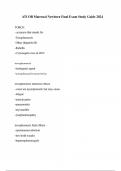
ATI OB Maternal Newborn Final Exam Study Guide 2024
TORCH - acronym that stands for -Toxoplasmosis -Other (hepatitis B) -Rubella -Cytomegalovirus & HSV toxoplasmosis – -teratogenic agent -transplacental transmission toxoplasmosis maternal effects - most are asymptomatic but may cause -fatigue -muscle pains -pneumonitis -myocarditis -lymphadenopathy toxoplasmosis fetal effects – -spontaneous abortion -low birth weight -hepatosplenomegaly -icterus (jaundice) -anemia -chorioretinitis -neurological disease prevention of toxoplasmosis - avoid -eating raw meat -contact w/cat feces toxoplasmosis management - -treat w/sulfadiazine or pyrimethamine hepatitis B - transmitted through direct contact w/blood or infected body fluid hepatitis B maternal effects - -30-50% asymptomatic -low-grade fever -nausea -anorexia -jaundice -hepatomegaly -preterm labor -preterm delivery hepatitis B fetal effects - -chronic infection -HBV carrier -liver disease -neonatal infection hepatitis B management - -antiviral maternal treatment -infant receives HBIG & hepatitis vaccine at delivery rubella - contagious viral disease that can cause fetal malformation if contracted in early pregnancy -aka German measles -nasopharyngeal secretions & transplacental transmission rubella maternal effects - -erythematous maculopapular rash -lymph node enlargement -slight fever -headache -malaise rubella fetal effects - -deafness -eye defects -CNS anomalies -severe cardiac malformation rubella management - -immunization is primary -if pregnant & not immune, should not receive vaccine until postpartum period -do not become pregnant for 3 months after vaccine cytomegalovirus - virus of herpes group -droplet contact & transplacental transmission cytomegalovirus maternal effects - most are asymptomatic but may have mononucleosis-like syndrome cytomegalovirus fetal effects - -low birth weight -IUGR -hearing impairment -microcephaly -CNS abnormalities -30% die cytomegalovirus management - no treatment available herpes simplex virus (HSV) - chronic lifelong viral infection -contact at delivery & ascending infection HSV maternal effects - painful genital lesions may be external or internal HSV management - -no cure -acyclovir used to suppress outbreak of lesions -antiviral therapy may be offered near term molar pregnancy - benign proliferate growth of trophoblast in which chorionic villi develop into edematous, cystic, vascular transparent vesicles that hang in grapelike clusters w/o a viable fetus -aka hydatidiform mole -nonviable pregnancy molar pregnancy risk factors - -maternal age 18 or 40 -previous molar pregnancy molar pregnancy risk for women - increased risk of choriocarcinoma molar pregnancy assessment findings - -pelvic pain/sensation of pressure -anemia -hyperemesis gravidarum -hyperthyroidism -gestational HTN/ preeclampsia -amenorrhea -nausea/vomiting -abnormal uterine bleeding -enlarged uterus -abdominal cramping/ expulsion of vesicles molar pregnancy medical management - -immediate evacuation w/ aspiration or suction -after, monitor hCG -follow up of hCG levels for at least 6 months 5 "Ps" - factors identified as essential to successful vaginal birth -powers (contractions & pushing efforts) -passage (pelvis & birth canal) -passenger (fetus) -psyche (response of woman) -position (positions that facilitate labor & birth) pregnancy hormones - -estrogen -progesterone -human chorionic gonadotropin (hCG) -human placental lactogen -relaxin estrogen - produced by placenta to help maintain healthy pregnancy -promotes maturation of ovum -stimulates enlargement of breast & uterus progesterone - prepares uterus to receive & sustain fertilized ovum & maintain pregnancy human chorionic gonadotropin - maintains corpus luteum during pregnancy human placental lactogen - -aka human chorionic somatomammotropin -stimulates pancreatic secretion of insulin in fetus -reduces peripheral uptake of glucose relaxin - produced by corpus luteum that causes pelvic ligaments & cervix to relax during pregnancy & delivery iron-deficiency anemia - hemoglobin 11 g/dL & hematocrit 33% prevention of seizures - magnesium sulfate in women w/gestational HTN, preeclampsia w/severe features, or eclampsia Moro reflex - elicit by making loud sound or lift baby's shoulders expected vs abnormal Moro reflex response - -symmetrical abduction & extension of arms & legs then legs flex up against trunk -makes C shape with thumb & index finger -slow response -asymmetrical response -unresponsive tonic neck reflex - elicit with neonate in supine, turn head to side so chin is over shoulder expected vs abnormal tonic neck reflex response - -assumes "fencing" position w/arms & legs extended in direction which head was turned -response after 6 months may indicate cerebral palsy rooting reflex - elicit by brushing side of cheek near corner of mouth expected vs abnormal rooting reflex response - -turns head toward stimulus & opens mouth -may not respond if recently fed -weak or absent response sucking reflex - elicit by placing gloved finger or nipple of bottle in mouth expected vs abnormal sucking reflex response - -sucking motion occurs -may not respond if recently fed -weak or absent response palmar grasp reflex - elicit by placing finger in palm of neonate's hand expected vs abnormal palmar grasp reflex response - -grasps finger tightly -absent or weak response plantar grasp reflex - elicit by placing thumb firmly against ball of infant's foot expected vs abnormal plantar grasp reflex response - -toes flex tightly down in a grasping motion -weak or absent reponse Babinski reflex - elicit by stroking lateral surface of sole in upward motion expected vs abnormal Babinski reflex response - -hyperextension & fanning of toes -absent or weak reponse stepping/dancing relfex - elicit by holding upright w/feet touching flat surface expected vs abnormal stepping reflex response - -neonate steps up & down in place -diminished response postpartum hemorrhage (PPH) - blood loss exceeding 500 mL following vaginal birth & 1,000 mL following cesarean birth primary cause of PPH - 4 Ts -Tone: uterine atony -Tissue: retained placental fragments -Trauma: lower genital tract lacerations -Thrombin disorders: DIC medications for PPH - -oxytocin -methylergonovine -carboprost -misoprostol oxygenated blood in fetal circulation - high levels of oxygenated blood enter fetal circulatory system from placenta via umbilical cord ductus venosus in fetal circulation - connects umbilical vein to inferior vena cava -allows majority of oxygenated blood to enter right atrium foramen ovale in fetal circulation - opening between right & left atria where oxygenated blood is shunted to left atrium -closes in response to increased blood returning to left atrium ductus arteriosus in fetal circulation - connects pulmonary artery w/descending aorta -through where majority of oxygenated blood is shunted to aorta w/smaller amounts going to lungs mastitis - inflammation of breast tissue common among lactating women usually occurring in one breast engorgement - increased fullness of breasts umbilical cord prolapse - occurs when cord lies below presenting part of fetus occult prolapse - cord is palpated through membranes but does not drop into vagina uterine rupture - actual separation of uterine myometrium or previous uterine scar, w/ROM & possible extrusion of fetus or fetal parts into peritoneal cavity uterine rupture assessment findings - -severe tearing sensation -burning/stabbing pain -contractions may occur -uterine tachysystole or hypertonus & vaginal bleeding -maternal: hypovolemic shock (hypotension, tachypnea, tachycardia, pallor) -ascending station of fetal presenting part observed uterine rupture medical management - -maternal hemodynamic stabilization -immediate cesarean birth -if possible, uterine defect is repaired or hysterectomy -control maternal hemorrhage Naegele's rule - from first day of last menstrual period, minus 3 months & add 7 days multiple gestation - more than one developing embryo such as twins monozygotic twins - aka identical twins -result from fertilized ovum that splits during early stages of cell division to form two identical embryos that are genetically the same dizygotic twins - aka fraternal twins -result from two separate ova fertilized by two separate sperm
Escuela, estudio y materia
Información del documento
- Subido en
- 27 de septiembre de 2024
- Número de páginas
- 24
- Escrito en
- 2024/2025
- Tipo
- Examen
- Contiene
- Preguntas y respuestas
Temas
- ati ob
- ob maternal newborn
-
ati ob maternal newborn final
-
ati ob maternal newborn final exam study guide

Documento también disponible en un lote