

Escrito por estudiantes que aprobaron Inmediatamente disponible después del pago Leer en línea o como PDF ¿Documento equivocado? Cámbialo gratis 4,6 TrustPilot
logo-home
Document preview thumbnail
Vista previa 1 fuera de 3 páginas
Examen

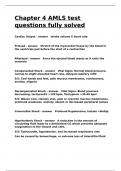
Chapter 4 AMLS test questions fully solved

Document preview thumbnail
Vista previa 1 fuera de 3 páginas

Cardiac Output stroke volume X heart rate Preload Stretch of the myocardial tissue by the blood in the ventricles just before the start of a contraction Previous Play Next Rewind 10 seconds Move forward 10 seconds Unmute 0:01 / 0:15 Full screen Brainpower Read More Afterload Force the ejected blood meets as it exits the ventricle Compensated Shock Vital Signs: Normal blood pressure, normal to slight elevated heart rate, delayed capillary refill S/S: Cool hands and feet, pale mucous membranes, restlessness, anxiety, oliguria Decompensated Shock Vital Signs: Blood pressure decreasing, tachycardic 120 bpm, Tachypneic 30-40 bpm S/S: Waxen cool, clammy skin, pale or cyanotic mucous membranes, profound weakness, anxiety, absent or decreased peripheral pulses Irreversible Shock Profound Hypotension, lactate 8mEqL Hypolvolemic Shock A reduction in the amount of circulating fluid leads to a diminished CO which prevents adequate oxygenation to the tissues and cells. S/S: Tachycardia, hypotension, and increased respiratory rate Can be caused by hemorrhage, or extreme loss of interstitial fluid Hemorrhagic Shock Most common cause of hypovolemic shock, significant blood loss occurs Distributive Shock Inadequate volume of blood to fill the vascular space, caused by a precipitous increase in vascular capacity Septic Shock Result of a massive systemic inflammatory response. Criteria: Temperature 100 Heart Rate 90 Respiratory Rate 20 Anaphylactic Shock Antibody-antigen hypersensitivity response is the primary cause. Has vasodilation, bronchoconstriction, excessive mucus secretion, coronary vasoconstriction, inflammation, and cutaneous reactions. Neurogenic Shock Form of distributive shock, signal transmission in the sympathetic nervous system is interrupted. S/S: Warm, hypotension, pink below sight of injury Cardiogenic Shock Caused by a problem with rate or strength of hear contractions. S/S: Respiratory rate is increased, crackles caused by pulmonary edema, increased heart rate, diminished heart sounds Obstructive Shock Blood flow in the great vessels or heart is occluded. Common causes include pericardial tamponade, massive pulmonary embolus, and tension pneumothorax Cardiac Tamponade Displays by beck's triad: JVD, hypotension, and muffled heart sounds Pulmonary Embolus Life threatening condition that occurs when a thrombus travel through vasculature and lodges in the pulmonary artery. Disseminated intravascular coagulation a pathologic form of coagulation that is diffuse or systemic rather than localized. Clotting factor are consumed to such an extent that generalized bleeding or clotting may occur

Vista previa del contenido

Chapter 4 AMLS test
questions fully solved
Cardiac Output - answer stroke volume X heart rate


Preload - answer Stretch of the myocardial tissue by the blood in
the ventricles just before the start of a contraction


Afterload - answer Force the ejected blood meets as it exits the
ventricle


Compensated Shock - answer Vital Signs: Normal blood pressure,
normal to slight elevated heart rate, delayed capillary refill
S/S: Cool hands and feet, pale mucous membranes, restlessness,
anxiety, oliguria


Decompensated Shock - answer Vital Signs: Blood pressure
decreasing, tachycardic >120 bpm, Tachypneic >30-40 bpm
S/S: Waxen cool, clammy skin, pale or cyanotic mucous membranes,
profound weakness, anxiety, absent or decreased peripheral pulses


Irreversible Shock - answer Profound Hypotension, lactate >8mEqL


Hypolvolemic Shock - answer A reduction in the amount of
circulating fluid leads to a diminished CO which prevents adequate
oxygenation to the tissues and cells.
S/S: Tachycardia, hypotension, and increased respiratory rate
Can be caused by hemorrhage, or extreme loss of interstitial fluid


Información del documento

Subido en
26 de septiembre de 2024
Número de páginas
3
Escrito en
2024/2025
Tipo
Examen
Contiene
Preguntas y respuestas
$15.49

¿Documento equivocado? Cámbialo gratis Dentro de los 14 días posteriores a la compra y antes de descargarlo, puedes elegir otro documento. Puedes gastar el importe de nuevo.
Escrito por estudiantes que aprobaron
Inmediatamente disponible después del pago
Leer en línea o como PDF

Seller avatar
Los indicadores de reputación están sujetos a la cantidad de artículos vendidos por una tarifa y las reseñas que ha recibido por esos documentos. Hay tres niveles: Bronce, Plata y Oro. Cuanto mayor reputación, más podrás confiar en la calidad del trabajo del vendedor.
BRAINBOOSTERS
4.5
(354)
Vendido
777
Seguidores
257
Artículos
25937
Última venta
6 días hace


Por qué los estudiantes eligen Stuvia

Creado por compañeros estudiantes, verificado por reseñas

Calidad en la que puedes confiar: escrito por estudiantes que aprobaron y evaluado por otros que han usado estos resúmenes.

¿No estás satisfecho? Elige otro documento

¡No te preocupes! Puedes elegir directamente otro documento que se ajuste mejor a lo que buscas.

Paga como quieras, empieza a estudiar al instante

Sin suscripción, sin compromisos. Paga como estés acostumbrado con tarjeta de crédito y descarga tu documento PDF inmediatamente.

Student with book image

“Comprado, descargado y aprobado. Así de fácil puede ser.”

Alisha Student

Preguntas frecuentes