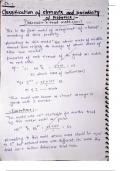
Handwritten class notes of chemistry class XI chapter *Periodic classification of elements
Here's a detailed description of handwritten notes for Periodic Classification of Elements, Chemistry Class XI: *Periodic Classification of Elements* *I. Introduction* - Definition of periodic table - History: Dobereiner, Newlands, Mendeleev - Importance of periodic table in chemistry *II. Periodic Trends* - Atomic radius - Electronegativity - Ionization energy - Electron affinity - Valency *III. Periodic Table Structure* - Blocks: s, p, d, f - Groups (families): vertical columns - Periods: horizontal rows - Metals, nonmetals, and metalloids *IV. Periodic Classification* - Classification based on electronic configuration - Classification based on chemical properties - Transition metals and inner transition metals *V. Modern Periodic Table* - 7 rows (periods) and 18 columns (groups) - Lanthanides and actinides (inner transition metals) - Position of hydrogen *VI. Periodicity of Elements* - Periodic variations in physical properties - Periodic variations in chemical properties *Key Equations and Formulas* - Atomic radius = (distance between nucleus and outermost electron) - Electronegativity = (ability to attract electrons) *Important Points* - Atomic radius decreases from left to right across a period - Electronegativity increases from left to right across a period - Ionization energy increases from left to right across a period - Metals are more electropositive than nonmetals *Summary/Concept Review* - Key terms and definitions - Important concepts and equations - Questions and answers or practice problems These handwritten notes provide a comprehensive summary of the Periodic Classification of Elements chapter, highlight relationships. Here's a detailed description of handwritten notes for Periodic Classification of Elements, Chemistry Class XI: *Periodic Classification of Elements* *I. Introduction* - Definition of periodic table - History: Dobereiner, Newlands, Mendeleev - Importance of periodic table in chemistry *II. Periodic Trends* - Atomic radius - Electronegativity - Ionization energy - Electron affinity - Valency *III. Periodic Table Structure* - Blocks: s, p, d, f - Groups (families): vertical columns - Periods: horizontal rows - Metals, nonmetals, and metalloids *IV. Periodic Classification* - Classification based on electronic configuration - Classification based on chemical properties - Transition metals and inner transition metals *V. Modern Periodic Table* - 7 rows (periods) and 18 columns (groups) - Lanthanides and actinides (inner transition metals) - Position of hydrogen *VI. Periodicity of Elements* - Periodic variations in physical properties - Periodic variations in chemical properties *Key Equations and Formulas* - Atomic radius = (distance between nucleus and outermost electron) - Electronegativity = (ability to attract electrons) *Important Points* - Atomic radius decreases from left to right across a period - Electronegativity increases from left to right across a period - Ionization energy increases from left to right across a period - Metals are more electropositive than nonmetals *Summary/Concept Review* - Key terms and definitions - Important concepts and equations - Questions and answers or practice problems These handwritten notes provide a comprehensive summary of the Periodic Classification of Elements chapter, highlighting key concepts, trends and relationship
Escuela, estudio y materia
- Institución
- Escuela secundaria
- Chemistry handwritten notes
- Año escolar
- 5
Información del documento
- Subido en
- 20 de septiembre de 2024
- Número de páginas
- 18
- Escrito en
- 2024/2025
- Tipo
- Notas de lectura
- Profesor(es)
- Mr s kumar msc
- Contiene
- Todas las clases
Temas
-
handwritten notes of chemistry class xi

Documento también disponible en un lote