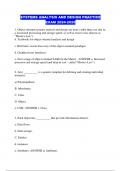
1. Object-oriented systems analysis and design are more viable than ever due to:
a. Increased processing and storage speed, as well as lower costs (known as
"Moore's Law").
b. Textbooks for object-oriented analysis and design
c. Bill Gates' recent discovery of the object-oriented paradigm.
d. Graphical user interfaces.
e. Neo's usage of object-oriented SA&D in the Matrix - ANSWER a. Increased
processor and storage speed (and drop in cost - called "Moore's Law").
2. A(n) __________ is a generic template for defining and creating individual
instances.
a) Polymorphism
B. Inheritance
C. Class
D. Object
e. UML: ANSWER c. Class
3. Each object has __________ that provide information about it.
a. Data flows.
b. Data storage.
C. Entities
d. instances
e. Attributes: ANSWER e) Attributes
, 4. Methods implement an object's __________—
a. characteristics.
b. Behaviour
C. Properties
D. Size
e. screen location: ANSWER b. behaviour
5. Brett Bradanini and Tim O'Sullivan are'students'. In this case,'students' will
be considered:
a. concrete class
b. An abstract class.
b. a group of students
d. An aggregate class.
g. an attribute of Brett and Tim - ANSWER a. a specific class
6. What is not true about the content awareness design principle?
a. The date of August 6, 2009 will be understood universally.
b. Drawing boxes around related items (such as name, address, city, state, and
zip) will benefit users.
c. Field labels should be relatively short, yet long enough so that users are not
confused.
d. Input fields should have a logical progression that users are comfortable with.
g. All printed forms should carry version numbers for better control - ANSWER
a. The date 8/6/09 will be understood internationally.
a. Increased processing and storage speed, as well as lower costs (known as
"Moore's Law").
b. Textbooks for object-oriented analysis and design
c. Bill Gates' recent discovery of the object-oriented paradigm.
d. Graphical user interfaces.
e. Neo's usage of object-oriented SA&D in the Matrix - ANSWER a. Increased
processor and storage speed (and drop in cost - called "Moore's Law").
2. A(n) __________ is a generic template for defining and creating individual
instances.
a) Polymorphism
B. Inheritance
C. Class
D. Object
e. UML: ANSWER c. Class
3. Each object has __________ that provide information about it.
a. Data flows.
b. Data storage.
C. Entities
d. instances
e. Attributes: ANSWER e) Attributes
, 4. Methods implement an object's __________—
a. characteristics.
b. Behaviour
C. Properties
D. Size
e. screen location: ANSWER b. behaviour
5. Brett Bradanini and Tim O'Sullivan are'students'. In this case,'students' will
be considered:
a. concrete class
b. An abstract class.
b. a group of students
d. An aggregate class.
g. an attribute of Brett and Tim - ANSWER a. a specific class
6. What is not true about the content awareness design principle?
a. The date of August 6, 2009 will be understood universally.
b. Drawing boxes around related items (such as name, address, city, state, and
zip) will benefit users.
c. Field labels should be relatively short, yet long enough so that users are not
confused.
d. Input fields should have a logical progression that users are comfortable with.
g. All printed forms should carry version numbers for better control - ANSWER
a. The date 8/6/09 will be understood internationally.