24- Populations
A population is all the organisms of one species in a habitat. Population size is the total number of
organisms of one species in a habitat, this changes over time due to various factors.
Abiotic Factors:
• Abiotic factors such as the amount of light, water of space available in uence population size.
When abiotic factors are ideal for organisms, they grow fast and reproduce successfully. When
abiotic factors aren’t ideal for an organism, they can’t grow as fast or reproduce as successfully.
Biotic Factors:
• Factors such as interspeci c and intraspeci c competition and predation in uence population
size.
Interspeci c competition- when organisms of di erent species compete for the same resources
which means the resources available for both populations are reduced. Population sizes will be
limited for both species. Interspeci c competition can also a ect the distribution of species, if two
species are competing but one species is better adapted then the less well adapted species is
likely to be out competed.
Intraspeci c competition- when organisms of the same species compete for the same
resources. It can cause a cyclical change in population size, where the population shrinks and
then grows again. The population size increases when resources are plentiful but then increasing
population limits the resources and the population declines again. The maximum stable
population size of a species that an ecosystem can support is called the carrying capacity.
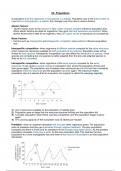
1) lots of resources available so the population of rabbits grew
2) Population grew so large that the resources became limiting and the population fell
3) A smaller population meant there was less competition and the population began to grow
again
4) The carrying capacity of the ecosystem was 22 rabbits per hectare
Predation- when an organism (predator) kills and eats other organisms (prey). The population
sizes of predators and prey are interlinked through negative feedback. The prey population
increases and there is more food for predators so the predator population grows. As the predator
population increases more prey is eaten so the prey population falls. This restores the prey
population to a more manageable size and there is less food for the predators so their population
decreases.
fi fi fi fi ff ff fl fl
A population is all the organisms of one species in a habitat. Population size is the total number of
organisms of one species in a habitat, this changes over time due to various factors.
Abiotic Factors:
• Abiotic factors such as the amount of light, water of space available in uence population size.
When abiotic factors are ideal for organisms, they grow fast and reproduce successfully. When
abiotic factors aren’t ideal for an organism, they can’t grow as fast or reproduce as successfully.
Biotic Factors:
• Factors such as interspeci c and intraspeci c competition and predation in uence population
size.
Interspeci c competition- when organisms of di erent species compete for the same resources
which means the resources available for both populations are reduced. Population sizes will be
limited for both species. Interspeci c competition can also a ect the distribution of species, if two
species are competing but one species is better adapted then the less well adapted species is
likely to be out competed.
Intraspeci c competition- when organisms of the same species compete for the same
resources. It can cause a cyclical change in population size, where the population shrinks and
then grows again. The population size increases when resources are plentiful but then increasing
population limits the resources and the population declines again. The maximum stable
population size of a species that an ecosystem can support is called the carrying capacity.
1) lots of resources available so the population of rabbits grew
2) Population grew so large that the resources became limiting and the population fell
3) A smaller population meant there was less competition and the population began to grow
again
4) The carrying capacity of the ecosystem was 22 rabbits per hectare
Predation- when an organism (predator) kills and eats other organisms (prey). The population
sizes of predators and prey are interlinked through negative feedback. The prey population
increases and there is more food for predators so the predator population grows. As the predator
population increases more prey is eaten so the prey population falls. This restores the prey
population to a more manageable size and there is less food for the predators so their population
decreases.
fi fi fi fi ff ff fl fl