
• ¿Documento equivocado? Cámbialo gratis
  • Escrito por estudiantes que aprobaron
  • Inmediatamente disponible después del pago
  • Leer en línea o como PDF
Vender
¿Dónde estudias?
Tu idioma
Document preview thumbnail
Vista previa 1 fuera de 4 páginas
Examen

Biochem Exam 3 Lecture 1 MCPHS Questions With Answers Graded A+ Assured Success

Document preview thumbnail
Vista previa 1 fuera de 4 páginas

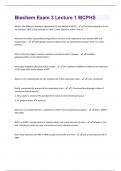
What is the difference between ubiquinone (Q) and ubiquinol (QH2) - Q is fully oxidized so it has no electrons, QH2 is fully reduced so it has 2 more electrons and H+ than Q What are the other sequentially acting electron carriers in the respiratory chain besides NAD and flavoproteins - Hydrophobic quinone (ubiquinone, Q), Cytochrome (contain iron), Iron-sulfur proteins What is the final stage of cellular respiration and where does it happen - Oxidative phosphorylation, in the mitochondria What does oxidative phosphorylation couple - The oxidation of NADH or FADH2 to the reduction of O2 to get H2O and formation of ATP Where in the mitochondria are the components of the respiratory chain - Inner membrane Briefly summarize the process of the respiratory chain - 1. Electrons flow through a chain of membrane-bound carriers 2. This results in protons (H+) pumped from matrix to inter membrane space 3. H+ gradient drives ATP synthesis Electrons are transferred from a substrate to which universal electron acceptors - NAD+, NADP+, FAD, FMN NAD+ or NADP+ accepts what and releases what, how many electrons at once - Accepts H- (H+ and 2 electrons), picks up a pair of electrons at once, releases a proton How many electrons can FAD or FMN accept and transfer at a time - One or two electrons AT A TIMEDescribe the characteristics of ubiquinone AKA Coenzyme Q [Q] - Lipid-soluble, small, freely diffusible (can move around everywhere) How many electrons can Q accept and what does it carry - Accepts 1 or 2 electrons, carries a proton with each electron Cytochromes have how many classes and what distinguishes between them - 3 classes: a,b,c, different R groups differentiates between the classes What do all cytochromes have - An iron-containing heme prosthetic group The iron group in cytochromes can be in what two oxidative states - Fe2+= has extra electron, and Fe3+= gives up electron How are heme groups in cytochromes bound - Covalently or non-covalently but either way, TIGHTLY BOUND Cytochrome class a, b and some of c have what type of proteins - Integral (inner membrane) Cytochrome class c has what type of proteins - Soluble and mobile (outer surface of inner membrane) The names of cytochromes are sometimes based on what - Absorbance maximum (e.g. b562) The iron in iron-sulfur proteins are associated with what - Inorganic sulfur, cysteine, or both The iron is the electron carrier in iron-sulfur proteins, how many electrons can one iron carry - 1 iron=1 electron carriedThe electron carriers of the respiratory chain are organized into supramolecular complexes that can be separated into what - 4 individual complexes and ATP synthase What is the enzyme complex in Complex I - "NADH: ubiquinone oxidoreductase" Where does Complex I receive electrons from and where is it delivered to - from NADH, delivered to Q Electrons move along Complex I until the end where the electrons do what - Each electron teams up with Q, 2 electrons given up to make QH2 What is the enzyme complex for Complex II - Succinate dehydrogenase from CAC In Complex II, what receives electrons and where is it found in the mitochondria - FAD, it is embedded (never leaves) in the matrix In the CAC, succinate is oxidized to fumarate and is coupled to what - the reduction of FAD to FADH2 From FADH2, where are the electrons transferred to - to Q, which becomes QH2 Is there any H+ pumping in Complex II - No During B-oxidation from FAs, electrons are transferred from the substrate to what - FAD, making FADH2 Electrons are then transferred from FADH2 to what - Q What happens to the FAD electrons from glycolysis - The complex, Glycerol-3-phosphate dehydrogenase gives electrons to FAD, making FADH2, Q docks to receive electrons and becomes QH2, then goes back to FADUbiquinol (QH2) can diffuse to what - Complex III Each subunit of complex III has 11 different subunits, including which two - Cytochromes b and c1

Vista previa del contenido

Biochem Exam 3 Lecture 1 MCPHS
What is the difference between ubiquinone (Q) and ubiquinol (QH2) - Q is fully oxidized so it has
no electrons, QH2 is fully reduced so it has 2 more electrons and H+ than Q


What are the other sequentially acting electron carriers in the respiratory chain besides NAD and
flavoproteins - Hydrophobic quinone (ubiquinone, Q), Cytochrome (contain iron), Iron-sulfur
proteins


What is the final stage of cellular respiration and where does it happen - Oxidative
phosphorylation, in the mitochondria


What does oxidative phosphorylation couple - The oxidation of NADH or FADH2 to the reduction
of O2 to get H2O and formation of ATP


Where in the mitochondria are the components of the respiratory chain - Inner membrane


Briefly summarize the process of the respiratory chain - 1. Electrons flow through a chain of
membrane-bound carriers

2. This results in protons (H+) pumped from matrix to inter membrane space

3. H+ gradient drives ATP synthesis


Electrons are transferred from a substrate to which universal electron acceptors - NAD+, NADP+,
FAD, FMN


NAD+ or NADP+ accepts what and releases what, how many electrons at once - Accepts H- (H+
and 2 electrons), picks up a pair of electrons at once, releases a proton


How many electrons can FAD or FMN accept and transfer at a time - One or two electrons AT A
TIME

Información del documento

Subido en
27 de agosto de 2024
Número de páginas
4
Escrito en
2024/2025
Tipo
Examen
Contiene
Preguntas y respuestas
$8.49

¿Documento equivocado? Cámbialo gratis Dentro de los 14 días posteriores a la compra y antes de descargarlo, puedes elegir otro documento. Puedes gastar el importe de nuevo.
Escrito por estudiantes que aprobaron
Inmediatamente disponible después del pago
Leer en línea o como PDF

Seller avatar
Los indicadores de reputación están sujetos a la cantidad de artículos vendidos por una tarifa y las reseñas que ha recibido por esos documentos. Hay tres niveles: Bronce, Plata y Oro. Cuanto mayor reputación, más podrás confiar en la calidad del trabajo del vendedor.
Brainarium
3.8
(338)
Vendido
2036
Seguidores
1048
Artículos
24238
Última venta
7 horas hace


Por qué los estudiantes eligen Stuvia

Creado por compañeros estudiantes, verificado por reseñas

Calidad en la que puedes confiar: escrito por estudiantes que aprobaron y evaluado por otros que han usado estos resúmenes.

¿No estás satisfecho? Elige otro documento

¡No te preocupes! Puedes elegir directamente otro documento que se ajuste mejor a lo que buscas.

Paga como quieras, empieza a estudiar al instante

Sin suscripción, sin compromisos. Paga como estés acostumbrado con tarjeta de crédito y descarga tu documento PDF inmediatamente.

Student with book image

“Comprado, descargado y aprobado. Así de fácil puede ser.”

Alisha Student

Preguntas frecuentes
