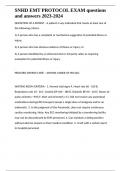
SNHD EMT PROTOCOL EXAM questions
and answers 2023-2024
DEFINITION OF A PATIENT - A patient is any individual that meets at least one of
the following criteria:
1) A person who has a complaint or mechanism suggestive of potential illness or
injury;
2) A person who has obvious evidence of illness or injury; or
3) A person identified by an informed 2nd or 3rd party caller as requiring
evaluation for potential illness or injury.
PEDIATRIC PATIENTS ARE? - ANYONE UNDER 18 YRS OLD
WAITING ROOM CRITERIA - 1. Normal vital signs A. Heart rate 60 - 100 B.
Respiratory rate 10 - 20 C. Systolic BP 100 - 180 D. Diastolic BP 60 - 110 E. Room air
pulse oximetry >94% F. Alert and oriented x 4 2. Did not receive any parenteral
medications during EMS transport except a single dose of analgesia and/or an
antiemetic. 3. In the judgment of the Paramedic, does not require continuous
cardiac monitoring. Note: Any ECG monitoring initiated by a transferring facility
may not be discontinued by EMS personnel. 4. Can maintain a sitting position
without adverse impact on their medical condition. 5. Is left with a verbal report
to hospital personnel
, SNHD EMT PROTOCOL EXAM questions
and answers 2023-2024
INTERNAL DISASTER CRITERIA - EMT can transport if CARDIAC ARREST AND/OR
INABILITY TO MAINTAIN AIRWAY and has informed ER of delivery of patient
ALLERGIC REACTION PROTOCOL - EMT can assist with own epi and mdi
Altered Mental Status (AMS) - EMT can administer oral glucose if patient can
maintain their own airway. BG below 60 only
SAFER Model - S.A.F.E.R. · S.tabilize the situation by containing and lowering the
stimuli. ·
A.ssess and acknowledge the crisis. · F.acilitate the identification and activation of
resources (chaplain, family, friends or police). ·
E.ncourage patient to use resources and take actions in his/her best interest. ·
R.ecovery or referral
Burns (Burn Centers) - UMC & Sunrise
Cardiac Arrest - Adults: 2 in depth, 100 compression per minute, 30:2 ratio.
and answers 2023-2024
DEFINITION OF A PATIENT - A patient is any individual that meets at least one of
the following criteria:
1) A person who has a complaint or mechanism suggestive of potential illness or
injury;
2) A person who has obvious evidence of illness or injury; or
3) A person identified by an informed 2nd or 3rd party caller as requiring
evaluation for potential illness or injury.
PEDIATRIC PATIENTS ARE? - ANYONE UNDER 18 YRS OLD
WAITING ROOM CRITERIA - 1. Normal vital signs A. Heart rate 60 - 100 B.
Respiratory rate 10 - 20 C. Systolic BP 100 - 180 D. Diastolic BP 60 - 110 E. Room air
pulse oximetry >94% F. Alert and oriented x 4 2. Did not receive any parenteral
medications during EMS transport except a single dose of analgesia and/or an
antiemetic. 3. In the judgment of the Paramedic, does not require continuous
cardiac monitoring. Note: Any ECG monitoring initiated by a transferring facility
may not be discontinued by EMS personnel. 4. Can maintain a sitting position
without adverse impact on their medical condition. 5. Is left with a verbal report
to hospital personnel
, SNHD EMT PROTOCOL EXAM questions
and answers 2023-2024
INTERNAL DISASTER CRITERIA - EMT can transport if CARDIAC ARREST AND/OR
INABILITY TO MAINTAIN AIRWAY and has informed ER of delivery of patient
ALLERGIC REACTION PROTOCOL - EMT can assist with own epi and mdi
Altered Mental Status (AMS) - EMT can administer oral glucose if patient can
maintain their own airway. BG below 60 only
SAFER Model - S.A.F.E.R. · S.tabilize the situation by containing and lowering the
stimuli. ·
A.ssess and acknowledge the crisis. · F.acilitate the identification and activation of
resources (chaplain, family, friends or police). ·
E.ncourage patient to use resources and take actions in his/her best interest. ·
R.ecovery or referral
Burns (Burn Centers) - UMC & Sunrise
Cardiac Arrest - Adults: 2 in depth, 100 compression per minute, 30:2 ratio.