Chemical Quantities & the Mole
A mole (mol) is a fundamental unit in the International System of Units (SI) used to
quantify the amount of a substance. This unit is essential for measuring mass, volume, and the
number of particles, and it represents incredibly large quantities. The mole is defined by
Avogadro’s number, which is 6.02 x 10²³. This number honors the Italian scientist Amedeo
Avogadro, who made significant contributions to our understanding of the differences between
atoms and molecules.
Every mole of a substance contains Avogadro’s number of entities. To put it in perspective, just
as a dozen means 12 eggs, a mole means 6.02 x 10²³ of anything. So, how many eggs are in a
mole? How many airplanes? How many books? The answer is the same for all: 6.02 x 10²³. If
someone asks you how many eggs are in 2 moles, the answer would be 1.2 x 1024 (since 6.02 x
1023 multiplied by 2 equals 1.2 x 1024).
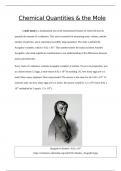
Avogadro’s Number: 6.02 x 10²³
https://commons.wikimedia.org/wiki/File:Amedeo_Avogadro2.jpg
, The Mole Chart
This doesn’t need much explanation, but here’s the gist:
GOING UP = Divide
GOING DOWN = Multiply
To find the mass in grams of a compound like Co₂O₃, follow these steps:
1. Get the atomic masses for cobalt and oxygen. Remember, elements like BRINClHOF
(Bromine, Iodine, Nitrogen, Chlorine, Hydrogen, Oxygen, and Fluorine) are diatomic
when alone, meaning they pair up. So, for oxygen gas (O₂), you need to double the
atomic mass of oxygen, which gives you 31.9988.
2. Calculate the total mass:
o For cobalt: (2 times 58.933195 = 117.86639)
o For oxygen: (3 times 15.9994 = 47.9982)
3. Add the masses together to get the total mass in grams (don’t forget significant figures):
o (117.86639 + 47.9982 = 165.8646) grams
A mole (mol) is a fundamental unit in the International System of Units (SI) used to
quantify the amount of a substance. This unit is essential for measuring mass, volume, and the
number of particles, and it represents incredibly large quantities. The mole is defined by
Avogadro’s number, which is 6.02 x 10²³. This number honors the Italian scientist Amedeo
Avogadro, who made significant contributions to our understanding of the differences between
atoms and molecules.
Every mole of a substance contains Avogadro’s number of entities. To put it in perspective, just
as a dozen means 12 eggs, a mole means 6.02 x 10²³ of anything. So, how many eggs are in a
mole? How many airplanes? How many books? The answer is the same for all: 6.02 x 10²³. If
someone asks you how many eggs are in 2 moles, the answer would be 1.2 x 1024 (since 6.02 x
1023 multiplied by 2 equals 1.2 x 1024).
Avogadro’s Number: 6.02 x 10²³
https://commons.wikimedia.org/wiki/File:Amedeo_Avogadro2.jpg
, The Mole Chart
This doesn’t need much explanation, but here’s the gist:
GOING UP = Divide
GOING DOWN = Multiply
To find the mass in grams of a compound like Co₂O₃, follow these steps:
1. Get the atomic masses for cobalt and oxygen. Remember, elements like BRINClHOF
(Bromine, Iodine, Nitrogen, Chlorine, Hydrogen, Oxygen, and Fluorine) are diatomic
when alone, meaning they pair up. So, for oxygen gas (O₂), you need to double the
atomic mass of oxygen, which gives you 31.9988.
2. Calculate the total mass:
o For cobalt: (2 times 58.933195 = 117.86639)
o For oxygen: (3 times 15.9994 = 47.9982)
3. Add the masses together to get the total mass in grams (don’t forget significant figures):
o (117.86639 + 47.9982 = 165.8646) grams