
• ¿Documento equivocado? Cámbialo gratis
  • Escrito por estudiantes que aprobaron
  • Inmediatamente disponible después del pago
  • Leer en línea o como PDF
Vender
¿Dónde estudias?
Tu idioma
Document preview thumbnail
Vista previa 2 fuera de 15 páginas
Examen

CCMA Certification study guide

Document preview thumbnail
Vista previa 2 fuera de 15 páginas

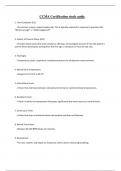
CCMA Certification study guide 1. Chief Complaint (CC): - The primary reason a patient seeks help. This is typically captured in response to questions like "What's wrong?" or "What happened?" 2. History of Present Illness (HPI): - Provides details about the chief complaint, offering a chronological account of how the patient’s current illness developed, starting from the first sign or symptom or from the last visit. 3. Vital Signs: - Temperature, pulse, respiration, and blood pressure are all objective measurements. 4. Normal Oral Temperature: - Ranges from 97.6°F to 99.6°F. 5. Intermittent Fever: - A fever that alternates between elevated and normal or subnormal body temperatures. 6. Remittent Fever: - A fever in which the temperature fluctuates significantly but never returns to normal levels. 7. Continuous Fever: - A fever that stays consistently above the baseline and does not fluctuate. 8. Normal Pulse Rate: - Between 60-100 BPM (beats per minute). 9. Respirations: - The rate, rhythm, and depth are important metrics when measuring breathing. 10. Systole: - The phase of heart contraction. 11. Diastole: - The phase of heart relaxation. 12. Anthropometric Measurements: - Includes measurements of height (length for infants), weight, BMI, head circumference in infants, waist-to-hip ratio, and body fat percentage. 13. Inspection: - Involves evaluating general appearance, nutritional status, body habits, symmetry, posture and gait, and speech. 14. Palpation: - The examination of the body through touch. 15. Percussion: - A physical examination technique that involves tapping the body to produce sounds and vibrations to assess size, borders, or fluid content in areas like the chest. 16. Auscultation: - The process of listening to sounds within the body (like those from the lungs or heart) to aid in diagnosis and treatment. 17. OSHA (Occupational Safety and Health Administration): - A government agency under the Department of Labor aimed at ensuring a safe and healthy work environment. 18. Cardiopulmonary Resuscitation (CPR): - An emergency life support procedure that includes artificial respiration and manual external cardiac compressions. 19. Shock: - A condition caused by inadequate blood flow to the heart and subsequently to the rest of the body. 20. Symptoms of Shock: - Signs such as pale, cold, clammy skin; rapid, weak pulse; increased shallow breathing; and an expressionless face or staring eyes are all indicators of shock. 21. First Aid for Shock: - Maintain an open airway for the victim, call for help, keep the victim lying down with their head lower than the rest of the body, manage bleeding or other known causes of shock, and keep the victim warm until medical assistance arrives. 22. Portal of Exit: - The method by which an infectious agent leaves its reservoir, such as through contact with body fluids like blood or saliva. 23. Mode of Transmission: - Can occur through contact, droplets, air, vehicles, or vectorborne means. Portal of entry ️A pathway by which the causative agent enters the host. The area in which a microorganism enters the body. They may be cuts, lesions, injection sites, or natural body orifices. Susceptible host ️An individual who has little resistance to an infectious agent. Disinfection ️Process used to destroy microorganisms; destroys all pathogenic organisms except spores, can only be used on inanimate objects. Will not be used for invasive procedures, and will not be inserted into body orifices nor be used in sterile procedure. Chemical sterilization ️Uses the same chemical used for disinfection, but exposure time is longer. Steam sterilization (Autoclave) ️uses steam under pressure to obtain higher temperature (250-254F) with exposure time of 20-40 minutes depending on item being sterilized. hand washing ️What is the most important means of preventing the spread of infection? hand antisepsis ️the removal & destruction of transient microorganisms using antimicrobial soaps. PPE Personal protective equipment ️mask, goggle, face shield, respirator Intradermal Injection ️ID; 15 degrees no aspiration; used for TB test, allergy test, and local anesthetic Intramuscular Injection ️IM; 90 degress with aspiration Subcutaneous Injection ️SQ; 45 degress pericardium ️protective sac enclosing the heart composed of two layers with fluid between Right atrium ️The upper right chamber of the heart, where deoxygenated blood is received from the vena cava and then sent to the right ventricle.

Vista previa del contenido

CCMA Certification study guide
1. Chief Complaint (CC):

- The primary reason a patient seeks help. This is typically captured in response to questions like
"What's wrong?" or "What happened?"


2. History of Present Illness (HPI):

- Provides details about the chief complaint, offering a chronological account of how the patient’s
current illness developed, starting from the first sign or symptom or from the last visit.


3. Vital Signs:

- Temperature, pulse, respiration, and blood pressure are all objective measurements.


4. Normal Oral Temperature:

- Ranges from 97.6°F to 99.6°F.


5. Intermittent Fever:

- A fever that alternates between elevated and normal or subnormal body temperatures.


6. Remittent Fever:

- A fever in which the temperature fluctuates significantly but never returns to normal levels.


7. Continuous Fever:

- A fever that stays consistently above the baseline and does not fluctuate.


8. Normal Pulse Rate:

- Between 60-100 BPM (beats per minute).


9. Respirations:

- The rate, rhythm, and depth are important metrics when measuring breathing.

, 10. Systole:

- The phase of heart contraction.


11. Diastole:

- The phase of heart relaxation.


12. Anthropometric Measurements:

- Includes measurements of height (length for infants), weight, BMI, head circumference in infants,
waist-to-hip ratio, and body fat percentage.


13. Inspection:

- Involves evaluating general appearance, nutritional status, body habits, symmetry, posture and gait,
and speech.


14. Palpation:

- The examination of the body through touch.


15. Percussion:

- A physical examination technique that involves tapping the body to produce sounds and vibrations
to assess size, borders, or fluid content in areas like the chest.


16. Auscultation:

- The process of listening to sounds within the body (like those from the lungs or heart) to aid in
diagnosis and treatment.


17. OSHA (Occupational Safety and Health Administration):

- A government agency under the Department of Labor aimed at ensuring a safe and healthy work
environment.


Información del documento

Subido en
10 de agosto de 2024
Número de páginas
15
Escrito en
2024/2025
Tipo
Examen
Contiene
Preguntas y respuestas
$9.79

¿Documento equivocado? Cámbialo gratis Dentro de los 14 días posteriores a la compra y antes de descargarlo, puedes elegir otro documento. Puedes gastar el importe de nuevo.
Escrito por estudiantes que aprobaron
Inmediatamente disponible después del pago
Leer en línea o como PDF

Seller avatar
Los indicadores de reputación están sujetos a la cantidad de artículos vendidos por una tarifa y las reseñas que ha recibido por esos documentos. Hay tres niveles: Bronce, Plata y Oro. Cuanto mayor reputación, más podrás confiar en la calidad del trabajo del vendedor.
CertifiedGrades
3.9
(38)
Vendido
149
Seguidores
61
Artículos
8729
Última venta
1 mes hace


Por qué los estudiantes eligen Stuvia

Creado por compañeros estudiantes, verificado por reseñas

Calidad en la que puedes confiar: escrito por estudiantes que aprobaron y evaluado por otros que han usado estos resúmenes.

¿No estás satisfecho? Elige otro documento

¡No te preocupes! Puedes elegir directamente otro documento que se ajuste mejor a lo que buscas.

Paga como quieras, empieza a estudiar al instante

Sin suscripción, sin compromisos. Paga como estés acostumbrado con tarjeta de crédito y descarga tu documento PDF inmediatamente.

Student with book image

“Comprado, descargado y aprobado. Así de fácil puede ser.”

Alisha Student

Preguntas frecuentes