

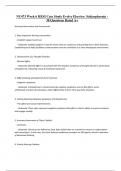
NU473 Week 6 HESI Case Study Evolve Elsevier: Schizophrenia -
38 Questions Rated A+
Nursing Interventions and Assessments
1. Most Important Nursing Intervention:
- Establish rapport and trust.
- Rationale: Building rapport is vital for clients who are suspicious and guarded due to their delusions.
Establishing trust helps facilitate communication and can contribute to a more therapeutic environment.
2. Characteristic of a Thought Disorder:
- Blunted affect.
- Rationale: Blunted affect is associated with the negative symptoms of thought disorders, particularly
schizophrenia, indicating a lack of emotional expression.
3. Differentiating Schizophrenia from Psychosis:
- Negative symptoms.
- Rationale: Schizophrenia is characterized by negative symptoms such as flat affect, social
withdrawal, and lack of motivation, which differentiate it from other psychotic disorders.
4. Finding Depicting Negative Symptoms of Schizophrenia:
- Flat affect and social inattentiveness.
- Rationale: These signs represent negative symptoms that affect a client's ability to express emotions
and engage socially.
5. Accurate Assessment of Client's Beliefs:
- Delusions.
- Rationale: Delusions are defined as fixed, false beliefs that are resistant to reason or confrontation
with actual facts. In this case, the client believes healthcare providers are FBI agents, which is indicative
of delusional thinking.
6. Priority Nursing Problem:
, - Alteration in thought processes.
- Rationale: This problem takes precedence as disturbed thought processes resulting from delusions
can significantly impede the client’s functioning and safety.
Medication Management
7. Benefit of Fluphenazine Decanoate:
- Maintain long-term medication compliance.
- Rationale: Fluphenazine decanoate is a long-acting injectable antipsychotic, administered every 1 to
3 weeks, which helps ensure that the client remains compliant with their medication regimen, reducing
the risk of relapse.
8. Reason for Ordering Fluphenazine Decanoate:
- Disorganized thoughts.
- Rationale: This medication is effective in addressing disorganized and delusional thinking associated
with schizophrenia, thereby helping to stabilize the client's thought processes.
Antipsychotic medications are useful to manage symptoms related to cognitive impairment such as
delusions and/or hallucinations, as well as behaviors related to agitation and aggression.
Which client behavior validates the need for involuntary hospitalization?
o Beliefs about FBI surveillance.
o Diagnosis of schizophrenia.
o Violence towards family.
o Guarded and suspicious.
o Violence towards family.
· Risk for violence toward self or others is a criterion for involuntary hospitalization.
The client is admitted to the mental health unit for 96 hours. The nurse reviews the routine admission
laboratory and medication orders and notes that the client will resume the fluphenazine decanoate. The
benztropine has not been prescribed. Which nursing action is best?
o Monitor the client for medication side effects.
o Obtain a prescription to begin the benztropine.
38 Questions Rated A+
Nursing Interventions and Assessments
1. Most Important Nursing Intervention:
- Establish rapport and trust.
- Rationale: Building rapport is vital for clients who are suspicious and guarded due to their delusions.
Establishing trust helps facilitate communication and can contribute to a more therapeutic environment.
2. Characteristic of a Thought Disorder:
- Blunted affect.
- Rationale: Blunted affect is associated with the negative symptoms of thought disorders, particularly
schizophrenia, indicating a lack of emotional expression.
3. Differentiating Schizophrenia from Psychosis:
- Negative symptoms.
- Rationale: Schizophrenia is characterized by negative symptoms such as flat affect, social
withdrawal, and lack of motivation, which differentiate it from other psychotic disorders.
4. Finding Depicting Negative Symptoms of Schizophrenia:
- Flat affect and social inattentiveness.
- Rationale: These signs represent negative symptoms that affect a client's ability to express emotions
and engage socially.
5. Accurate Assessment of Client's Beliefs:
- Delusions.
- Rationale: Delusions are defined as fixed, false beliefs that are resistant to reason or confrontation
with actual facts. In this case, the client believes healthcare providers are FBI agents, which is indicative
of delusional thinking.
6. Priority Nursing Problem:
, - Alteration in thought processes.
- Rationale: This problem takes precedence as disturbed thought processes resulting from delusions
can significantly impede the client’s functioning and safety.
Medication Management
7. Benefit of Fluphenazine Decanoate:
- Maintain long-term medication compliance.
- Rationale: Fluphenazine decanoate is a long-acting injectable antipsychotic, administered every 1 to
3 weeks, which helps ensure that the client remains compliant with their medication regimen, reducing
the risk of relapse.
8. Reason for Ordering Fluphenazine Decanoate:
- Disorganized thoughts.
- Rationale: This medication is effective in addressing disorganized and delusional thinking associated
with schizophrenia, thereby helping to stabilize the client's thought processes.
Antipsychotic medications are useful to manage symptoms related to cognitive impairment such as
delusions and/or hallucinations, as well as behaviors related to agitation and aggression.
Which client behavior validates the need for involuntary hospitalization?
o Beliefs about FBI surveillance.
o Diagnosis of schizophrenia.
o Violence towards family.
o Guarded and suspicious.
o Violence towards family.
· Risk for violence toward self or others is a criterion for involuntary hospitalization.
The client is admitted to the mental health unit for 96 hours. The nurse reviews the routine admission
laboratory and medication orders and notes that the client will resume the fluphenazine decanoate. The
benztropine has not been prescribed. Which nursing action is best?
o Monitor the client for medication side effects.
o Obtain a prescription to begin the benztropine.

