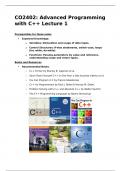
CO2402: Advanced Programming
with C++ Lecture 1
Prerequisites for these notes
Expected Knowledge:
o Variables: Declaration and usage of data types.
o Control Structures: If-else statements, switch-case, loops
(for, while, do-while).
o Functions: Passing parameters by value and reference,
understanding scope and return types.
Books and Resources
Recommended Books:
o C++ Primer by Stanley B. Lippman et al.
o Sams Teach Yourself C++ in One Hour a Day by Jesse Liberty et al.
o You Can Program in C by Francis Glassborow
o C++ for Programmers by Paul J. Deitel & Harvey M. Deitel
o Problem Solving with C++ and Absolute C++ by Walter Savitch
o The C++ Programming Language by Bjarne Stroustrup
, Online Resources:
StackOverflow for Q&A and community support.
HackerRank for coding practice.
Key Concepts in Object-Oriented Programming (OOP)
1. Object Orientation
o Overview: C++ extends the C language with object-oriented
features, enabling more complex and abstract programming.
o Examples of OOP languages include Java and C#.
o Core Concepts: Objects, classes, inheritance, polymorphism,
encapsulation, and abstraction.
2. Encapsulation
o Encapsulation involves bundling the data (attributes) and the
methods (functions) that manipulate that data into a single unit
called a class. It restricts direct access to some of an object's
components, which is a means of preventing unintended
interference and misuse.
o Example: In a Counter class, the data member amount is private
and can only be accessed or modified through public member
functions like set(), get(), and increment().
This encapsulation ensures that the internal representation of the
object is hidden from the outside, and only specific methods are
exposed to interact with it. For example, if amount needs to be
updated, it must be done through the set() method, which can
include checks or additional logic to ensure valid state changes.
with C++ Lecture 1
Prerequisites for these notes
Expected Knowledge:
o Variables: Declaration and usage of data types.
o Control Structures: If-else statements, switch-case, loops
(for, while, do-while).
o Functions: Passing parameters by value and reference,
understanding scope and return types.
Books and Resources
Recommended Books:
o C++ Primer by Stanley B. Lippman et al.
o Sams Teach Yourself C++ in One Hour a Day by Jesse Liberty et al.
o You Can Program in C by Francis Glassborow
o C++ for Programmers by Paul J. Deitel & Harvey M. Deitel
o Problem Solving with C++ and Absolute C++ by Walter Savitch
o The C++ Programming Language by Bjarne Stroustrup
, Online Resources:
StackOverflow for Q&A and community support.
HackerRank for coding practice.
Key Concepts in Object-Oriented Programming (OOP)
1. Object Orientation
o Overview: C++ extends the C language with object-oriented
features, enabling more complex and abstract programming.
o Examples of OOP languages include Java and C#.
o Core Concepts: Objects, classes, inheritance, polymorphism,
encapsulation, and abstraction.
2. Encapsulation
o Encapsulation involves bundling the data (attributes) and the
methods (functions) that manipulate that data into a single unit
called a class. It restricts direct access to some of an object's
components, which is a means of preventing unintended
interference and misuse.
o Example: In a Counter class, the data member amount is private
and can only be accessed or modified through public member
functions like set(), get(), and increment().
This encapsulation ensures that the internal representation of the
object is hidden from the outside, and only specific methods are
exposed to interact with it. For example, if amount needs to be
updated, it must be done through the set() method, which can
include checks or additional logic to ensure valid state changes.