

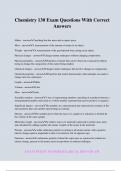
EXAM STUDY MATERIALS July 26, 2024 9:30 AM Chemistry 130 Exam Questions With Correct Answers Matter - answer✔✔Anything that has mass and occupies space. Mass - answer✔✔A measurement of the amount of m atter in an object. Weight - answer✔✔A measurement of the gravitational force acting on an object. Physical changes - answer✔✔Changes matter undergoes without changing composition. Physical properties - answer✔✔Properties of matter that can be observed or measured without trying to change the composition of the matter being studied. Chemical changes - answer✔✔Changes matter undergoes that involve changes in composition. Chemical properties - answer✔✔Properties that matter demonstrates when attempts are made to change into new substances. Length - answer✔✔Meter Volume - answer✔✔Liter Mass - answer✔✔Grams Scientific notation - answer✔✔A way of representing numbers consisting of a product between a nonexponential number and raised to a whole -number exponent tha t may be positive or negative. Significant figures - answer✔✔The numbers in a measurement that represent the certainty of the measurement, plus one number representing an estimate. Density - answer✔✔The number given when the mass of a sample of a substance is divided by the volume of the same sample. Molecular weight - answer✔✔The relative mass of a molecule expressed in atomic mass units and calculated by adding together the atomic weights of the atoms in the molecule. Protons - answer✔✔a stable subatomic particle occurring in all atomic nuclei, with a positive electric charge equal in magnitude to that of an electron, but of opposite sign. Neutrons - answer✔✔a subatomic particle of about the same mass as a proton but without an electric charge, present in all atomic nuclei except those of ordinary hydrogen. EXAM STUDY MATERIALS July 26, 2024 9:30 AM Electrons - answer✔✔a stable subatomic particle with a charge of negative electricity, found in all atoms and acting as the prim ary carrier of electricity in solids. Isotopes - answer✔✔Atoms that have the same atomic number but different mass numbers. That is, they are atoms of the same element that contain different numbers of neutrons in their nuclei. Atom - answer✔✔An atom is th e smallest unit of ordinary matter that forms a chemical element. Every solid, liquid, gas, and plasma is composed of neutral or ionized atoms. Mass number of an atom - answer✔✔A number equal to the sum of the number of protons and neutrons in the nucleus of an atom. Symbolically it is represented by. Mole - answer✔✔The number of particles (atoms or molecules) contained in a sample of an element or compound with a mass in grams equal to the atomic or molecular weight, respectively. Numerically, mol is equal to particles. Period of the periodic table - answer✔✔A horizontal row of elements. Group of the periodic table - answer✔✔A vertical column of elements that have similar chemical properties; also called family of the periodic table. Metals - answer✔✔Elemen ts found in the left two -thirds of the periodic table. Most have the following properties: high thermal and electrical conductivities, high malleability and ductility, and a metallic luster. Nonmetals - answer✔✔Elements found in the right one -third of the periodic table. They often occur as brittle, powdery solids or gasses and have properties generally opposite those of metals. Metalloids - answer✔✔Elements that form a narrow diagonal band in the periodic table between metals and nonmetals. They have prope rties somewhat between those of metals and nonmetals. Metallic property - answer✔✔Physical properties associated with metallic character include metallic luster, shiny appearance, high density, high thermal conductivity, and high electrical conductivity. M ost metals are malleable and ductile and can be deformed without breaking. Many metals are hard and dense. Atomic radii - answer✔✔is a measure of the size of its atom, usually the mean or typical distance from the center of the nucleus to the outermost iso lated electron. Ionization energy - answer✔✔ionization energy, ionization energy is the minimum energy required to remove the most loosely bound electron of an isolated gaseous atom, positive ion, or molecule. How to find the number of valence electrons - answer✔✔the number of valence electrons is equal to the atom's main group number.
Vista previa 2 fuera de 7 páginas
Examen
Chemistry 130 Exam Questions With Correct Answers
Vista previa 2 fuera de 7 páginas
Chemistry 130 Exam Questions With Correct Answers Matter - answerAnything that has mass and occupies space. Mass - answerA measurement of the amount of matter in an object. Weight - answerA measurement of the gravitational force acting on an object. Physical changes - answerChanges matter undergoes without changing composition. Physical properties - answerProperties of matter that can be observed or measured without trying to change the composition of the matter being studied. Chemical changes - answerChanges matter undergoes that involve changes in composition. Chemical properties - answerProperties that matter demonstrates when attempts are made to change into new substances. Length - answerMeter Volume - answerLiter Mass - answerGrams Scientific notation - answerA way of representing numbers consisting of a product between a nonexponential number and raised to a whole-number exponent that may be positive or negative. Significant figures - answerThe numbers in a measurement that represent the certainty of the measurement, plus one number representing an estimate. Density - answerThe number given when the mass of a sample of a substance is divided by the volume of the same sample. Molecular weight - answerThe relative mass of a molecule expressed in atomic mass units and calculated by adding together the atomic weights of the atoms in the molecule. Protons - answera stable subatomic particle occurring in all atomic nuclei, with a positive electric charge equal in magnitude to that of an electron, but of opposite sign. Neutrons - answera subatomic particle of about the same mass as a proton but without an electric charge, present in all atomic nuclei except those of ordinary hydrogen. EXAM STUDY MATERIALS July 26, 2024 9:30 AM Electrons - answera stable subatomic particle with a charge of negative electricity, found in all atoms and acting as the primary carrier of electricity in solids. Isotopes - answerAtoms that have the same atomic number but different mass numbers. That is, they are atoms of the same element that contain different numbers of neutrons in their nuclei. Atom - answerAn atom is the smallest unit of ordinary matter that forms a chemical element. Every solid, liquid, gas, and plasma is composed of neutral or ionized atoms. Mass number of an atom - answerA number equal to the sum of the number of protons and neutrons in the nucleus of an atom. Symbolically it is represented by. Mole - answerThe number of particles (atoms or molecules) contained in a sample of an element or compound with a mass in grams equal to the atomic or molecular weight, respectively. Numerically, mol is equal to particles. Period of the periodic table - answerA horizontal row of elements. Group of the periodic table - answerA vertical column of elements that have similar chemical properties; also called family of the periodic table. Metals - answerElements found in the left two-thirds of the periodic table. Most have the following properties: high thermal and electrical conductivities, high malleability and ductility, and a metallic luster. Nonmetals - answerElements found in the right one-third of the periodic table. They often occur as brittle, powdery solids or gasses and have properties generally opposite those of metals. Metalloids - answerElements that form a narrow diagonal band in the periodic table between metals and nonmetals. They have properties somewhat between those of metals and nonmetals. Metallic property - answerPhysical properties associated with metallic character include metallic luster, shiny appearance, high density, high thermal conductivity, and high electrical conductivity. Most metals are malleable and ductile and can be deformed without breaking. Many metals are hard and dense. Atomic radii - answeris a measure of the size of its atom, usually the mean or typical distance from the center of the nucleus to the outermost isolated electron. Ionization energy - answerionization energy, ionization energy is the minimum energy required to remove the most loosely b
Vista previa del contenido
Información del documento
- Subido en
- 1 de agosto de 2024
- Número de páginas
- 7
- Escrito en
- 2024/2025
- Tipo
- Examen
- Contiene
- Preguntas y respuestas
$11.99
¿Documento equivocado? Cámbialo gratis
Dentro de los 14 días posteriores a la compra y antes de descargarlo, puedes elegir otro documento. Puedes gastar el importe de nuevo.
Escrito por estudiantes que aprobaron
Inmediatamente disponible después del pago
Leer en línea o como PDF

Los indicadores de reputación están sujetos a la cantidad de artículos vendidos por una tarifa y las reseñas que ha recibido por esos documentos. Hay tres niveles: Bronce, Plata y Oro. Cuanto mayor reputación, más podrás confiar en la calidad del trabajo del vendedor.
