Lecture 8
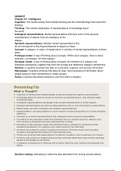
Chapter 8.4 - Intelligence
Cognition: The mental activity that includes thinking and the understandings that result from
thinking.
Thinking: The mental manipulation of representations of knowledge about
the world.
Analogical representations: Mental representations that have some of the physical
characteristics of objects; they are analogous to the
objects.
Symbolic representations: Abstract mental representations that
do not correspond to the physical features of objects or ideas.
Concept: A category, or class, of related items; it consists of mental representations of those
items.
Prototype model: A way of thinking about concepts: Within each category, there is abest
example—a prototype—for that category.
Exemplar model: A way of thinking about concepts: All members of a category are
examples (exemplars); together they form the concept and determine category membership.
Schema: a cognitive structure that help us to perceive, organize, and process information.
Stereotypes: Cognitive schemas that allow for easy, fast processing of information about
people based on their membership in certain groups.
Script: a schema that directs behaviour over time within a situation.
Decision making: Attempting to select the best alternative from among several options.
,Problem solving: Finding a way around an obstacle to reach a goal.
Normative decision theories: Attempts to define how people should
make decisions.
Descriptive decision theories: Attempts to predict how people actually make choices, not
to define ideal choices.
Heuristics: Shortcuts (rules of thumb or informal guidelines) used to reduce the amount of
thinking that is needed to make decisions.
Anchoring: The tendency, in making judgments, to rely on the first piece of information
encountered or information that comes most quickly to mind.
Framing: In decision making, the tendency to emphasize the potential losses or potential
gains from at least one alternative
Availability heuristic: Making a decision based on the answer that most easily comes to
mind.
Representativeness heuristic: Placing a person or object in a category if that person or
object is similar to one’s prototype for that category.
Affective forecasting: The tendency for people to overestimate how events will make them
feel in the future.
Restructuring: A new way of thinking about a problem that aids its solution.
Mental sets: Problem-solving strategies that have worked in the past.
Functional fixedness: In problem solving, having fixed ideas about the typical functions of
objects.
Insight: The sudden realization of a solution to a problem.
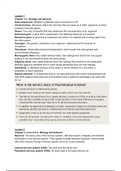
,Language: A system of communication using sounds and symbols according to grammatical
rules.
Morphemes: The smallest language units that have meaning, including suffixes and
prefixes.
Phonemes: The basic sounds of speech, the building blocks of language.
Aphasia: A language disorder that results in deficits in language comprehension and
production.
Wernicke’s area: An area of the left hemisphere where
the temporal and parietal lobes meet, involved in speech comprehension.
Linguistic relativity theory: The claim that language determines thought.
Telegraphic speech: The tendency for toddlers to speak using rudimentary sentences that
are missing words and grammatical markings but follow a logical syntax and convey a
wealth of meaning.
Surface structure: In language, the sound and order of words.
Deep structure: In language, the implicit meanings of sentences.
Phonics: A method of teaching reading in English that focuses on the association between
letters and their Phonemes.
Whole language: A method of teaching reading in English that emphasizes learning the
meanings of words and understanding
how words are connected in sentences.
, Intelligence: The ability to use knowledge to reason, make decisions, make sense of
events, solve problems, understand complex ideas, learn quickly, and adapt to
environmental challenges.
Mental age: An assessment of a child’s intellectual standing compared with that of
same-age peers; determined by comparing the child’s test score with the average score for
children of each chronological age.
Intelligence quotient (IQ): An index of intelligence computed by dividing a child’s estimated
mental age by the child’s chronological age, then multiplying this number by 100.
General intelligence (g): The idea that one general factor underlies intelligence.
Fluid intelligence: Intelligence that reflects the ability to process information, understand
relationships, and think logically, particularly in novel or complex circumstances.
Crystallized intelligence: Intelligence that reflects both the knowledge acquired through
experience and the ability to use that knowledge.
Emotional intelligence (EI): A form of social intelligence that emphasizes the abilities to
manage, recognize, and understand emotions and use emotions to guide appropriate
thought and action.
Stereotype threat: Apprehension about confirming negative stereotypes related to one’s
own group.
Psychometric approach: An attempt to understand the nature of intelligence by studying
the pattern of results obtained on intelligence tests.
There is a difference between reliability and validity. Reliability is the consistency of the
outcome of a test. Validity is well-founded and likely corresponds accurately to the real
world.
Intelligence tests:
- high reliability
- high predictive validity
Chapter 8.4 - Intelligence
Cognition: The mental activity that includes thinking and the understandings that result from
thinking.
Thinking: The mental manipulation of representations of knowledge about
the world.
Analogical representations: Mental representations that have some of the physical
characteristics of objects; they are analogous to the
objects.
Symbolic representations: Abstract mental representations that
do not correspond to the physical features of objects or ideas.
Concept: A category, or class, of related items; it consists of mental representations of those
items.
Prototype model: A way of thinking about concepts: Within each category, there is abest
example—a prototype—for that category.
Exemplar model: A way of thinking about concepts: All members of a category are
examples (exemplars); together they form the concept and determine category membership.
Schema: a cognitive structure that help us to perceive, organize, and process information.
Stereotypes: Cognitive schemas that allow for easy, fast processing of information about
people based on their membership in certain groups.
Script: a schema that directs behaviour over time within a situation.
Decision making: Attempting to select the best alternative from among several options.
,Problem solving: Finding a way around an obstacle to reach a goal.
Normative decision theories: Attempts to define how people should
make decisions.
Descriptive decision theories: Attempts to predict how people actually make choices, not
to define ideal choices.
Heuristics: Shortcuts (rules of thumb or informal guidelines) used to reduce the amount of
thinking that is needed to make decisions.
Anchoring: The tendency, in making judgments, to rely on the first piece of information
encountered or information that comes most quickly to mind.
Framing: In decision making, the tendency to emphasize the potential losses or potential
gains from at least one alternative
Availability heuristic: Making a decision based on the answer that most easily comes to
mind.
Representativeness heuristic: Placing a person or object in a category if that person or
object is similar to one’s prototype for that category.
Affective forecasting: The tendency for people to overestimate how events will make them
feel in the future.
Restructuring: A new way of thinking about a problem that aids its solution.
Mental sets: Problem-solving strategies that have worked in the past.
Functional fixedness: In problem solving, having fixed ideas about the typical functions of
objects.
Insight: The sudden realization of a solution to a problem.
,Language: A system of communication using sounds and symbols according to grammatical
rules.
Morphemes: The smallest language units that have meaning, including suffixes and
prefixes.
Phonemes: The basic sounds of speech, the building blocks of language.
Aphasia: A language disorder that results in deficits in language comprehension and
production.
Wernicke’s area: An area of the left hemisphere where
the temporal and parietal lobes meet, involved in speech comprehension.
Linguistic relativity theory: The claim that language determines thought.
Telegraphic speech: The tendency for toddlers to speak using rudimentary sentences that
are missing words and grammatical markings but follow a logical syntax and convey a
wealth of meaning.
Surface structure: In language, the sound and order of words.
Deep structure: In language, the implicit meanings of sentences.
Phonics: A method of teaching reading in English that focuses on the association between
letters and their Phonemes.
Whole language: A method of teaching reading in English that emphasizes learning the
meanings of words and understanding
how words are connected in sentences.
, Intelligence: The ability to use knowledge to reason, make decisions, make sense of
events, solve problems, understand complex ideas, learn quickly, and adapt to
environmental challenges.
Mental age: An assessment of a child’s intellectual standing compared with that of
same-age peers; determined by comparing the child’s test score with the average score for
children of each chronological age.
Intelligence quotient (IQ): An index of intelligence computed by dividing a child’s estimated
mental age by the child’s chronological age, then multiplying this number by 100.
General intelligence (g): The idea that one general factor underlies intelligence.
Fluid intelligence: Intelligence that reflects the ability to process information, understand
relationships, and think logically, particularly in novel or complex circumstances.
Crystallized intelligence: Intelligence that reflects both the knowledge acquired through
experience and the ability to use that knowledge.
Emotional intelligence (EI): A form of social intelligence that emphasizes the abilities to
manage, recognize, and understand emotions and use emotions to guide appropriate
thought and action.
Stereotype threat: Apprehension about confirming negative stereotypes related to one’s
own group.
Psychometric approach: An attempt to understand the nature of intelligence by studying
the pattern of results obtained on intelligence tests.
There is a difference between reliability and validity. Reliability is the consistency of the
outcome of a test. Validity is well-founded and likely corresponds accurately to the real
world.
Intelligence tests:
- high reliability
- high predictive validity