UCF Biomed Exit Exam Questions and Answers Solved 100%
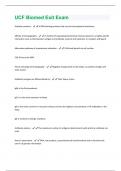
Activator proteins - A DNA-binding proteins that recruit transcriptional machinery Affinity chromatography - A method of separating biochemical mixtures based on a highly specific interaction such as that between antigen and antibody, enzyme and substrate, or receptor and ligand Alternative pathway of complement activation - C3b binds directly to cell surface C5b-9 forms the MAC Anion exchange chromatography - Negative charges bind to the beads, so positive charges will elute sooner. Antibody isotypes are differentiated by - Their heavy chains IgM is the first produced. IgG is in the most common in blood. IgA is the most common in mucosal surfaces and has the highest concentration of all antibodies in the body. IgE is involved in allergic reactions. Antibody valence - The maximum number of antigenic determinants with which an antibody can react Avery's experiment - DNA, not proteins, caused bacterial transformation and is therefore the carrier of genetic informationAvidity - The firmness of association between a multideterminant antigen and the antibodies produced against it Having multiple binding sites on an antibody dramatically increases its avidity, which is why IgM has high avidity. Base excision repair - Glycosylase scans major and minor groove, recognizes and removes the damaged base by base flipping and hydrolyzing the glycosidic bond. DNA Pol β removes the segment of the sugar backbone and puts in the correct nucleotide, and DNA ligase repairs the strand. Base pair recognition in major vs minor grooves - Major groove: -There is enough room to recognize arrangement of H bond donors and acceptors --- Can tell discriminate between CG, GC, AT, and TA Minor groove: - Can only discriminate between CG/GC and AT/TA but won't be able to tell whether it's CG or GC Blue/white screening - X-gal in medium is colorless unless cleaved by β-galactosidase Lac+ colonies are blue, while lac- colonies are white on this media. - We want Lac- colonies because we want our recombinant DNA to have disrupted the Lac Z gene. Chemiosmotic theory - Proton motive force Chemokines - Chemotactic cytokines Induce directed chemotaxis in nearby responsive cellsClassical pathway of complement activation - Antibody mediated Antibody cleaves C4 C4b2aC3b C5b-9 forms the MAC Cre-lox recombination - Conditional knockout Use Cre recombinase (topoisomerase) to cause recombination between loxP sites - You can make it so that only certain cell types have loxP sites, so the target gene would only be knocked out in that cell type. Cytokine - Signalling molecules produced by cell for specific biological functions Dendritic cells - Process antigen material and present it on the cell surface to the T cells of the immune system Once activated, they migrate to the lymph nodes where they interact with T cells and B cells to initiate and shape the adaptive immune response. DNA Helicase - Unwinds DNA, separating the two strands DNA mismatch repair - Distortion of DNA helix causes conformation change in protein, which recruits complex that nicks the DNA near the mismatch.
Escuela, estudio y materia
- Institución
- UCF Biomed
- Grado
- UCF Biomed
Información del documento
- Subido en
- 26 de julio de 2024
- Número de páginas
- 10
- Escrito en
- 2023/2024
- Tipo
- Examen
- Contiene
- Preguntas y respuestas
Temas

Documento también disponible en un lote