ATOMIC PHYSICS
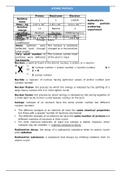
Proton Neutronm Electron
Relative
1 1 1/1836 Rutherford’s
mass
Mass / kg 1.67 x 10⁻²⁷ 1.67 x 10 -27
9.11 x 10 -31 alpha particle
Relative scattering
+1 Neutral -1 experiment
charge
Location Nucleus Nucleus Orbiting nucleus
Observation Conclusion
Symbol p+ N e-
Most particles went The atom is mostly empty -19
Charge / C +1.6 x 10⁻¹⁹ 0 -1.6 x 10
straight through space
undeflected
Some particles were The nucleus is positively
deflected back through charged as is the particles
large angels
Very small number of The nucleus carries most
particles were deflected of the atom’s mass
backwards
Nucleon: a particle found in the atomic nucleus: a proton or a neutron
A: nucleon number = proton number + neutron number A=
Z+N
Z: proton number
Nuclide: a ‘species’ of nucleus having particular values of proton number and
nucleon number
Nuclear fission: the process by which the energy is released by the splitting of a
large heavy nucleus into 2 or more lighter nuclei
Nuclear fusion: the process by which energy is released by the joining together of
2 small light nuclei to form a new heavier nucleus (in the Sun)
Isotope: isotopes of an element have the same proton number but different
nucleon numbers
The different isotopes of an element all have the same chemical properties
but those with a greater number of neutrons are heavier
The different isotopes of an element all have the same number of protons but
different numbers of neutrons in their nuclei
For most chemical elements, at least one isotope is stable; however, other
isotopes may be unstable -> undergo radioactive decay
Radioactive decay: the decay of a radioactive substance when its atomic nuclei
emit radiation
Radioactive substance: a substance that decays by emitting radiation from its
atomic nuclei
, ATOMIC PHYSICS
If a radioactive substance gets inside us, its radiation can harm us -> we have
been contaminated
If the radiation hits our bodies, we have received a dose of radiation -> we have
been irradiated
Contaminated: when an object has acquire some unwanted radioactive substance
Irradiated: when an object has been exposed to radiation
Background radiation: the radiation from the environment to which we are
exposed all the time
Radioactive gases like radon
The ground contains radioactive substances from materials to build
Living things takes in radioactive materials from soil -> food and drinks are
contaminated
Cosmic rays
Artificial radiation
Medical sources such as X-ray and Gamma rays to see inside the bodies and
destroy cancer cells
Nuclear weapons: bombs
Air travel: the higher the altitude, the greater the exposure of cosmic rays
Nuclear power stations: people working here need to be careful
Nuclear discharges: radiation levels need to be constantly checked and
measured around nuclear power station in order to keep the area safe for living
Detecting radiation
While investigating phosphorescence in Uranium using photographic films,
instead of glowing in the dark, Uranium emitted invisible radiation that darkened
photographic film
Geiger counter is pointed towards the object and radiation imparting from it
can be measured when it gives a pulse. The number of pulses are the number of
particles decaying -> quick
Radioactive decay: the decay of radioactive substance when its atomic nuclei
emit radiation
Radiation is emitted by the (unstable) nucleus of an atom
An unstable nucleus emits radiation in an attempt to become more stable, less
radioactive
Random process: process that happens at a random rate rather than steady; in
radioactive decay, it is impossible to predict which atom will be the next to
decay or when a given atom will decay
Release energy in 2 forms
Proton Neutronm Electron
Relative
1 1 1/1836 Rutherford’s
mass
Mass / kg 1.67 x 10⁻²⁷ 1.67 x 10 -27
9.11 x 10 -31 alpha particle
Relative scattering
+1 Neutral -1 experiment
charge
Location Nucleus Nucleus Orbiting nucleus
Observation Conclusion
Symbol p+ N e-
Most particles went The atom is mostly empty -19
Charge / C +1.6 x 10⁻¹⁹ 0 -1.6 x 10
straight through space
undeflected
Some particles were The nucleus is positively
deflected back through charged as is the particles
large angels
Very small number of The nucleus carries most
particles were deflected of the atom’s mass
backwards
Nucleon: a particle found in the atomic nucleus: a proton or a neutron
A: nucleon number = proton number + neutron number A=
Z+N
Z: proton number
Nuclide: a ‘species’ of nucleus having particular values of proton number and
nucleon number
Nuclear fission: the process by which the energy is released by the splitting of a
large heavy nucleus into 2 or more lighter nuclei
Nuclear fusion: the process by which energy is released by the joining together of
2 small light nuclei to form a new heavier nucleus (in the Sun)
Isotope: isotopes of an element have the same proton number but different
nucleon numbers
The different isotopes of an element all have the same chemical properties
but those with a greater number of neutrons are heavier
The different isotopes of an element all have the same number of protons but
different numbers of neutrons in their nuclei
For most chemical elements, at least one isotope is stable; however, other
isotopes may be unstable -> undergo radioactive decay
Radioactive decay: the decay of a radioactive substance when its atomic nuclei
emit radiation
Radioactive substance: a substance that decays by emitting radiation from its
atomic nuclei
, ATOMIC PHYSICS
If a radioactive substance gets inside us, its radiation can harm us -> we have
been contaminated
If the radiation hits our bodies, we have received a dose of radiation -> we have
been irradiated
Contaminated: when an object has acquire some unwanted radioactive substance
Irradiated: when an object has been exposed to radiation
Background radiation: the radiation from the environment to which we are
exposed all the time
Radioactive gases like radon
The ground contains radioactive substances from materials to build
Living things takes in radioactive materials from soil -> food and drinks are
contaminated
Cosmic rays
Artificial radiation
Medical sources such as X-ray and Gamma rays to see inside the bodies and
destroy cancer cells
Nuclear weapons: bombs
Air travel: the higher the altitude, the greater the exposure of cosmic rays
Nuclear power stations: people working here need to be careful
Nuclear discharges: radiation levels need to be constantly checked and
measured around nuclear power station in order to keep the area safe for living
Detecting radiation
While investigating phosphorescence in Uranium using photographic films,
instead of glowing in the dark, Uranium emitted invisible radiation that darkened
photographic film
Geiger counter is pointed towards the object and radiation imparting from it
can be measured when it gives a pulse. The number of pulses are the number of
particles decaying -> quick
Radioactive decay: the decay of radioactive substance when its atomic nuclei
emit radiation
Radiation is emitted by the (unstable) nucleus of an atom
An unstable nucleus emits radiation in an attempt to become more stable, less
radioactive
Random process: process that happens at a random rate rather than steady; in
radioactive decay, it is impossible to predict which atom will be the next to
decay or when a given atom will decay
Release energy in 2 forms