EUP1501
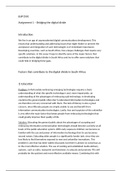
Assignment 1 – Bridging the digital divide
Introduction:
We live in an age of unprecedented digital communications development. This
means that understanding and addressing issues that might hinder or prevent the
acceptance and integration of such technologies is of immediate importance.
Developing countries, such as South Africa, face unique challenges that require very
specific solutions. In this essay I hope to identify some of the major factors that
contribute to the digital divide in South Africa and try to offer some solutions that
could help in bridging these gaps.
Factors that contribute to the digital divide in South Africa:
1) Education
Problem: Unfortunately embracing emerging technologies requires a basic
understanding of what the specific technology is and, more importantly, an
understanding of the advantages of embracing said technology. In developing
countries the general public often don’t understand information technologies and
are therefore not very concerned with them. The lack of literacy is also a great
concern, since illiterate people are simply unable to use and benefit from
information communication technologies. Lastly, fear and suspicion of the unfamiliar
is very often the main factor that keeps people from embracing technologies that
could greatly improve their quality of life.
Solution: Educating the general public about the advantages of accepting and
embracing information communication technologies should become a priority at all
levels of the public education system. With early exposure children can become so
familiar with the use and power of information technology that its use becomes
second nature. Educating older people is a significantly harder task, since they are
less likely to find themselves exposed to new and unfamiliar innovations. This
problem is one that has been widely discussed, but there is almost no consensus as
to the most effective solution. The use of existing and established media delivery
systems, such as radio, newsprint and television, to educate and promote ITCs will
probably be the quickest and most effective available means. Combining this with
, more enthusiastic endorsement by government and prominent public figures can
create greater public interest which will definitely help in narrowing the existing, and
fast growing, digital divide.
2) Infrastructure
Problem: In South Africa, as in almost all underdeveloped or poorer countries, we
have a problem with infrastructural development. There are many factors that make
this a difficult problem to solve. Geographical obstacles are often the reason that
large areas don’t have any access to existing internet infrastructure. Factors such as
the remoteness of a location, inaccessible terrain and extreme weather conditions
can make the establishment and maintenance of infrastructure very difficult.
Because of many contributing factors, the creation of any new infrastructure in
underprivileged communities often has to be prioritised. The lack of basic necessities
required for dignified human existence means that the infrastructural development
in support of information communication technologies is so far down the list it rarely
gets addressed.
Solution: South Africa is in a rather unique situation of having been a slow developer
of ground based communications infrastructure, but an early adopter of mobile
communications technologies. This fortunately has many advantages. Infrastructural
requirements to support mobile communication is generally cheaper and less labour
intensive to establish, for example; not having to physically connect users to a
network by cable make connecting residents of informal settlement cheap and easy,
something that was impossible with a line based system. In reality the main obstacle
in the way of infrastructural development, not only in regards to communication, is
money. It is only with substantial public and private investment that we can expect
functioning, reliable infrastructure to be available to all members of our society
within the near future.
3) Access
Problem: It is an economic reality that many South Africans simply cannot afford a
device that would grant them access to communications infrastructure. This is
especially true when it comes to the affordability of personal computers needed to
facilitate more specialised functions. These functions include access to education
and effective exploitation of business opportunities. Another issue regarding access
to communications and information technologies is the compatibility between
content and device. Unfortunately there are vast repositories of information that are
only accessible by specific devices, the greatest problem being that not all content is
accessible by mobile devices. The last access issue that creates digital division is
Assignment 1 – Bridging the digital divide
Introduction:
We live in an age of unprecedented digital communications development. This
means that understanding and addressing issues that might hinder or prevent the
acceptance and integration of such technologies is of immediate importance.
Developing countries, such as South Africa, face unique challenges that require very
specific solutions. In this essay I hope to identify some of the major factors that
contribute to the digital divide in South Africa and try to offer some solutions that
could help in bridging these gaps.
Factors that contribute to the digital divide in South Africa:
1) Education
Problem: Unfortunately embracing emerging technologies requires a basic
understanding of what the specific technology is and, more importantly, an
understanding of the advantages of embracing said technology. In developing
countries the general public often don’t understand information technologies and
are therefore not very concerned with them. The lack of literacy is also a great
concern, since illiterate people are simply unable to use and benefit from
information communication technologies. Lastly, fear and suspicion of the unfamiliar
is very often the main factor that keeps people from embracing technologies that
could greatly improve their quality of life.
Solution: Educating the general public about the advantages of accepting and
embracing information communication technologies should become a priority at all
levels of the public education system. With early exposure children can become so
familiar with the use and power of information technology that its use becomes
second nature. Educating older people is a significantly harder task, since they are
less likely to find themselves exposed to new and unfamiliar innovations. This
problem is one that has been widely discussed, but there is almost no consensus as
to the most effective solution. The use of existing and established media delivery
systems, such as radio, newsprint and television, to educate and promote ITCs will
probably be the quickest and most effective available means. Combining this with
, more enthusiastic endorsement by government and prominent public figures can
create greater public interest which will definitely help in narrowing the existing, and
fast growing, digital divide.
2) Infrastructure
Problem: In South Africa, as in almost all underdeveloped or poorer countries, we
have a problem with infrastructural development. There are many factors that make
this a difficult problem to solve. Geographical obstacles are often the reason that
large areas don’t have any access to existing internet infrastructure. Factors such as
the remoteness of a location, inaccessible terrain and extreme weather conditions
can make the establishment and maintenance of infrastructure very difficult.
Because of many contributing factors, the creation of any new infrastructure in
underprivileged communities often has to be prioritised. The lack of basic necessities
required for dignified human existence means that the infrastructural development
in support of information communication technologies is so far down the list it rarely
gets addressed.
Solution: South Africa is in a rather unique situation of having been a slow developer
of ground based communications infrastructure, but an early adopter of mobile
communications technologies. This fortunately has many advantages. Infrastructural
requirements to support mobile communication is generally cheaper and less labour
intensive to establish, for example; not having to physically connect users to a
network by cable make connecting residents of informal settlement cheap and easy,
something that was impossible with a line based system. In reality the main obstacle
in the way of infrastructural development, not only in regards to communication, is
money. It is only with substantial public and private investment that we can expect
functioning, reliable infrastructure to be available to all members of our society
within the near future.
3) Access
Problem: It is an economic reality that many South Africans simply cannot afford a
device that would grant them access to communications infrastructure. This is
especially true when it comes to the affordability of personal computers needed to
facilitate more specialised functions. These functions include access to education
and effective exploitation of business opportunities. Another issue regarding access
to communications and information technologies is the compatibility between
content and device. Unfortunately there are vast repositories of information that are
only accessible by specific devices, the greatest problem being that not all content is
accessible by mobile devices. The last access issue that creates digital division is