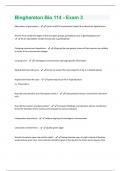
Binghamton Bio 114 - Exam 3 Alternation of generations - Cycle has BOTH multicellular haploid & multicellular diploid forms Are the most visible life stages of the land plant groups sporophytes (2n) or gametophytes (n)? - All are sporophyte except nonvascular is gametophyte Changing -environment hypothesis - offspring that are genetic clones of their parents are unlikely to thrive if the environment changes Crossing over - homologous chromosomes exchange genetic information Diploid dominant life cycle - Similar to animal life cycle (majority of life is in diploid phase) Haploid dominant life cycle - Spend majority of life in haploid phase ex. Plasmodium How did mitochondria and chloroplasts evolve? - Endosymbiosis theory: evolved from bacterial cells How did the nuclear envelope evolve? - Increased infoldings of prokaryotic plasma membranes led to the evolution of the nucleus and evolution by natural selection. Independent assortment - random aligning of homologous chromosomes Land plants evolved from: - aquatic green algae Should stomata be open day and/or night? - Having stomata open at night instead of daytime would reduce water loss; more stomata should be open in the day b/c the Calvin Cycle requires CO2 Significance b/w protists and public health? - Malaria & other human pathogens/parasites Under what conditions are stomata likely to be opened? Closed? - - high water availability = open stomata - low water availability = closed stomata What are common examples of protists? - Plasmodium falciparum (Malaria) - example of haploid dominant What are the 3 different modes of reproduction and how much genetic diversity do they produce? - Asexual (mitosis) - LEAST genetic variation Sexual (self -fertilization) - MORE genetic variation Sexual (cross -fertilization) - MOST genetic variation What are the advantages of infoldings? - * Increases SA:V - more infoldings = more ATP produced, more waste excreted, & more nutrients absorbed * as a cell gets bigger, SA:V gets smaller What are the advantages of mitochondria and chloroplasts in eukaryotic cells? - Enable increased ATP/energy production - mitochondria: aerobic respiration vs. glycolysis - chloroplasts: autotrophy vs. heterotrophy What are the characteristics of protists? - - most diverse group: uni- or multicellular diverse life cycles diverse metabolisms (hetero & photo) mobility - live in moist environments
Examen
Binghamton Bio 114 - Exam 3 (Questions + Answers) Verified 100% Correct!!.
Puntuación
Vendido
-
Páginas
5
Grado
A+
Subido en
27-06-2024
Escrito en
2023/2024
Alternation of generations - Cycle has BOTH multicellular haploid & multicellular diploid forms Are the most visible life stages of the land plant groups sporophytes (2n) or gametophytes (n)? - All are sporophyte except nonvascular is gametophyte Changing-environment hypothesis - offspring that are genetic clones of their parents are unlikely to thrive if the environment changes Crossing over - homologous chromosomes exchange genetic information Diploid dominant life cycle - Similar to animal life cycle (majority of life is in diploid phase) Haploid dominant life cycle - Spend majority of life in haploid phase ex. Plasmodium How did mitochondria and chloroplasts evolve? - Endosymbiosis theory: evolved from bacterial cells How did the nuclear envelope evolve? - Increased infoldings of prokaryotic plasma membranes led to the evolution of the nucleus and evolution by natural selection. Independent assortment - random aligning of homologous chromosomes Land plants evolved from: - aquatic green algae Should stomata be open day and/or night? - Having stomata open at night instead of daytime would reduce water loss; more stomata should be open in the day b/c the Calvin Cycle requires CO2Significance b/w protists and public health? - Malaria & other human pathogens/parasites Under what conditions are stomata likely to be opened? Closed? - - high water availability = open stomata - low water availability = closed stomata What are common examples of protists? - Plasmodium falciparum (Malaria) - example of haploid dominant What are the 3 different modes of reproduction and how much genetic diversity do they produce? - Asexual (mitosis) - LEAST genetic variation Sexual (self-fertilization) - MORE genetic variation Sexual (cross-fertilization)- MOST genetic variation What are the advantages of infoldings? - * Increases SA:V - more infoldings = more ATP produced, more waste excreted, & more nutrients absorbed * as a cell gets bigger, SA:V gets smaller What are the advantages of mitochondria and chloroplasts in eukaryotic cells? - Enable increased ATP/energy production - mitochondria: aerobic respiration vs. glycolysis - chloroplasts: autotrophy vs. heterotrophy What are the characteristics of protists? - - most diverse group: uni- or multicellular diverse life cycles diverse metabolisms (hetero & photo) mobility - live in moist environmentsWhat are the characteristics required for transition onto dry land? - Controlling water loss, surviving intense sunlight, growing upright in air, reproducing w/o water, & using animals to carry pollen & seeds What are the key traits that define eukaryotes? - - very diverse lineage - diverse morphology (uni- and multicellular, range in size) - diverse reproduction (asexually by mitosis, sexually by meiosis) - membrane-bound organelles & DNA (nucleus) - linear chromosomes What are the main differences between mitosis and meiosis? (in terms of ploidy, generation of genetic diversity, & stages/alignment of chromosomes during production of daughter cells/gametes) - Mitosis - produces genetically identical cells; sister chromatids separate; no genetic variation Meiosis - produces genetically unique cells; homologous pairs separate 1st, then sister chromatids; lots of genetic variation What are the main groups of land plants? (give examples) - Nonvascular (mosses), seedless vascular (ferns), gymnosperms (pine trees), angiosperms (fruiting/flowering plants) What are the xylem and phloem (types of vascular tissue)? - Xylem - carries water & dissolved nutrients from soil/roots up to the rest of plant Phloem - carries sugars & other substances down (& up) from "source" to "sink" What is the advantage of a nucleus? - Enables organization of "lots" of DNA which increases complexity What is the ecological significance of protists? - - food chain photosynthetic protists: generate much of ocean's oxygen, & organic carbon to feed other organisms - carbon sinksWhat is the Endosymbiosis Theory? - Mitochondria originated when a bacterial cell took up residence inside another cell (2bya) What is the evidence for the Endosymbiosis Theory? - Mitochondria & chloroplasts both have bacteria-like traits: - own circular genome - 2 cell membranes (inner & outer) - replication by binary fission - bacterial ribosomes What is the phylogenetic relationship of protists to each other and other groups (eukaryotes & prokaryotes)? - - paraphyletic group - any eukaryote that isn't a plant, animal, or fungus What is the relationship b/w the cuticle and stomata? How does this impact water loss, gas exchange, & rates of photosynthesis & cellular respiration? - Together, they allow land plants to keep photosynthesizing w/o drying out Waxy cuticle - reduces water loss from plant cells (hotter areas = thicker cuticle) - reduces CO2 intake Stomata - "trap doors" in epidermis/cuticle that enable CO2 to get in What is the significance of protists in regards to agriculture/economy? - crop, forestry, & fishery pests - Irish potato famine due to protists What is/are the advantage(s) of plants moving onto dry land? - Oceans were getting crowded so there was a lot of competition for sunlight, O2, CO2, and inorganic nutrients but no competition on land What roles do vascular tissue/lignin play in enabling plants to survive on land? - Vascular tissue allows plants to stand upright & get water from soil to the rest of the plant Vascular tissue - transports water & sugar through taller plantLignin - strongest part of vascular tissue, provides structural support When did land plants first evolve? Why is this important? - ~500mya. Important b/c first multicellular organisms to survive completely exposed to air - helped enable animals to adapt to terrestrial lifestyles Which mode of reproduction do independent assortment, crossing over, mixing of genomes, and mutation occur in? - Sexual (cross-fertilization)
Mostrar más
Leer menos
Institución
Binghamton Bio 114
Grado
Binghamton Bio 114
Ups! No podemos cargar tu documento ahora. Inténtalo de nuevo o contacta con soporte.
Escuela, estudio y materia
- Institución
- Binghamton Bio 114
- Grado
- Binghamton Bio 114
Información del documento
- Subido en
- 27 de junio de 2024
- Número de páginas
- 5
- Escrito en
- 2023/2024
- Tipo
- Examen
- Contiene
- Preguntas y respuestas
Temas
Vista previa del contenido
$8.49
Accede al documento completo:
100% de satisfacción garantizada
Inmediatamente disponible después del pago
Tanto en línea como en PDF
No estas atado a nada

Documento también disponible en un lote
Package deal
Binghamton bio 114 Exam Package Deal Graded A+
8
2024
$ 67.92
Más información