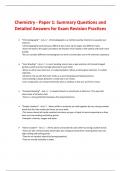
Chemistry - Paper 1: Summary Questions and Detailed Answers for Exam Revision Practices
*Chromatography* - Ans .-Chromatography is a method used by chemists to separate out mixtures. -Chromatography works because different dyes move up the paper and different rates. -Some will stick to the paper and others will dissolve more readily in the solvent and travel more quickly. -You can com[are different chromatograms to work out what dyes are in the unknown substance. *Ionic Bonding* - Ans .-In ionic bonding, atoms lose or gain electrons to formed charged particles which are then strongly attracted to each other. -When an atom loses electrons, it's called oxidation. When an atom gains electrons, it's called reduction. -All atoms end up with full outer shells as a result of giving and taking electrons. -Ionic bonding is always between a metal and a non-metal. -Ionic compounds can conduct electricity when a solution as the ions are free to move. *Covalent Bonding* - Ans .-A covalent bond is a shared pair of electrons. This way both atoms have a full outer shell. -There is a strong attraction between the shared electrons. *Simple Covalent* - Ans .-Atoms within a molecule are held together by very strong covalent bonds but the inter-molecular forces are very weak. -This means almost all simple covalent structures are gas or liquid at room temperature as they have very low melting and boiling points. -Examples: chlorine, oxygen and water *Giant Covalent* - Ans .-All the atoms are bonded to each other by strong covalent bonds. -There are lots of these bonds which takes lots energy to break them meaning they have very high melting and boiling points. -They do not conduct electricity (except graphite). -They are usually insoluble in water. *Isotopes* - Ans .-Isotopes are different atomic forms of the same element, which have the SAME number of PROTONS but a DIFFERENT number of NEUTRONS. -Isomers have the same proton number but different mass numbers. *Empirical and Molecular Formulae* - Ans .-Empirical formula of a compound is the simplest formula that tells you the ration of different elements in a compound. -Molecular formula of a compound tells you the actual number of atoms of each element in a single molecule. *Calculating Masses* - Ans .1. Write out the balanced equation. 2. Work out the relative formula mass and multiply them by the balancing numbers in the equation. 3. Divide to get one and then multiply to get all. *Moles* - Ans .number of moles = mass (g) / relative formula mass *Concentration* - Ans .number of moles = concentration x volume *Converting from moles per dm^3 to grams per dm^3* - Ans .-Multiply by the RFM to get grams per dm^3 *Electrical Conductivity* - Ans .Compounds that conduct electricity: -Ionic (when molten or in a solution so the ions are free to move) -Metals (delocalised sea of electrons) *Electrolysis* - Ans .-If you pass a current through a ionic substance that is molten or in a solution, it breaks it down into new substances. -Electrolytes are liquids that conduct electricity. -+ve ions are called cations because they are attracted to the -ve cathode. --ve ions are called anions because they're attracted to the +ve anode. -The electrodes are made from an inert material so they don't take part in the reaction. *Group 1 - The Alkali Metals* - Ans .-Lithium, sodium and potassium all react vigorously. -The reaction produces a metal hydroxide solution. This solution is alkaline, hence why they are called the alkali metals. -eg. potassium + water potassium hydroxide + hydrogen -They all fizz when put in water but potassium burns with a lilac flame. *Group 7 - The Halogens* - Ans .-The higher up in group 7 an element is, the more reactive it is. -Iodine is a solid (dark grey) at room temperature, bromine is a liquid (red-brown) and chlorine is a gas (green). -Hydrogen chloride gas disassociates in water to create hydrochloric acid but not in methylbenzene so it is not acidi
Escuela, estudio y materia
Información del documento
- Subido en
- 20 de junio de 2024
- Número de páginas
- 7
- Escrito en
- 2023/2024
- Tipo
- Examen
- Contiene
- Preguntas y respuestas
Temas
-
chemistry paper 1 summary questions and detail

Documento también disponible en un lote