ASSIGNMENT 01
UNIQUE NUMBER: 838156
DUE DATE: 12 AUGUST 2019
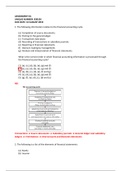
1. The following information relates to the financial accounting cycle.
(a) Completion of source documents.
(b) Posting to the general ledger.
(c) Transactions take place.
(d) Recording of transactions in subsidiary journals.
(e) Reporting in financial statements.
(f) Decision making by management.
(g) Analysis and interpretation of financial statements.
What is the correct order in which financial accounting information is processed through
the financial accounting cycle?
(1) (a), (c), (d), (b), (e), (g) and (f)
(2) (c), (a), (d), (b), (e), (g) and (f)
(3) (a), (b), (c), (d), (e), (f) and (g)
(4) (c), (d), (a), (b), (e), (g) and (f)
(5) (g), (f), (e), (d), (c), (b) and (a)
NB:
Transactions → Source documents → Subsidiary journals → General ledger and subsidiary
ledgers → Trial balance → Final accounts and financial statements.
2. The following is a list of the elements of financial statements:
(a) Equity
(b) Income
, (c) Assets
(d) Liabilities
(e) Expenses
Which elements measure the profitability of an entity?
(1) (c) and (d)
(2) (b) and (d)
(3) (a) and (c)
(4) (b) and (e)
(5) (a) and (e)
The elements that measure the financial performance on the statement of profit or loss
and other comprehensive income are:
o income; and
o expenses.
3. The following is a list of balances that appeared in the accounting records of Williams
Traders as at 31 July 2018:
Assets – Non-Current
Assets – Non-Current
Assets – Current
Equity
Assets – Current
Liability
Liability
Which one of the following amounts represents the other liabilities of Williams Traders as at
31 July 2018?
(1) R70 000
(2) R460 000
(3) R90 000
(4) R230 000
(5) R260 000
A=E+L
R460 000 = R300 000 + (R70 000 +R90 000)
UNIQUE NUMBER: 838156
DUE DATE: 12 AUGUST 2019
1. The following information relates to the financial accounting cycle.
(a) Completion of source documents.
(b) Posting to the general ledger.
(c) Transactions take place.
(d) Recording of transactions in subsidiary journals.
(e) Reporting in financial statements.
(f) Decision making by management.
(g) Analysis and interpretation of financial statements.
What is the correct order in which financial accounting information is processed through
the financial accounting cycle?
(1) (a), (c), (d), (b), (e), (g) and (f)
(2) (c), (a), (d), (b), (e), (g) and (f)
(3) (a), (b), (c), (d), (e), (f) and (g)
(4) (c), (d), (a), (b), (e), (g) and (f)
(5) (g), (f), (e), (d), (c), (b) and (a)
NB:
Transactions → Source documents → Subsidiary journals → General ledger and subsidiary
ledgers → Trial balance → Final accounts and financial statements.
2. The following is a list of the elements of financial statements:
(a) Equity
(b) Income
, (c) Assets
(d) Liabilities
(e) Expenses
Which elements measure the profitability of an entity?
(1) (c) and (d)
(2) (b) and (d)
(3) (a) and (c)
(4) (b) and (e)
(5) (a) and (e)
The elements that measure the financial performance on the statement of profit or loss
and other comprehensive income are:
o income; and
o expenses.
3. The following is a list of balances that appeared in the accounting records of Williams
Traders as at 31 July 2018:
Assets – Non-Current
Assets – Non-Current
Assets – Current
Equity
Assets – Current
Liability
Liability
Which one of the following amounts represents the other liabilities of Williams Traders as at
31 July 2018?
(1) R70 000
(2) R460 000
(3) R90 000
(4) R230 000
(5) R260 000
A=E+L
R460 000 = R300 000 + (R70 000 +R90 000)