Summary #1 The birds and the bees
Genetic transmission
Nucleus chromosome (46) genes DNA nucleotides (A-T & G-C) amino acid
22 pairs of autosomes and 1 pair of sex chromosomes (XX or XY) {X=large, Y=few genes}
3 nucleotides = 1 amino acid & Chains of amino acids = protein
Protein = essential in bodily processes, give different characteristic to a cell. (enzymes etc.)
Cells can duplicate, thus genetic information can also duplicate
‘zip’ open the DNA helix transcribe the genetic information (complementary to the
nucleotides) formation of mRNA (=copy of gene) reading mRNA = translation
decode mRNA into amino acids produce proteins
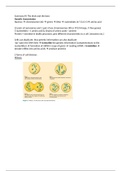
2 forms of cell division:
Mitosis
, Meiosis
MITOSIS MEIOSIS
BODY CELLS SEX CELLS/GERM CELLS
DAUGHTER/MOTHER CELLS = IDENTICAL DAUGHTER/MOTHER CELLS = UNIQUE
46 CHROMOSOMES (DIPLOID) 23 CHROMOSOMES (HAPLOID)
NO DNA EXCHANGE CROSSING OVER (+ genetic variation)
Crossing over:
Equivalent sections of chromosomes cross & exchange segments of genetic material across
its length
genetic variability/hereditary uniqueness
The splitting up of either part of the chromosomes happens by chance 2 to the power of
23 = 8 million different germ cells may be created per person.
8 Million different sperm cells X 8 million different egg cells = 64 trillion different possible
children.
Genotype: genetic makeup
Phenotype: observable/measurable
characteristics of an individual
May be affected by environment or other
genes
Genes influence & are influenced
- Intracellular
- Extracellular
determines epigenetics: how
genes are expressed
- External environment
Genetic transmission
Nucleus chromosome (46) genes DNA nucleotides (A-T & G-C) amino acid
22 pairs of autosomes and 1 pair of sex chromosomes (XX or XY) {X=large, Y=few genes}
3 nucleotides = 1 amino acid & Chains of amino acids = protein
Protein = essential in bodily processes, give different characteristic to a cell. (enzymes etc.)
Cells can duplicate, thus genetic information can also duplicate
‘zip’ open the DNA helix transcribe the genetic information (complementary to the
nucleotides) formation of mRNA (=copy of gene) reading mRNA = translation
decode mRNA into amino acids produce proteins
2 forms of cell division:
Mitosis
, Meiosis
MITOSIS MEIOSIS
BODY CELLS SEX CELLS/GERM CELLS
DAUGHTER/MOTHER CELLS = IDENTICAL DAUGHTER/MOTHER CELLS = UNIQUE
46 CHROMOSOMES (DIPLOID) 23 CHROMOSOMES (HAPLOID)
NO DNA EXCHANGE CROSSING OVER (+ genetic variation)
Crossing over:
Equivalent sections of chromosomes cross & exchange segments of genetic material across
its length
genetic variability/hereditary uniqueness
The splitting up of either part of the chromosomes happens by chance 2 to the power of
23 = 8 million different germ cells may be created per person.
8 Million different sperm cells X 8 million different egg cells = 64 trillion different possible
children.
Genotype: genetic makeup
Phenotype: observable/measurable
characteristics of an individual
May be affected by environment or other
genes
Genes influence & are influenced
- Intracellular
- Extracellular
determines epigenetics: how
genes are expressed
- External environment