Week 1. The innovator’s dilemma
Christensen and Overdorf
Why the logical, competent decisions of good management that lead to the success are also the reason why they
lose their position of leadership (dilemma): (1) trajectories of market needs versus technology improvement, (2)
sustaining versus disruptive technologies and (3) disruptive technologies versus rationale investments.
(1) Large companies depend on customers and investors for
resources. They listen and kill ideas for which there is little need.
Overshooting: overselling products when there is no value.
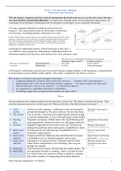
Products whose features and functionality closely match the market needs today often follow a
trajectory of improvement (A) by which they overshoot mainstream market needs tomorrow
(B). At the same time, products that seriously underperform today, relative to customer
expectation in mainstream markets (C), may meet basic needs (D) and become directly
performance-competitive tomorrow (E).
(2) Disruptive technologies destroy current businesses as they have a
very different value proposition, underperform established products in
mainstream markets, but they have other features that a few customers value.
The effect of new technological innovation on existing one
Sustaining (improve needs) Disruptive (destroy)
The pace of technological Incremental (little) New razor Ford’s model T
innovation Radical (big) Air Fryer Digital photography
(3) Disruptive technologies typically have lower profit margins (crappy products in the beginning), commercialized
in small markets and no reliable market stability. This makes it unattractive for firms to invest in.
Why do firms not invest in/ principles disruptive innovation:
1. Companies depend on customers and investors for resources – “customers don’t want disruptive”;
2. Small markets don’t solve the growth needs of large companies – “not large enough to be interested”;
3. Markets that don’t exist can’t be analysed – “no rational investment”;
4. An organization’s capabilities determine its disabilities;
5. Technology supply may not equal market demand, see figure above.
Moore
Darwin stands for the evolution of firms whereby the fittest will survive. The demon is thereby the inertia. “How
can firms innovate and survive in the long term? What are the forces that the firm must overcome?”
1 Early Attention of early adopters – enthusiasts (cool) and visionaries Disruptive innovation
(GM – Entr)
market (potentially disruptive). The press writes as “the next big thing”.
2 The Chasm Lost its novelty; visionaries don’t make big bets and not enough
to convince pragmatists. To move forward, target a niche market
3 Bowling Pragmatics acceptance. Within niche it has loyal following and Application Innovation
(GM – Mar)
alley attracting partners. Outside the niche, it is still largely unknown.
4 Tornado Standard. Pragmatists do not want to miss out. Customers are Product Innovation
(GM -Engi, last fase overshooting possible)
making first purchases and revenue grows. Competition is fierce.
5 Main street No hypergrowth, but still growing. Consolidation wave 1. Process innovation
(VP Op – Op)
(early) Systematic improvements.
6 Main street Category growth has flattened, and commoditization increases. Experiential/ marketing
(mature) Consolidation wave 2. Standard category, press is quit. innovation (VP mar – Mar/cs)
7 Main street Unresponsive to customer needs. Customers look for relief, Business model and
(decline) which attracts entrepreneurs; next technology (has not gone structural innovation
(CEO – GM)
through the tornado).
8 Fault line Fault line between what is sold and what the market desires. The
9 End of life next-generation tornado is wreaking. There is no path forward;
how much money are customers willing to spend on a category
that almost vanishes. Leveraged buyouts become attractive.
Master Strategic Management | M. Nijskens 1
, To overcome inertia, management must aggressively extract resources from legacy processes and organizations
constructions and repurpose them to serve the new innovation type, or, if that’s not possible, take them out of the
company altogether. It is important to recognize that differentiation creating innovation and productivity creating
deconstruction must be conducted at the same time.
Legacy deconstruction driven by productivity not differentiation:
1. Centralize the function;
2. Standardize the process;
3. Simplify the process;
4. Automate or outsource the process.
Master Strategic Management | M. Nijskens 2
Christensen and Overdorf
Why the logical, competent decisions of good management that lead to the success are also the reason why they
lose their position of leadership (dilemma): (1) trajectories of market needs versus technology improvement, (2)
sustaining versus disruptive technologies and (3) disruptive technologies versus rationale investments.
(1) Large companies depend on customers and investors for
resources. They listen and kill ideas for which there is little need.
Overshooting: overselling products when there is no value.
Products whose features and functionality closely match the market needs today often follow a
trajectory of improvement (A) by which they overshoot mainstream market needs tomorrow
(B). At the same time, products that seriously underperform today, relative to customer
expectation in mainstream markets (C), may meet basic needs (D) and become directly
performance-competitive tomorrow (E).
(2) Disruptive technologies destroy current businesses as they have a
very different value proposition, underperform established products in
mainstream markets, but they have other features that a few customers value.
The effect of new technological innovation on existing one
Sustaining (improve needs) Disruptive (destroy)
The pace of technological Incremental (little) New razor Ford’s model T
innovation Radical (big) Air Fryer Digital photography
(3) Disruptive technologies typically have lower profit margins (crappy products in the beginning), commercialized
in small markets and no reliable market stability. This makes it unattractive for firms to invest in.
Why do firms not invest in/ principles disruptive innovation:
1. Companies depend on customers and investors for resources – “customers don’t want disruptive”;
2. Small markets don’t solve the growth needs of large companies – “not large enough to be interested”;
3. Markets that don’t exist can’t be analysed – “no rational investment”;
4. An organization’s capabilities determine its disabilities;
5. Technology supply may not equal market demand, see figure above.
Moore
Darwin stands for the evolution of firms whereby the fittest will survive. The demon is thereby the inertia. “How
can firms innovate and survive in the long term? What are the forces that the firm must overcome?”
1 Early Attention of early adopters – enthusiasts (cool) and visionaries Disruptive innovation
(GM – Entr)
market (potentially disruptive). The press writes as “the next big thing”.
2 The Chasm Lost its novelty; visionaries don’t make big bets and not enough
to convince pragmatists. To move forward, target a niche market
3 Bowling Pragmatics acceptance. Within niche it has loyal following and Application Innovation
(GM – Mar)
alley attracting partners. Outside the niche, it is still largely unknown.
4 Tornado Standard. Pragmatists do not want to miss out. Customers are Product Innovation
(GM -Engi, last fase overshooting possible)
making first purchases and revenue grows. Competition is fierce.
5 Main street No hypergrowth, but still growing. Consolidation wave 1. Process innovation
(VP Op – Op)
(early) Systematic improvements.
6 Main street Category growth has flattened, and commoditization increases. Experiential/ marketing
(mature) Consolidation wave 2. Standard category, press is quit. innovation (VP mar – Mar/cs)
7 Main street Unresponsive to customer needs. Customers look for relief, Business model and
(decline) which attracts entrepreneurs; next technology (has not gone structural innovation
(CEO – GM)
through the tornado).
8 Fault line Fault line between what is sold and what the market desires. The
9 End of life next-generation tornado is wreaking. There is no path forward;
how much money are customers willing to spend on a category
that almost vanishes. Leveraged buyouts become attractive.
Master Strategic Management | M. Nijskens 1
, To overcome inertia, management must aggressively extract resources from legacy processes and organizations
constructions and repurpose them to serve the new innovation type, or, if that’s not possible, take them out of the
company altogether. It is important to recognize that differentiation creating innovation and productivity creating
deconstruction must be conducted at the same time.
Legacy deconstruction driven by productivity not differentiation:
1. Centralize the function;
2. Standardize the process;
3. Simplify the process;
4. Automate or outsource the process.
Master Strategic Management | M. Nijskens 2