PRTP SUMMARY 2018 1
ELECTIVE SUMMARY: PSYCHOTHERAPY -
RESEARCH, THEROY AND PRACTICE
Renée Lipka, IBP 2019-20
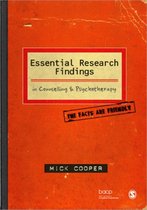
BOOK 1: ESSENTIAL RESEARCH FINDINGS
IN COUNSELING AND PSYCHOTHERAPY
Chapter 1. Introduction: The Challenge of Research
1.1 The value of research
- Research = a systematic process of inquiry that leads to the development of new knowledge
- Empirical = based on concrete experiences or observations, as opposed to purely theoretical
conjecture
- Until the therapist knows which problems a particular client has/what this client wants, it is
useful to look at general results of research as a source of guidance
- Research findings can help practitioners to understand therapy from a clients perspective: even
if he thinks he already knows what the client is experiencing — this belief is often misguided,
especially in the beginning of therapy
> Patient and therapist ratings of therapeutic relationships only show moderate agreement
> In only 30-40% of instances therapists agree with clients on most significant parts of therapy
(often overestimating technical as opposed to relational aspects)
> Therapists are often poor at predicting the outcomes of therapy
> Therapists overestimate their effectiveness: 90% perceive themselves in top 25%
> = Research does not teach but challenge therapists and can shake them out of their own
belief system
- Therapists should be aware of research findings in order to communicate with others and help
consumers understand its value
2.2. The limitations of research
- The stance of this book is to communicate that research findings are like good friends — yet
many therapists are not even acquainted with them
> Only a small amount see research as a useful source, usually they see ‘ongoing experiences
with clients’ as the best information
- It is true that we shouldn’t wholly base therapeutic practice on research, since it always works
with averages that may not align with individual preferences
- Research will also always be influenced by the researchers own assumptions
,PRTP SUMMARY 2018 2
> In 90% of studies, the antipsychotic drug that came out on top was manufactured by the
company sponsoring the research
- Research findings are always arrived at through a particular tool, measure or procedure —
which also influences what we find
> e.g. mental wellbeing defined as ‘lack of mental illness’ or ‘potential for growth’
- Researchers come up with vastly different conclusions on the same data set
- Research is always conducted on a particular sample which may not translate to all populations
- Sample = the collection of participants used in a study, from whom we want to make
generalizations to a wider ‘population’
- Even if it were possible for researchers and research tools to be entirely objective, value-free
and comprehensive — we are still faced with the fact that the scientific method is not an
assumption-free tool
2.3 A research-informed approach to therapy
- Basic premise of this book: therapy should not be research-directed, but research-informed
- Theory, supervisory input and personal experiences and many other factors have a role too:
research is not a superior fount of knowledge
- Evidence-based psychological practice: integration of best available research with clinical
expertise in the context of patient characteristics, culture and preferences (APA)
2.5 Trying to achieve balance
- The author here explains in length his own view on psychotherapy: he says that there is no way
for him to be completely unbiased to this book will represent his point of view to some extend
- He gives away his own preferences so we can take that into account and be critical when
reading:
> He is an advocate of democratic client-therapist relationships (person-centered, existential-,
relational therapies) where the client has a say in the direction of therapy
> He is a bit weary of hierarchical client-therapist relationships (CBT, psychodynamic) where
the therapist is the expert and the client the patient
> Him and his friend work at a pluralistic therapeutic framework: different clients want
different things, which differ across the life-span, from their therapy
- Similarly, he thinks that different forms of research make different contributions at different
times: he doesn’t think its necessary to make an either/or split between quantitative and
qualitative
- Quantitative research = number-based; generally incorporating statistical analysis
- Qualitative research = language-based; experiences, perceptions, observations not reduced to
numerical form
- Methodological pluralism: he draws from both quantitative and qualitative research
,PRTP SUMMARY 2018 3
Chapter 2. The Outcomes of Counseling and
Psychotherapy
2.1 The efficacy of counselling and psychotherapy
- Before and after psychotherapy we see positive effects on objective measures (weight in
Anorexia), but also subjective ones: people feel better after
- This does not mean therapy was responsible for the observed changes (spontaneous
remission) — must include control group waiting for therapy or receiving treatment-as-usual
(GP)
- Efficacy = potential to bring about a desired effect
- Experimental group = individuals who participate in the procedure being tested
- Control group = individuals similar in characteristics to those in experimental group but who do
not participate in the procedure being tested
- Randomization & randomized controlled trials (RCTs) = random allocation of participants to
different conditions (gold standard of research)
> To ensure that individuals in control and experimental group are as similar as possible
- ‘Significant’ difference = to an extent that is almost certainly not due to chance
> P (probability) value: ranges from 0 to 1, with lower values indicating a lower probability that
the experimental results are a product of random variations
> Cutoff p = 0.05 → p values below this → reject hypothesis that results came about by chance
→ differences between conditions are significant
> If p insignificant it does not mean that we have proven no difference in effectiveness between
conditions, only that at the present time we could not find those differences
- So after controlling for time (spontaneous remission) we find the same but to a lesser extend:
people improve over time but more so with therapy (significantly)
- But how do we know its due to active ingredients of therapy and not peoples expectations
(placebo-like effects)
> Included control groups in which participants thought they were receiving a real therapy
when it was just listening and befriending
> Placebo conditions brings out better results than standard care of GP, but active therapy still
better → efficacy of therapy cannot be put down to clients expectations
- Placebo = procedure that, while remaining credible to the patient, lacks the supposedly
effective ingredients
2.2 How much effect does counseling and psychotherapy have?
- To describe how much impact counseling and psychotherapy has researchers usually use a
measure of effect size
- Variable = something that can take on different numerical values
, PRTP SUMMARY 2018 4
- Effect size (ES) = measure of strength of relationship between two variables
> Large effect size → things are strongly linked, small effect size → things are weakly linked
> Most commonly used: Cohen’s d → expresses the amount of difference between scores of
different groups relative to background variation within groups
> (0.2 small | 0.5 moderate | 0.8 large)
> A larger Cohens d usually comes with a significant difference but they are not synonymous:
factors like sample size make it possible to have one without the other
- Correlation = another way of expressing effect sizes; take value between 0 (not related at all)
and +/- 1 (perfectly related)→ appropriate for two continuous variables
- Meta analysis = statistical procedure which brings together findings from similar studies to
estimate overall effects → one of the most reliable sources of information
> Found that effect sizes for counseling and psychotherapeutic practices (compared with no-
treatment control) are somewhere around 0.75-0.85 (large)
- Cohens d of 8.0 can be translated into around 79% of clients who will do better after therapy
than people who did not receive it
- Clinical change = effect sizes do not necessarily translate into the clinical setting → even with a
large effect size, people still may be leaving therapy with larger than desired distress (e.g. if
prestress levels were high)
> Clinically significant improvement = movement from within a range of scores of a clinical
population to a range that is non-clinical (normal)
2.3 Change in the real world: the effectiveness of therapy
- Effectiveness = extent to which an intervention, when used under ordinary circumstances,
brings about a desired effect
- Real people do not fit into the neat recruitment clusters of research → e.g. they have a number
of diagnoses
- There is a difference between efficacy (what difference therapy can make) and effectiveness
(what actual difference it makes)
- Studies of clinically representative (real world) conditions indicate its highly effective (just as
effective as under controlled conditions)
2.4 Do some people get worse in therapy?
- There is a significant minority that does not improve → 5-10% deteriorate in therapy, compared
to less than 5% deterioration rates in non-therapy groups
> Some therapies are harmful, problematic or traumatizing
- Drop out = when client fails to attend schedules visits or withdraws from therapy before
therapist thinks its advisable
> About half of all clients drop out → 1/3 due to dissatisfaction with therapist, 1/3 due to feeling
their problems are sufficiently solved, and 1/3 due to environmental constraints (lack of time)
> Higher rates of drop out among people with lower SES, education, and black/minority status
ELECTIVE SUMMARY: PSYCHOTHERAPY -
RESEARCH, THEROY AND PRACTICE
Renée Lipka, IBP 2019-20
BOOK 1: ESSENTIAL RESEARCH FINDINGS
IN COUNSELING AND PSYCHOTHERAPY
Chapter 1. Introduction: The Challenge of Research
1.1 The value of research
- Research = a systematic process of inquiry that leads to the development of new knowledge
- Empirical = based on concrete experiences or observations, as opposed to purely theoretical
conjecture
- Until the therapist knows which problems a particular client has/what this client wants, it is
useful to look at general results of research as a source of guidance
- Research findings can help practitioners to understand therapy from a clients perspective: even
if he thinks he already knows what the client is experiencing — this belief is often misguided,
especially in the beginning of therapy
> Patient and therapist ratings of therapeutic relationships only show moderate agreement
> In only 30-40% of instances therapists agree with clients on most significant parts of therapy
(often overestimating technical as opposed to relational aspects)
> Therapists are often poor at predicting the outcomes of therapy
> Therapists overestimate their effectiveness: 90% perceive themselves in top 25%
> = Research does not teach but challenge therapists and can shake them out of their own
belief system
- Therapists should be aware of research findings in order to communicate with others and help
consumers understand its value
2.2. The limitations of research
- The stance of this book is to communicate that research findings are like good friends — yet
many therapists are not even acquainted with them
> Only a small amount see research as a useful source, usually they see ‘ongoing experiences
with clients’ as the best information
- It is true that we shouldn’t wholly base therapeutic practice on research, since it always works
with averages that may not align with individual preferences
- Research will also always be influenced by the researchers own assumptions
,PRTP SUMMARY 2018 2
> In 90% of studies, the antipsychotic drug that came out on top was manufactured by the
company sponsoring the research
- Research findings are always arrived at through a particular tool, measure or procedure —
which also influences what we find
> e.g. mental wellbeing defined as ‘lack of mental illness’ or ‘potential for growth’
- Researchers come up with vastly different conclusions on the same data set
- Research is always conducted on a particular sample which may not translate to all populations
- Sample = the collection of participants used in a study, from whom we want to make
generalizations to a wider ‘population’
- Even if it were possible for researchers and research tools to be entirely objective, value-free
and comprehensive — we are still faced with the fact that the scientific method is not an
assumption-free tool
2.3 A research-informed approach to therapy
- Basic premise of this book: therapy should not be research-directed, but research-informed
- Theory, supervisory input and personal experiences and many other factors have a role too:
research is not a superior fount of knowledge
- Evidence-based psychological practice: integration of best available research with clinical
expertise in the context of patient characteristics, culture and preferences (APA)
2.5 Trying to achieve balance
- The author here explains in length his own view on psychotherapy: he says that there is no way
for him to be completely unbiased to this book will represent his point of view to some extend
- He gives away his own preferences so we can take that into account and be critical when
reading:
> He is an advocate of democratic client-therapist relationships (person-centered, existential-,
relational therapies) where the client has a say in the direction of therapy
> He is a bit weary of hierarchical client-therapist relationships (CBT, psychodynamic) where
the therapist is the expert and the client the patient
> Him and his friend work at a pluralistic therapeutic framework: different clients want
different things, which differ across the life-span, from their therapy
- Similarly, he thinks that different forms of research make different contributions at different
times: he doesn’t think its necessary to make an either/or split between quantitative and
qualitative
- Quantitative research = number-based; generally incorporating statistical analysis
- Qualitative research = language-based; experiences, perceptions, observations not reduced to
numerical form
- Methodological pluralism: he draws from both quantitative and qualitative research
,PRTP SUMMARY 2018 3
Chapter 2. The Outcomes of Counseling and
Psychotherapy
2.1 The efficacy of counselling and psychotherapy
- Before and after psychotherapy we see positive effects on objective measures (weight in
Anorexia), but also subjective ones: people feel better after
- This does not mean therapy was responsible for the observed changes (spontaneous
remission) — must include control group waiting for therapy or receiving treatment-as-usual
(GP)
- Efficacy = potential to bring about a desired effect
- Experimental group = individuals who participate in the procedure being tested
- Control group = individuals similar in characteristics to those in experimental group but who do
not participate in the procedure being tested
- Randomization & randomized controlled trials (RCTs) = random allocation of participants to
different conditions (gold standard of research)
> To ensure that individuals in control and experimental group are as similar as possible
- ‘Significant’ difference = to an extent that is almost certainly not due to chance
> P (probability) value: ranges from 0 to 1, with lower values indicating a lower probability that
the experimental results are a product of random variations
> Cutoff p = 0.05 → p values below this → reject hypothesis that results came about by chance
→ differences between conditions are significant
> If p insignificant it does not mean that we have proven no difference in effectiveness between
conditions, only that at the present time we could not find those differences
- So after controlling for time (spontaneous remission) we find the same but to a lesser extend:
people improve over time but more so with therapy (significantly)
- But how do we know its due to active ingredients of therapy and not peoples expectations
(placebo-like effects)
> Included control groups in which participants thought they were receiving a real therapy
when it was just listening and befriending
> Placebo conditions brings out better results than standard care of GP, but active therapy still
better → efficacy of therapy cannot be put down to clients expectations
- Placebo = procedure that, while remaining credible to the patient, lacks the supposedly
effective ingredients
2.2 How much effect does counseling and psychotherapy have?
- To describe how much impact counseling and psychotherapy has researchers usually use a
measure of effect size
- Variable = something that can take on different numerical values
, PRTP SUMMARY 2018 4
- Effect size (ES) = measure of strength of relationship between two variables
> Large effect size → things are strongly linked, small effect size → things are weakly linked
> Most commonly used: Cohen’s d → expresses the amount of difference between scores of
different groups relative to background variation within groups
> (0.2 small | 0.5 moderate | 0.8 large)
> A larger Cohens d usually comes with a significant difference but they are not synonymous:
factors like sample size make it possible to have one without the other
- Correlation = another way of expressing effect sizes; take value between 0 (not related at all)
and +/- 1 (perfectly related)→ appropriate for two continuous variables
- Meta analysis = statistical procedure which brings together findings from similar studies to
estimate overall effects → one of the most reliable sources of information
> Found that effect sizes for counseling and psychotherapeutic practices (compared with no-
treatment control) are somewhere around 0.75-0.85 (large)
- Cohens d of 8.0 can be translated into around 79% of clients who will do better after therapy
than people who did not receive it
- Clinical change = effect sizes do not necessarily translate into the clinical setting → even with a
large effect size, people still may be leaving therapy with larger than desired distress (e.g. if
prestress levels were high)
> Clinically significant improvement = movement from within a range of scores of a clinical
population to a range that is non-clinical (normal)
2.3 Change in the real world: the effectiveness of therapy
- Effectiveness = extent to which an intervention, when used under ordinary circumstances,
brings about a desired effect
- Real people do not fit into the neat recruitment clusters of research → e.g. they have a number
of diagnoses
- There is a difference between efficacy (what difference therapy can make) and effectiveness
(what actual difference it makes)
- Studies of clinically representative (real world) conditions indicate its highly effective (just as
effective as under controlled conditions)
2.4 Do some people get worse in therapy?
- There is a significant minority that does not improve → 5-10% deteriorate in therapy, compared
to less than 5% deterioration rates in non-therapy groups
> Some therapies are harmful, problematic or traumatizing
- Drop out = when client fails to attend schedules visits or withdraws from therapy before
therapist thinks its advisable
> About half of all clients drop out → 1/3 due to dissatisfaction with therapist, 1/3 due to feeling
their problems are sufficiently solved, and 1/3 due to environmental constraints (lack of time)
> Higher rates of drop out among people with lower SES, education, and black/minority status