BACHELOR OF SCIENCE IN NURSING (BSN)
B.SC NURSING
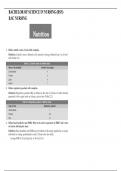
Nutrition
1. Define calorific value of food with examples.
Definition: Calorific value is defined as the amount of energy obtained from 1 g of food-
stuff (Table 12.1).
Table 12.1: Calorific values of different foods
Name of the foodstuff Calorific value (cal/g)
Carbohydrates 4
Proteins 4
Lipids 9
Alcohol 7
2. Define respiratory quotient with examples.
Definition: Respiratory quotient (RQ) is defined as the ratio of volume of carbon dioxide
generated to the oxygen used up during a given time (Table 12.2).
Table 12.2: Respiratory quotient of different foods
Type of food Respiratory quotient
Carbohydrates 1
Proteins 0.8
Fats 0.7
3. Define basal metabolic rate (BMR). What is the unit of expression of BMR? Add a note
on factors affecting the same.
Definition: Basal metabolic rate (BMR) may be defined as the energy required by an awake
individual in resting, postabsorptive state (12 hours after last meal).
Average BMR is 24 kcal/kg/day or 34 kcal/m2/h.
Ch-12.indd 166 21-06-2014 11:51:21
, 761
Factors Affecting BMR
• Age: BMR of children is much higher than adults
• Sex: Women normally have lower BMR than men
• Surface area: BMR is directly proportional to the body surface area
• Climate: In colder climates, the BMR is high and in tropical climates it is proportionately low
• Fever: During febrile states, BMR is high
• Hormones: Thyroid hormones increase BMR.
4. Define specific dynamic action (thermogenic effect of food) with examples.
Definition: Specific dynamic action (SDA) may be defined as the extra heat produced other
than the energy normally generated from a particular amount of food. This 'extra heat' is
derived from energy reserves of the body. It is used for the metabolic interconversions of
food in the liver before it can be used by the body (Table 12.3).
Nutrition
Table 12.3: SDA of different foods
Type of diet Specific dynamic action (SDA)
Proteins 30%
Carbohydrates 15%
Fats 5%
Mixed diet 10%
5. What are dietary fibers? Why are they important?
Definition: Dietary fibers are non-digestible/non-absorbable carbohydrates in diet. Aver-
age intake of these should be 15–25 g/day. For example, cellulose, hemicellulose, lignin,
pectin, etc.
Functions of Dietary Fibers
• Increase peristalsis and prevent constipation
• Increase bile acid excretion
• Increase cholesterol excretion
• Prevent colon cancer
• Improve glucose tolerance
• Act as an antioxidant.
Ch-12.indd 167 21-06-2014 11:51:21
B.SC NURSING
Nutrition
1. Define calorific value of food with examples.
Definition: Calorific value is defined as the amount of energy obtained from 1 g of food-
stuff (Table 12.1).
Table 12.1: Calorific values of different foods
Name of the foodstuff Calorific value (cal/g)
Carbohydrates 4
Proteins 4
Lipids 9
Alcohol 7
2. Define respiratory quotient with examples.
Definition: Respiratory quotient (RQ) is defined as the ratio of volume of carbon dioxide
generated to the oxygen used up during a given time (Table 12.2).
Table 12.2: Respiratory quotient of different foods
Type of food Respiratory quotient
Carbohydrates 1
Proteins 0.8
Fats 0.7
3. Define basal metabolic rate (BMR). What is the unit of expression of BMR? Add a note
on factors affecting the same.
Definition: Basal metabolic rate (BMR) may be defined as the energy required by an awake
individual in resting, postabsorptive state (12 hours after last meal).
Average BMR is 24 kcal/kg/day or 34 kcal/m2/h.
Ch-12.indd 166 21-06-2014 11:51:21
, 761
Factors Affecting BMR
• Age: BMR of children is much higher than adults
• Sex: Women normally have lower BMR than men
• Surface area: BMR is directly proportional to the body surface area
• Climate: In colder climates, the BMR is high and in tropical climates it is proportionately low
• Fever: During febrile states, BMR is high
• Hormones: Thyroid hormones increase BMR.
4. Define specific dynamic action (thermogenic effect of food) with examples.
Definition: Specific dynamic action (SDA) may be defined as the extra heat produced other
than the energy normally generated from a particular amount of food. This 'extra heat' is
derived from energy reserves of the body. It is used for the metabolic interconversions of
food in the liver before it can be used by the body (Table 12.3).
Nutrition
Table 12.3: SDA of different foods
Type of diet Specific dynamic action (SDA)
Proteins 30%
Carbohydrates 15%
Fats 5%
Mixed diet 10%
5. What are dietary fibers? Why are they important?
Definition: Dietary fibers are non-digestible/non-absorbable carbohydrates in diet. Aver-
age intake of these should be 15–25 g/day. For example, cellulose, hemicellulose, lignin,
pectin, etc.
Functions of Dietary Fibers
• Increase peristalsis and prevent constipation
• Increase bile acid excretion
• Increase cholesterol excretion
• Prevent colon cancer
• Improve glucose tolerance
• Act as an antioxidant.
Ch-12.indd 167 21-06-2014 11:51:21