
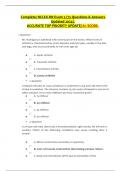
Complete; NCLEX-RN Exam 5 (75 Questions & Answers Updated 2024). ACCURATE TOP PRIORITY UPDATE| A+ SCORE.
Complete; NCLEX-RN Exam 5 (75 Questions & Answers Updated 2024). ACCURATE TOP PRIORITY UPDATE| A+ SCORE. 1. Question Mr. Rodriguez is admitted with severe pain in the knees. Which form of arthritis is characterized by urate deposits and joint pain, usually in the feet and legs, and occurs primarily in men over age 30? o A. Septic arthritis o B. Traumatic arthritis o C. Intermittent arthritis o D. Gouty arthritis • 2. Question A heparin infusion at 1,500 units/hour is ordered for a 64-year-old client with stroke in evolution. The infusion contains 25,000 units of heparin in 500 ml of saline solution. How many milliliters per hour should be given? o A. 15 ml/hour o B. 30 ml/hour o C. 45 ml/hour o D. 50 ml/hour • 3. Question A 76-year-old male client had a thromboembolic right stroke; his left arm is swollen. Which of the following conditions may cause swelling after a stroke? o A. Elbow contracture secondary to spasticity. o B. Loss of muscle contraction decreasing venous return. o C. Deep vein thrombosis (DVT) due to immobility of the ipsilateral side. o D. Hypoalbuminemia due to protein escaping from an inflamed glomerulus. • 4. Question Heberden’s nodes are a common sign of osteoarthritis. Which of the following statements is correct about this deformity? o A. It appears only in men. o B. It appears on the distal interphalangeal joint. o C. It appears on the proximal interphalangeal joint. o D. It appears on the dorsolateral aspect of the interphalangeal joint. • 5. Question Which of the following statements explains the main difference between rheumatoid arthritis and osteoarthritis? o A. Osteoarthritis is gender-specific, rheumatoid arthritis isn’t. o B. Osteoarthritis is a localized disease rheumatoid arthritis is systemic. o C. Osteoarthritis is a systemic disease, rheumatoid arthritis is localized. o D. Osteoarthritis has dislocations and subluxations, rheumatoid arthritis doesn’t. • 6. Question Mrs. Cruz uses a cane for assistance in walking. Which of the following statements is true about a cane or other assistive devices? o A. A walker is a better choice than a cane. o B. The cane should be used on the affected side. o C. The cane should be used on the unaffected side. o D. A client with osteoarthritis should be encouraged to ambulate without the cane. • 7. Question A male client with type 1 diabetes is scheduled to receive 30 U of 70/30 insulin. There is no 70/30 insulin available. As a substitution, the nurse may give the client: o A. 9 U regular insulin and 21 U neutral protamine Hagedorn (NPH). o B. 21 U regular insulin and 9 U NPH. o C. 10 U regular insulin and 20 U NPH. o D. 20 U regular insulin and 10 U NPH. • 8. Question Nurse Len should expect to administer which medication to a client with gout? o A. Aspirin o B. Furosemide (Lasix) o C. Colchicines o D. Calcium gluconate (Kalcinate) • 9. Question Mr. Domingo with a history of hypertension is diagnosed with primary hyperaldosteronism. This diagnosis indicates that the client’s hypertension is caused by excessive hormone secretion from which of the following glands? o A. Adrenal cortex o B. Pancreas o C. Adrenal medulla o D. Parathyroid • 10. Question For a diabetic male client with a foot ulcer, the doctor orders bed rest, a wet to- dry dressing change every shift, and blood glucose monitoring before meals and bedtime. Why are wet-to-dry dressings used for this client? o A. They contain exudate and provide a moist wound environment. o B. They protect the wound from mechanical trauma and promote healing. o C. They debride the wound and promote healing by secondary intention. o D. They prevent the entrance of microorganisms and minimize wound discomfort. • 11. Question Nurse Zeny is caring for a client in an acute Addisonian crisis. Which laboratory data would the nurse expect to find? o A. Hyperkalemia o B. Reduced blood urea nitrogen (BUN) o C. Hypernatremia o D. Hyperglycemia • 12. Question A client is admitted for treatment of the syndrome of inappropriate antidiuretic hormone (SIADH). Which nursing intervention is appropriate? o A. Infusing I.V. fluids rapidly as ordered. o B. Encouraging increased oral intake. o C. Restricting fluids. o D. Administering glucose-containing I.V. fluids as ordered. • 13. Question A female client tells nurse Nikki that she has been working hard for the last 3 months to control her type 2 diabetes mellitus with diet and exercise. To determine the effectiveness of the client’s efforts, the nurse should check: o A. Urine glucose level. o B. Fasting blood glucose level. o C. Serum fructosamine level. o D. Glycosylated hemoglobin level. • 14. Question Nurse Trinity administered neutral protamine Hagedorn (NPH) insulin to a diabetic client at 7 a.m. At what time would the nurse expect the client to be most at risk for a hypoglycemic reaction? o A. 10:00 am o B. Noon o C. 4:00 pm o D. 10:00 pm • 15. Question The adrenal cortex is responsible for producing which substances? o A. Glucocorticoids and androgens o B. Catecholamines and epinephrine o C. Mineralocorticoids and catecholamines o D. Norepinephrine and epinephrine • 16. Question On the third day after a partial thyroidectomy, Proserfina exhibits muscle twitching and hyperirritability of the nervous system. When questioned, the client reports numbness and tingling of the mouth and fingertips. Suspecting a life-threatening electrolyte disturbance, the nurse notifies the surgeon immediately. Which electrolyte disturbance most commonly follows thyroid surgery? o A. Hypocalcemia o B. Hyponatremia o C. Hyperkalemia o D. Hypermagnesemia • 17. Question Which laboratory test value is elevated in clients who smoke and can’t be used as a general indicator of cancer? o A. Acid phosphatase level o B. Serum calcitonin level o C. Alkaline phosphatase level o D. Carcinoembryonic antigen level • 18. Question Francis with anemia has been admitted to the medical-surgical unit. Which assessment findings are characteristic of iron- deficiency anemia? o A. Nights sweats, weight loss, and diarrhea o B. Dyspnea, tachycardia, and pallor o C. Nausea, vomiting, and anorexia o D. Itching, rash, and jaundice • 19. Question In teaching a female client who is HIV-positive about pregnancy, the nurse would know more teaching is necessary when the client says: o A. The baby can get the virus from my placenta.” o B. “I’m planning on starting on birth control pills.”
Información del documento
- Subido en
- 2 de junio de 2024
- Número de páginas
- 27
- Escrito en
- 2023/2024
- Tipo
- Examen
- Contiene
- Preguntas y respuestas

