MEA 130 NCSU Exam 1 Questions and Answers with complete solution
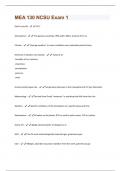
Earth's axis tilt - 23.5° Atmosphere - Thin gaseous envelope, 99% within 30km, protects from uv Climate - "Average weather" or mean conditions over extended period of time Elements of weather and climate - -temp of air -humidity of air, moisture -cloudiness -precipitation -pressure -wind Environmental lapse rate - Temperature decrease in the troposphere (6.5°C per kilometer) Meteorology - Derived from Greek "meteoros" or anything that falls from their sky Weather - Specific conditions of the atmosphere at a specific place and time Hydrosphere - All water on the planet, 97% or earth's water covers 71% or surface Ozone O3 - 40ppb, photoreceptor of dangerous uv H2O - 0 to 4% most meteorologically important gas, greenhouse gas CO2 - 390ppm, absorbes long wave radiation from the earth, greenhouse gasArgon - ~1% Nitrogen - 78% of atmosphere Troposphere - Greek "Tropein" turn or change, air is mixed well, most weather occurs here Radiosonde - Sent up in atmosphere to collect data Stratosphere - Stratified, not well mixed, temp inversion increase with height Tropopause - Isothermal layer, Around 12km "Equal tempature" separates troposphere from stratosphere Solar Elevation angle - Greek B, omega is latitude, N is Julian day of the year Temperature - Degree of hotness or coldness, generally decreases with height, is a form of kinetic energy Moisture - Measure of water content, relativetc humidity, dewpoint Synoptic - "Seen together" weather on map nationwide (thing with them dot and the numbers around it) Heat waves - #1 killer in average year, #2 is floods Hydrological (water) cycle - Evaporation, sublimation, transpiration, condensation, deposition, precipitationOxygen O2 - 21% of atmosphere Montreal Protocol - 1987 International agreement to stop chlorofluorocarbon (CFO) emmisions which degrade O3 Pressure - Weight of the atmosphere above a given point, always decreases with height Solar Radiation - Knowing the solar elevation angle calculate, J measure of intensity of solar radiation in watts per Sq m Summer solstice - (For us north hemi) sun at highest in sky, more than 12hr sunlight, directly overhead at 23.5°N Winter Solstice - Sun lowest in sky, less than 12 hr sunlight Equinox - Equal night, Autumnal and Vernal, 12hr or light and dark everywhere, sun directly overhead at equator Energy - Capacity to do work, potential (virtue of position) and kinetic (virtue of motion) Heat - Energy in process of being transfered between or within substance, hot->cold Conduction - Transfer of heat by molecular activity, larger temp faster transfer, solids are good conductors, air is poor, only occurs at earth's surface Convection - Vertical transfer of heat by mass movement of fluid Advection - Horizontal transfer of heatRadiation - Propagation of heat through electromagnetic waves, does not need medium, only release when striking object, occurs at speed of light, as wavelength decreases energy increases UV-Rays - A sunburn, B sunburn and skin cancer, C most harmful absorbed by O3 Stefan-Boltzman Law - E=oT^4 All objects emit radiant energy Wiens Displacement Law - Max wavelength = Constant/ Temp Hotter means shorter wavelength Kirchhoffs Law - Objects good at emiting and absorbing radiation at same wavelength Blackbodies - Both emit and absorb all radiation possible, atmosphere is not, sun and earth are close at 70-90% Latitude - Horizontal slices of earth, major controller of temperature along with ocean currents, altitude, geographic position, cloud cover, and different heating between land and water Specific Heat - Amount of heat needed to raise temperature of 1g by 1°C, land heats 3x faster than water Thermister - Temperature by flow of electricity, used on radiosondes Absolute zero - Lowest temperature possible, all molecules stop moving, 0K -273C -459F Degree Days - Take away 65 from average
Escuela, estudio y materia
- Institución
- MEA 130 NCSU
- Grado
- MEA 130 NCSU
Información del documento
- Subido en
- 1 de junio de 2024
- Número de páginas
- 4
- Escrito en
- 2023/2024
- Tipo
- Examen
- Contiene
- Preguntas y respuestas
Temas

Documento también disponible en un lote