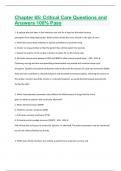
Chapter 65: Critical Care Questions and Answers 100% Pass
Chapter 65: Critical Care Questions and Answers 100% Pass 1. A patient who has been in the intensive care unit for 4 days has disturbed sensory perception from sleep deprivation. Which action should the nurse include in the plan of care? a. Administer prescribed sedatives or opioids at bedtime to promote sleep. b. Cluster nursing activities so that the patient has uninterrupted rest periods. c. Silence the alarms on the cardiac monitors to allow 30- to 40-minute naps. d. Eliminate assessments between 2200 and 0600 to allow uninterrupted sleep. - ANS- ANS: B Clustering nursing activities and providing uninterrupted rest periods will minimize sleep-cycle disruption. Sedative and opioid medications tend to decrease the amount of rapid eye movement (REM) sleep and can contribute to sleep disturbance and disturbed sensory perception. Silencing the alarms on the cardiac monitors would be unsafe in a critically ill patient, as would discontinuing all assessments during the night. 2. Which hemodynamic parameter best reflects the effectiveness of drugs that the nurse gives to reduce a patient's left ventricular afterload? a. Mean arterial pressure (MAP) b. Systemic vascular resistance (SVR) c. Pulmonary vascular resistance (PVR) d. Pulmonary artery wedge pressure (PAWP) - ANS- ANS: B SVR reflects the resistance to ventricular ejection, or afterload. The other parameters may be monitored but do not reflect afterload as directly. 3. While close family members are visiting, a patient has a respiratory arrest, and resuscitation is started. Which action by the nurse is best? a. Tell the family members that watching the resuscitation will be very stressful. b. Ask family members if they wish to remain in the room during the resuscitation. c. Take the family members quickly out of the patient room and remain with them. d. Assign a staff member to wait with family members just outside the patient room. - ANS- ANS: B Evidence indicates that many family members want the option of remaining in the room during procedures such as cardiopulmonary resuscitation (CPR) and that this decreases anxiety and facilitates grieving. The other options may be appropriate if the family decides not to remain with the patient. 4. After surgery for an abdominal aortic aneurysm, a patient's central venous pressure (CVP) monitor indicates low pressures. Which action should the nurse take? a. Administer IV diuretic medications. b. Increase the IV fluid infusion per protocol. c. Increase the infusion rate of IV vasodilators. d. Elevate the head of the patient's bed to 45 degrees. - ANS- ANS: B A low CVP indicates hypovolemia and a need for an increase in the infusion rate. Diuretic administration will contribute to hypovolemia and elevation of the head or increasing vasodilators may decrease cerebral perfusion. 5. When caring for a patient with pulmonary hypertension, which parameter will the nurse use to directly evaluate the effectiveness of the treatment? a. Central venous pressure (CVP) b. Systemic vascular resistance (SVR) c. Pulmonary vascular resistance (PVR) d. Pulmonary artery wedge pressure (PAWP) - ANS- ANS: C PVR is a major contributor to pulmonary hypertension, and a decrease would indicate that pulmonary hypertension was improving. The other parameters may also be monitored but do not directly assess for pulmonary hypertension. 6. The intensive care unit (ICU) nurse educator determines that teaching a new staff nurse about arterial pressure monitoring has been effective when the nurse a. balances and calibrates the monitoring equipment every 2 hours. b. positions the zero-reference stopcock line level with the phlebostatic axis. c. ensures that the patient is supine with the head of the bed flat for all readings. d. rechecks the location of the phlebostatic axis with changes in the patient's position. - ANS- ANS: B For accurate measurement of pressures, the zero-reference level should be at the phlebostatic axis. There is no need to rebalance and recalibrate monitoring equipment every 2 hours. Accurate hemodynamic readings are possible with the patient's head raised to 45 degrees or in the prone position. The anatomic position of the phlebostatic axis does not change when patients are repositioned. 7. When monitoring the effectiveness of treatment for a patient with a large anterior wall myocardial infarction, the most pertinent measurement for the nurse to obtain is a. central venous pressure (CVP). b. systemic vascular resistance (SVR). c. pulmonary vascular resistance (PVR).
Información del documento
- Subido en
- 28 de mayo de 2024
- Número de páginas
- 20
- Escrito en
- 2023/2024
- Tipo
- Examen
- Contiene
- Preguntas y respuestas