

1-1 CHAPTER 1 ACCOUNTING INFORMATION SYSTEMS: AN OVERV IEW SUGGESTED ANSWERS TO DISCUSSION QUESTIONS 1.1 The value of information is the difference between the benefits realized from using that information and the costs of producing it. Would you, or any organization, ever produce information if its expected costs exceeded its benefits? If so, provide some examples. If not, why not? Most organizations produce information only if its value exceeds its cost. However, there are two situations where information may be produced even if its cost exceeds its value. a. It is often difficult to estimate accurately the value of information and the cost of producing it. Therefore, organizations may produce information that they expect will produce benefits in excess of its costs, only to be disappointed after the fact. b. Production of the information may be mandated by either a government agency or a private organization. Examples include the tax reports required by the IRS and disclosure requirements for financial reporting. 1.2 Can the characteristics of useful information listed in Table 1 -1 be met simultaneously? Or does achieving one mean sacrificing another? Several of the criteria in Table 1. 1 can be met simultaneously . For example, more timely information is also likely to be more relevant. Verifiable information is likely to be more reliable. However, achieving one objective may require sacrificing another. For example, ensuring that information is more complete may reduce its timeliness. Similarly, increased verifiability and reliability may reduce its timeliness. The decision maker must decide which trade-offs are warranted in a given situation. Ch. 1: Accounting Information Systems: An Overview 1-2 1.3 You and a few of your classmates decided to become entrepreneurs. You came up with a great idea for a new mobile phone application that you think will make lots of money. Your business pl an won second place in a local competition, and you are using the $10,000 prize to support yourselves as you start your company. a. Identify the key decisions you need to make to be successful entrepreneurs, the information you need to make them, and the bus iness processes you will need to engage in. b. Your company will need to exchange information with various external parties. Identify the external parties, and specify the inform ation received from and sent to each of them . The author turns this question i nto an in- class group activity. Students are divided up in groups, told to close their books, and given 15 minutes to: a. Think through the business processes, key decisions, and information needs issues in their group. b. Identify the external users of info rmation and specify the information received from and sent to each of them. One group is selected to present their answers to the class. The other groups are told to challenge the group’s answers, provide alternative answers, and chip in with additional answers not provided by the selected group. Since the group that presents is not selected until after the time has expired, students are motivated to do a good job, as they will be presenting to their peers. The value of this activity is not in arriving at a “right answer” as there are many right answers and student answers will vary. Instead, it is in thinking through the issues presented in Table 1-2 (business processes, key decisions, and information needs) and Figure 1-1 (interactions with external parties). Student answers should contain many of the things in Table 1-2 and Figure 1- 1 as well as others not shown, as a retail operation differs from an application development enterprise. The author conc ludes the exercise by having the students turn to Table 1-2 and Figure 1-1 while he emphasizes the need for owners, managers, and employees of organizations to identify the information needed to make key decisions in the company’s business processes and th e key information interchanges with external parties. All of the data needed to produce this information must be entered into the AIS, processed, stored, protected, and made available to the appropriate users. While this active learning activity takes m ore time than a lecture does, it drives the point home much better than a lecture would. It also keeps the students more engaged in the material. Accounting Information Systems 1-3 1.4 How do an organization’s business processes and lines of business affect the design of its AIS? Give several examples of how differences among organizations are reflected in their AIS. An organization’s AIS must reflect its business processes and its line of business. For example: · Manufacturing companies will need a set of procedures and documents for the production cycle; non -manufacturing companies do not. · Government agencies need procedures to track separately all inflows and outflows from various funds, to ensure that legal requirements about the use of specific funds are followed. · Financial institutions do not need extensive inventory control systems. · Passenger service companies (e.g., airlines, bus, and trains) generally receive payments in advance of providing services. Therefore, extensive billing and accounts receivable procedures are not needed; instead, they must develop procedures to account for prepaid revenue. · Construction firms typically receive payments at regular intervals, based on the percentage of work completed. Thus, their revenue cycles must be designed to track carefully all work performed and the amount of work remaining to be done. · Service companies (e.g., public accounting and law firms) do not sell physical goods and, therefore, do not need inventory control systems. They must develop and maintain detailed record s of the work performed for each customer to provide backup for the amounts billed. Tracking individual employee time is especially important for these firms because labor is the major cost component. 1.5 Figure 1 -4 shows that organizational culture and t he design of an AIS influence one another. What does this imply about the degree to which an innovative system developed by one company can be transferred to another company? Since people are one of the basic components of any system, it will always be difficult to transfer successfully a specific information systems design intact to another organization. Considering in advance how aspects of the new organizational culture are likely to affect acceptance of the system can increase the chances for successful transfer . Doing so may enable the organization to take steps to mitigate likely causes of resistance. The design of an AIS, however, itself can influence and change an organization’s culture and philosophy. Therefore, with adequate top management support, implementation of a new AIS can be used as a vehicle to change an organization. The reciprocal effects of technology and organizational culture on one another, however, mean that it is unrealistic to expect that the introduction of a new AIS will produce the same results observed in another organization. Ch. 1: Accounting Information Systems: An Overview 1-4 1.6 Figure 1 -4 shows that developments in IT affect both an organization’s strategy and the design of its AIS. How can a company determine whether it is spending too much, too little, or just en ough on IT? There is no easy answer to this question . Although a company can try to identify the benefits of a new IT initiative and compare those benefits to the associated costs, this is often easier said than done. Usually, it is difficult to measure precisely the benefits of new uses of IT . Nevertheless, companies should gather as much data as possible about changes in market share, sales trends, cost reductions, and other results that can plausibly be associated with an IT initiative and that were predicted in the planning process. 1.7 Apply the value chain concept to S&S. Explain how it would perform the various primary and support activities. The value chain classifies business activities into two categories: primary and support. The five primary activities at S&S: a. Inbound logistics includes all processes involved in ordering, receiving , and temporarily storing merchandise that is going to be sold to S&S customers. b. S&S does not manufacture any goods, thus its operations activities consists of displaying merchandise for sale and protecting it from theft. c. Outbound logistics includes delivering the products to the customer. d. Sales & marketing includes ringing up and processing all sales transactions and advertising products to increase sa les. e. Service includes repairs, periodic maintenance, and all other post- sales services offered to customers. The four support activities at S&S: a. Firm infrastructure includes the accounting, finance, legal , and general administration functions required to start and maintain a business. b. Human resource management includes recruiting, hiring, training, evaluating, compensating, and dismissing employees. c. Technology includes all investments in computer technology and various input/output devices, such as point -of-sale scanners. It also includes all support activities for the technology. d. Purchasing includes all processes involved in identifying and selecting vendors to supply goods and negotiating the best prices, terms, and support from those suppliers.
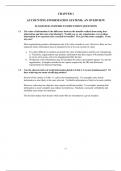
Voorbeeld 4 van de 746 pagina's
Tentamen (uitwerkingen)
Instructor Solution Manual for Accounting Information Systems, 12E
Voorbeeld 4 van de 746 pagina's
Instructor Solution Manual for Accounting Information Systems, 12E
Voorbeeld van de inhoud
Documentinformatie
- Geüpload op
- 28 mei 2024
- Aantal pagina's
- 746
- Geschreven in
- 2023/2024
- Type
- Tentamen (uitwerkingen)
- Bevat
- Vragen en antwoorden
$18.99
Verkeerd document? Gratis ruilen
Binnen 14 dagen na aankoop en voor het downloaden kun je een ander document kiezen. Je kunt het bedrag gewoon opnieuw besteden.
Geschreven door studenten die geslaagd zijn
Direct beschikbaar na je betaling
Online lezen of als PDF

De reputatie van een verkoper is gebaseerd op het aantal documenten dat iemand tegen betaling verkocht heeft en de beoordelingen die voor die items ontvangen zijn. Er zijn drie niveau’s te onderscheiden: brons, zilver en goud. Hoe beter de reputatie, hoe meer de kwaliteit van zijn of haar werk te vertrouwen is.

