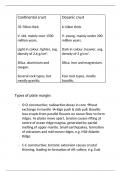
Continental crust Oceanic crust
35-70km thick 6-10km thick
V. old, mainly over 1500 V. young, mainly under 200
million years. million years.
Light in colour, lighter, avg. Dark in colour, heavier, avg.
density of 2.6 g/cm3. density of 3 g/cm3.
Silica, aluminium and Silica, iron and magnesium.
oxygen.
Several rock types, but Few rock types, mostly
mostly granitic. basaltic.
Types of plate margin:
- O-O constructive; radioactive decay in core heat
exchange in mantle ridge push & slab pull. Basaltic
lava erupts from parallel fissures on ocean floor to form
ridges. As plates move apart, tension causes rifting at
centre of ocean ridge magma, generated by partial
melting of upper mantle. Small earthquakes, formation
of volcanoes and mid-ocean ridges, e.g. Mid-Atlantic
Ridge.
- C-C constructive; tectonic extension causes crustal
thinning, leading to formation of rift valleys, e.g. East
, African Rift Valley. Magma can penetrate thinned,
faulted crust.
- C-C destructive (collision); low density crust crumples
under compression, creating fold mountains at major
fault zones, e.g. Himalayas.
- O-C destructive; friction between subducting oceanic
plate and overlying plate leads to inclined zone of EQ
generation called Benioff Zone (can extend to 600km
deep). Melting of furthest part of subducting plate leads
to formation of andesitic magmas and violent volcanic
activity. E.g. Pacific Ring of Fire.
- O-O destructive; violent volcanic and EQ activity, and
formation of island arcs, e.g. Aleutian Islands, SW of
Alaska.
- Conservative; plates slowly slide past each other in
opposite directions or at different speeds. Friction builds
as plates snag and grind on one another, and parts of
fault line ‘lock’. Eventually plates buckle under stress,
leading to infrequent but major EQs as shock waves are
sent through crust. E.g. San Andreas Fault – Pacific plate
is moving NW at faster rate than North American plate.
Theories of movement:
, Convection currents – radioactive decay in core, heat
exchange in mantle whereby magma rises to the
surface, before spreading out at mid-ocean ridges.
Dragging theory – plates are subducted by their oldest
edges, which have cooled down and become heavier
(plates are hot at mid-ocean ridge but get cooler as they
move away). As they descend at trenches, pressure
causes the rock to change and become denser, pulling
the rest of the plate with them.
Hotspots – plumes of lava that rise vertically through the
mantle. Most found near plate margins and may be
responsible for initial rifting of crust. BUT can also be
found away from margins, e.g. Hawaiian hotspot.
Outward flow of viscous rock from centre may create a
drag force on the plates, causing movement.
Sea-floor spreading:
- Discovery of symmetrical magnetic anomalies across
either side of Mid-Atlantic Ridge.
- Only explanation for these magnetic anomalies was
creation of new oceanic crust and consequent sea-floor
spreading.
- When lava cools on sea floor, magnetic grains in the
rock acquire direction of Earth’s magnetic field at time
of cooling (paleomagnetism).
- Slow-spreading ridges (like M-A) have pronounced rift
down the centre. They are fed by discontinuous magma
chambers, allowing for eruption of wide range of
basaltic lava types.
35-70km thick 6-10km thick
V. old, mainly over 1500 V. young, mainly under 200
million years. million years.
Light in colour, lighter, avg. Dark in colour, heavier, avg.
density of 2.6 g/cm3. density of 3 g/cm3.
Silica, aluminium and Silica, iron and magnesium.
oxygen.
Several rock types, but Few rock types, mostly
mostly granitic. basaltic.
Types of plate margin:
- O-O constructive; radioactive decay in core heat
exchange in mantle ridge push & slab pull. Basaltic
lava erupts from parallel fissures on ocean floor to form
ridges. As plates move apart, tension causes rifting at
centre of ocean ridge magma, generated by partial
melting of upper mantle. Small earthquakes, formation
of volcanoes and mid-ocean ridges, e.g. Mid-Atlantic
Ridge.
- C-C constructive; tectonic extension causes crustal
thinning, leading to formation of rift valleys, e.g. East
, African Rift Valley. Magma can penetrate thinned,
faulted crust.
- C-C destructive (collision); low density crust crumples
under compression, creating fold mountains at major
fault zones, e.g. Himalayas.
- O-C destructive; friction between subducting oceanic
plate and overlying plate leads to inclined zone of EQ
generation called Benioff Zone (can extend to 600km
deep). Melting of furthest part of subducting plate leads
to formation of andesitic magmas and violent volcanic
activity. E.g. Pacific Ring of Fire.
- O-O destructive; violent volcanic and EQ activity, and
formation of island arcs, e.g. Aleutian Islands, SW of
Alaska.
- Conservative; plates slowly slide past each other in
opposite directions or at different speeds. Friction builds
as plates snag and grind on one another, and parts of
fault line ‘lock’. Eventually plates buckle under stress,
leading to infrequent but major EQs as shock waves are
sent through crust. E.g. San Andreas Fault – Pacific plate
is moving NW at faster rate than North American plate.
Theories of movement:
, Convection currents – radioactive decay in core, heat
exchange in mantle whereby magma rises to the
surface, before spreading out at mid-ocean ridges.
Dragging theory – plates are subducted by their oldest
edges, which have cooled down and become heavier
(plates are hot at mid-ocean ridge but get cooler as they
move away). As they descend at trenches, pressure
causes the rock to change and become denser, pulling
the rest of the plate with them.
Hotspots – plumes of lava that rise vertically through the
mantle. Most found near plate margins and may be
responsible for initial rifting of crust. BUT can also be
found away from margins, e.g. Hawaiian hotspot.
Outward flow of viscous rock from centre may create a
drag force on the plates, causing movement.
Sea-floor spreading:
- Discovery of symmetrical magnetic anomalies across
either side of Mid-Atlantic Ridge.
- Only explanation for these magnetic anomalies was
creation of new oceanic crust and consequent sea-floor
spreading.
- When lava cools on sea floor, magnetic grains in the
rock acquire direction of Earth’s magnetic field at time
of cooling (paleomagnetism).
- Slow-spreading ridges (like M-A) have pronounced rift
down the centre. They are fed by discontinuous magma
chambers, allowing for eruption of wide range of
basaltic lava types.