Thermodynamics (Chapter 12)-Questions and Answers Graded A+
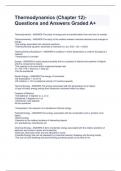
Thermodynamics (Chapter 12)-Questions and Answers Graded A+ Thermodynamics - ANSWER-The study of energy and its transformation from one form to another. Thermochemistry - ANSWER-The study of the relation between chemical reactions and changes in energy. -The energy associated with chemical reactions. -Thermochemical equation: describes a chemical rxn. (ex: 2H2 + O2 - 2H2O Thermochemical Equilibrium - ANSWER-A condition in which temperature is uniform throughout a material. -Temperature is constant Energy - ANSWER-A scalar physical quantity that is a property of objects and systems of objects which is conserved by nature. -The capacity to do work and/or supply/exchange heat -E = KE + PE = Work (w) + Heat (q) -Can be transferred Kinetic Energy - ANSWER-The energy of movement. -KE (translation) = 1/2 mv^2 -KE (rotation) = 1/2 w (rotational velocity) i^2 (inertia squared) Thermal Energy - ANSWER-The energy associated with the temperature of an object. -A type of kinetic energy arising from molecular movement within an object. Freedom of Motions: -Translational: 3 degrees (x, y, or z) -Rotational: 2 degrees (x or y) -Vibrational: multi degrees. All are quantized. -Temperature: the measure of a substance's thermal energy Potential Energy - ANSWER-The energy associated with the composition and or position of an object. -Stored energy -Depends on the relative locations of interacting objects -Ex: gravitational, mechanical, etc. Chemical Energy - ANSWER-A form of potential energy associated with the relative positions of electrons and nuclei in atoms and molecules. -Electrons repel each other and are attracted to nuclei -Potential Energy that can be released by a chemical reaction (breaking and forming bonds) -The sum of bond breaking and bond forming processes gives us the heat of rxn Law of Conservation of Energy - ANSWER-Energy cannot be created or destroyed; it can be converted from one form to another.
Escuela, estudio y materia
- Institución
- THERMODYNAMICS
- Grado
- THERMODYNAMICS
Información del documento
- Subido en
- 24 de mayo de 2024
- Número de páginas
- 115
- Escrito en
- 2023/2024
- Tipo
- Examen
- Contiene
- Preguntas y respuestas
Temas
- thermochemistry
- kinetic energy
- potential energy
- chemical energy
- aerodynamics
- reaction energy
- thermometer
-
classical thermodynamics
-
the caloric theory
-
equ
-
thermodynamics chapter 12 questions and answers

Documento también disponible en un lote