
Jen Leik Fnp Practice Questions
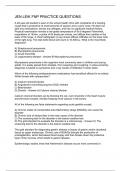
A 28-year-old student is seen in the school health clinic with complaints of a hacking cough that is productive of small amounts of sputum and a runny nose. He does not take any medications, denies any allergies, and has no significant medical history. Physical examination reveals a low-grade temperature of 99.9 degrees Fahrenheit, respirations of 16/min, a pulse of 90 beats per minute, and diffuse fine crackles in the base of the lungs. A chest radiograph (x-ray) shows diffuse infiltrates on the lower lobe of the right lung. The total white blood cell count is 10,500/uL. What is the most likely diagnosis? A) Streptococcal pneumonia B) Mycoplasma pneumonia C) Acute bronchitis D) Legionnaires disease - Answer-B) Mycoplasma pneumonia Mycoplasma pneumonia is the organism most commonly seen in children and young adults. It is easily spread from droplets, from sneezing and coughing, in close proximity. Diagnosis is based on symptoms and x-ray results of infiltrates in lower lobes. Which of the following antihypertensive medications has beneficial effects for an elderly White female with osteoporosis? A) Calcium channel blocker B) Angiotensin-converting enzyme (ACE) inhibitor C) Beta-blocker D) Diuretic - Answer-A) Calcium channel blocker Calcium channel blockers act by blocking the cal- cium channels in the heart muscle and the blood vessels, thereby keeping more calcium in the bones. All of the following are false statements regarding acute gastritis except: A) Chronic intake of nonsteroidal anti-inflammatory drugs (NSAIDs) can cause the disorder B) Chronic lack of dietary fiber is the main cause of the disorder C) The screening test for the disorder is the barium swallow test D) The gold standard to evaluate the disorder is a colonoscopy - Answer-C) The screening test for the disorder is the barium swallow test The gold standard for diagnosing gastric disease is biopsy of gastric and/or duodenal tissue by upper endoscopy. Chronic use of NSAIDs disrupts the production of prostaglandins, which decreases blood supply and then breaks down the protective layer of the mucosa, which leads to gastric disease. Epidemiologi
Información del documento
- Subido en
- 24 de mayo de 2024
- Número de páginas
- 44
- Escrito en
- 2023/2024
- Tipo
- Examen
- Contiene
- Preguntas y respuestas

