
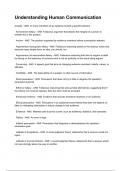
Understanding Human Communication Questions and answers
Understanding Human Communication Argumentum ad populum fallacy - ANS Fallacious reasoning based on the dubious notion that because many people favor an idea, you should, too. Argumentum ad verecundiam fallacy - ANS Fallacious reasoning that tries to support a belief by relying on the testimony of someone who is not an authority on the issue being argued. Convincing - ANS A speech goal that aims at changing audience members; beliefs, values, or attitudes. Credibility - ANS The believability of a speaker or other source of information. Direct persuasion - ANS Persuasion that does not try to hide or disguise the speaker's persuasive purpose. Either-or fallacy - ANS Fallacious reasoning that sets up false alternatives, suggesting that if the inferior one must be rejected, then the other must be accepted. Emotional evidence - ANS Evidence that arouses emotional reactions in an audience. Ethical persuasion - ANS Persuasion in an audience's best interest that does not depend on false or misleading information to induce change in that audience. Evidence - ANS Material used to prove a point, such as testimony, statistics, and examples. Fallacy - ANS An error in logic Indirect persuasion - ANS Persuasion that disguises or deemphasizes the speaker's persuasive goal. Latitude of acceptance - ANS In social judgment theory, statements that a receiver would not reject. Latitude of noncommitment - ANS in social judgment theory, statements that a receiver would not care strongly about one way or another. Latitude of rejection - ANS In social judgment theory, statements that a receiver could not possibly accept. Motivated Sequence - ANS A five-step plan used in persuasive speaking; also known as "Monroe's Motivated Sequence." Persuasion - ANS The act of motivating a listener, through communication, to change a particular belief, attitude, value, or behavior. Post hoc fallacy - ANS Fallacious reasoning that mistakenly assumes that one event causes another because the occur sequentially. Proposition of fact - ANS Claim bearing on issue in which there are two or more sides of conflicting factual evidence. Proposition of policy - ANS Claim bearing on issue that involves adopting or rejecting a specific course of action. Proposition of value - ANS Claim bearing on issue involving the worth of some idea, person, or object.
Documentinformatie
- Geüpload op
- 22 mei 2024
- Aantal pagina's
- 7
- Geschreven in
- 2023/2024
- Type
- Tentamen (uitwerkingen)
- Bevat
- Vragen en antwoorden


