Friday 3rd December 2021 LEC 172
Deformation -1
Deformation:
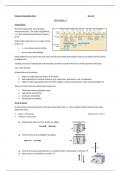
The time required for some geologic
events/processes. The scale is logarithmic,
i.e. it has equal divisions between powers
of 10.
Deformation takes place on a range of time
scales, e.g.
• s – min during seismic activity
• Ma for mountain building
Deformation has occurred in the past (we know this from field observations) and occurs today (seismic activity,
landslides etc).
Geologic structures resulting from deformation, provide a record of the forces which operated in the past.
e.g., Faults & Folds
Interpretation of structures:
1. Helps to understand the history of the Earth
2. Aids exploration of natural resources (e.g. natural gas, petroleum, coal, ore deposits)
3. Helps to select appropriate sites for dams, bridges, nuclear power plants, roads, housing estates etc
Sources of information on deformation processes:
1. Field observations (geologic maps)
2. Laboratory experiments
3. Computer simulations
4. Theoretical calculations
Stress & Strain:
Fractured and contorted minerals/rocks have been deformed, i.e., their original shapes/volumes have been
altered by stress.
Stress = force/area (SI unit = Pa = N m-2)
Pressure = force/area
Compression stress acts to shorten an object:
Tension stress acts to lengthen an object:
Normal stress acts perpendicular to a surface (either compression or tension)
Shear stress acts parallel to a surface
Deformation -1
Deformation:
The time required for some geologic
events/processes. The scale is logarithmic,
i.e. it has equal divisions between powers
of 10.
Deformation takes place on a range of time
scales, e.g.
• s – min during seismic activity
• Ma for mountain building
Deformation has occurred in the past (we know this from field observations) and occurs today (seismic activity,
landslides etc).
Geologic structures resulting from deformation, provide a record of the forces which operated in the past.
e.g., Faults & Folds
Interpretation of structures:
1. Helps to understand the history of the Earth
2. Aids exploration of natural resources (e.g. natural gas, petroleum, coal, ore deposits)
3. Helps to select appropriate sites for dams, bridges, nuclear power plants, roads, housing estates etc
Sources of information on deformation processes:
1. Field observations (geologic maps)
2. Laboratory experiments
3. Computer simulations
4. Theoretical calculations
Stress & Strain:
Fractured and contorted minerals/rocks have been deformed, i.e., their original shapes/volumes have been
altered by stress.
Stress = force/area (SI unit = Pa = N m-2)
Pressure = force/area
Compression stress acts to shorten an object:
Tension stress acts to lengthen an object:
Normal stress acts perpendicular to a surface (either compression or tension)
Shear stress acts parallel to a surface