BIO 170 MSU Questions With 100% Correct Answers!!
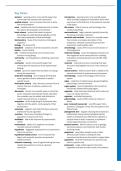
ecology - the scientific study of the distribution and abundance of organisms and the interactions between organisms and the environment natural history - the research and study of organisms including animals, fungi and plants in their environment (known as naturalist or natural historian) Ecologists - use observations an experiments to understand the natural world Evolution - 1. The idea that living species are descendants of ancestral species that were different from the present day ones 2. Change in genetic composition of population from generation to generation ecological time scale - interactions take place Evolutionary time scale - Adaptions of populations occur Four limits of an organisms distribution or abundance - Dispersal, Habitat selection, Biotic factors, Abiotic factors Dispersal - An organisms ability to move may limit their distribution Species Transplants - ecologists use this to determine if dispersal limits the distribution of that species Habitat Selection - the distribution of a species may be limited by where an organism lives Biotic Factors (living) - the distribution of a species may be limited by other individuals or speciesAbiotic Factors (non-living) - temperature, water, sunlight, wind, salinity, rock type and soils Climate is the result of four key abiotic factors - Temperature, precipitation, sunlight, wind Microclimate - determined by fine-scale differences in the environment that affect light and wind patterns Bozeman - Northern Coniferous forest Variation in sunlight - causes global patterns in air circulation and precipitation seasonal variation - intensity of light latitudinal variation - intensity of sunlight (earth is curved) mountains - sunlight, temperature, aspect (north vs. south facing) oceans and large lakes - moderate costal climate Combinations of climate and species determine biomes - the major aquatic and terrestrial life zones on earth Ocean pelagic zone - 70% of earth's surface population ecology - the study of populations in relation to their environment Population dynamics - examine characteristics of populations and how they change over time or spacepopulation characteristics - dispersion and density Demographics - life tables, survivorship curves, reproductive rates Dispersion - 1. the pattern of spacing among individuals 2. reflects environmental conditions and interactions What affects dispersion patterns - food, predators, competitors, microclimate, reproduction, age/sex patters of dispersion - clumped, uniform, random density - the number of individuals per unit area or volume demography - the study of the vital statistics of a population, and change in these values over space or time vital statistics - factors that affects present and future population size (e.g., births, deaths, age, ratios, sex ratios, movement) Life table - is an age-specific summary of the survival pattern of a population survivorship curves - 1. graphical representation of life tables 2. changes in survival over maximum life span 3. 3 general patterns survivorship curve TYPE 1 - survival is high in early/middle life survival decreases as get oldersurvivorship curve TYPE 2 - survival rate is constant over the organism's life span survivorship curve TYPE 3 - survival is low for the young mortality decline for survivors reproductive rate - and age-specific summary of reproductive rates in a population many offspring - decreased survival probability fewer offspring - increased survival probability semelparity - (big-bang reproduction, 1x) salmon, annual plants iteroparity - (repeated reproduction) most large mammals, perennial plats what determines population size - births, immigration, death, emigration, patterns of population growth - exponential growth logistic growth exponential growth - constant rate of increase cannot be sustained for long in any population logistic growth - growth rate changes, density dependent what factors affect growth as population density increases - density dependance competition - increased population increased competition for resourcesterritoriality - competition for space may limit density disease - in dense populations, pathogens can spread more quickly predation - as prey population grows predators may feed on that
Escuela, estudio y materia
- Institución
- BIO 170 MSU
- Grado
- BIO 170 MSU
Información del documento
- Subido en
- 21 de mayo de 2024
- Número de páginas
- 8
- Escrito en
- 2023/2024
- Tipo
- Examen
- Contiene
- Preguntas y respuestas
Temas

Documento también disponible en un lote