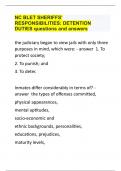
NC BLET SHERIFFS’ RESPONSIBILITIES DETENTION DUTIES questions and answers.
the judiciary began to view jails with only three purposes in mind, which were: 1. To protect society; 2. To punish; and 3. To deter. Inmates differ considerably in terms of? the types of offenses committed, physical appearances, mental aptitudes, socio-economic and ethnic backgrounds, personalities, educations, prejudices, maturity levels, respect for authority, and their abilities to handle stress or high anxiety levels. In most cases, they must live under the same roof on the same floor, in the same cell block, or the same cell. A written commitment order from a judicial official is required for: (All written commitments orders) 1. Pretrial detainees 2. Convicted inmates. 3. Probation revocation 4. Writs. 5. Federal inmates. -A written custody order from a United States Marshall 6. Witnesses. 7. Confinement in response to violation ("Dunk") A written commitment order is required from what official for a pretrial detainee? Judicial judge A written commitment order is required from what official for a probation revocation? Judicial Judge. A written commitment order is required from what official for a witness? Judge. A written commitment order is required from what official for Confinement in response to violation ("Dunk")? Judicial judge The court may impose confinement for ninety days for a defendant under supervision for a felony or up to ninety days for a defendant under supervision for a misdemeanor. An inmate may be committed to the detention facility under the following writs for matters pending before a court: 1. A writ of habeas corpus ad prosequendum to determine whether he or she is entitled to release (G.S. 17-15); and 2. A writ of habeas corpus ad testificandum to be a witness (G.S. 17-43). A written commitment order from a judicial officer is not required for: 1. Public intoxicated individuals. 2. Parole revocation. 3. Bond Surrender of Surety. 4. Quick dip confinement ("Quick Dip"). T/F A written commitment order from a judicial official is not required to hold a parolee arrested under a revocation order (parole warrant) issued by the Parole Commission. TRUE. When may a surety surrender a defendant? 1. Going off the bond before breach 2. Surrender after breach of condition When a defendant is surrendered by a surety, what shall the sheriff do? the sheriff shall without unnecessary delay take the defendant before a judicial official, along with a copy of the undertaking received from the surety and a copy of the receipt provided to the surety. The key people in the booking process are? the person in custody, the arresting officer, and the magistrate. Before a person may be committed to the detention facility, a magistrate will? determine the circumstances of the arrest from the arresting officer and interview the person in custody to determine if that person should be committed to the detention facility or released. AOC Form CR-200 "Release Order" "Blue Sheet" The AOC-CR-200 is the document used to track inmates through the system Who fills out the AOC-CR-200 form? the AOC-CR-200 is filled out by the judicial officer. This form has three copies: 1. the original sent to the clerk of court's research division, 2. a copy given to the defendant, and 3. one given to the arresting officer to take to the detention facility and is the legal document used to lawfully incarcerate the arrestee. Once the arrestee is at the detention facility, either of two processes will occur: 1. The inmate will stay in custody until the case is finished. 2. The inmate is released The inmate is released by one of five different ways: 1. secured bond, 2. written promise to appear, 3. custody release, 4. unsecured bond, or 5. house arrest with electronic monitoring. If the case is dismissed, it returns to clerk of court records to become part of permanent records. If inmate is sentenced it is then sent back to the? detention facility. AOC-CR-200 must contain the following six items before the person may be accepted by the detention facility: 1. Subject's name or identity. 2. Offense charged 3. Provisions for release of subject or a judicial official's order to hold subject until bail hearing. 4. Order for commitment addressed to a specific detention facility. 5. Directions for disposition must be indicated, when and where to appear in court. 6. Signature and office of judicial officer ordering the commitment. T/F John Doe or some other "made up" name is correct if the name is not acquired. FALSE. If the name is unknown, enter "unknown" and identify the arrestee by his or her physical description. T/F A badge or uniform alone is proper identification when brining an inmate to the detention facility FALSE. The person bringing the inmate to the detention facility should furnish the booking officer with his or her credentials or identification card. A badge or uniform alone is not proper identification. T?F Accepting "custody" of an inmate and "confinement" of an inmate is not the same thing TRUE.
Escuela, estudio y materia
- Institución
- Nc blet
- Grado
- Nc blet
Información del documento
- Subido en
- 17 de mayo de 2024
- Número de páginas
- 16
- Escrito en
- 2023/2024
- Tipo
- Examen
- Contiene
- Preguntas y respuestas
Temas
-
nc blet sheriffs responsibilities detention

Documento también disponible en un lote