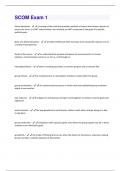
SCOM Exam 1 Questions with well explained answers
liberal education - a training of the mind that provides methods of inquiry that allows a person to pursue the truth. it is NOT indoctrination. the methods are NOT connected to the goals of a specific political party. goals of a liberal education - provides intellectual skills necessary to be successful, exposes one to a variety of perspectives thesis of the course - to understand the purpose and power of communication in human relations. communication works on us, for us, and through us. interedependence - when a small group shares a common purpose and a common fate group climate - the emotional tone or atmosphere members create within the group group socialization - the communication process in which new and established group members adjust to one another task cohesion - the degree to which group members work together to achieve common goals and objectives social cohesion - the way people form social bonds, relate to each other, and get along on a dayto-day basis group conformity - compliance with a group's goals, even when the group's goals may be in direct contrast to an individual's goals groupthink - the mode of thinking that occurs when the desire for harmony in a decision-making group overrides a realistic appraisal of alternativesgroup conflict (procedural, substantive & interpersonal) - Conflict can appear in indirect or direct forms within group interaction, just as it can in interpersonal interactions. Group members may openly question each other's ideas or express anger toward or dislike for another person. brainstorming - the process of getting a group to think of unlimited ways to vary a product or solve a problem. refers to the quick generation of ideas free of evaluation. decision-making rules (majority, minority & consensus) - can appear fair and democratic but really only be a gesture that covers up the fact that certain group members or the group leader have already decided. often more informed, since all group members develop a shared understanding of a problem through discussion and debate. The shared understanding may also be more complex and deep than what an individual would develop, problem-solving method (define problem, analyze problem, generate solution, evaluate solutions, implement and assess solutions) - involves thoughts, discussions, actions, and decisions that occur from the first consideration of a problematic situation to the goal. T communication - the process of generating meaning by sending and receiving verbal and nonverbal symbols and signs that are influenced by multiple contexts. communication contexts (social, relational & cultural) - The values, attitudes, beliefs, orientations, and underlying assumptions prevalent among people in a society intrapersonal communication - communication with oneself (debating what to eat, where to go) interpersonal communication - the exchange of thoughts, feelings, and beliefs between two or more people. defined by context of relationship (co-worker, friend, family) can influence how and what is communicated group communication - Communication among members of a team or a collective about topics such as goals, strategies, and c communication - to a certain extent has largely been subsumed by network communication (instagram, twitter). in real life example: black lives mater protests
Escuela, estudio y materia
- Institución
- SCOM
- Grado
- SCOM
Información del documento
- Subido en
- 17 de mayo de 2024
- Número de páginas
- 10
- Escrito en
- 2023/2024
- Tipo
- Examen
- Contiene
- Preguntas y respuestas
Temas

Documento también disponible en un lote