

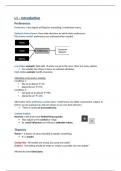
L1 – Introduction
Preferences
Preference = the degree of liking for something; it motivates choice.
Rational choice theory: they make decisions to satisfy their preferences.
File drawer model: preferences are retrieved when needed.
Low stakes example: light bulb when you go to the store, there are many options.
You simplify the choice to focus on relevant attributes.
High stakes example: health insurance
Attending a free poetry reading:
Condition 1:
• Pay €2 to attend 3%
• Attend for €0 97%
Condition 2:
• Get paid €2 to attend 59%
• Attend for €0 41%
Alternative view: preference construction: “preferences are labile, inconsistent, subject to
factors we are unaware of, and not always in our own best interests.”
“There’s mostly no true preference.”
Context matters
Neurons in the brain have limited firing capacity.
They adjust to the context or range.
So, social influences can influence attitudes/values.
Theories
Theory = a system of ideas intended to explain something.
It’s a model.
George Box: “All models are wrong, but some are useful.”
Einstein: “Everything should be made as simple as possible, but not simpler.”
All theories have blind spots.
,What makes a theory useful?
1) Internally consistent it doesn’t contradict itself.
2) Testable predictions
3) Empirically supported likely to be true.
Generality-specificity trade-off
General: covers many phenomena and behaviors.
Specific: able to predict behavior with high precision.
Gambler’s fallacy: treat independent events (die rolls) as
non-independent, assuming it will tend toward evening out.
Example: if tails comes up in many coin tosses,
expect head to be more likely on the next coin toss.
Highly specific explanations
Sometimes high specific explanations are tautological (optimism bias).
Can be masked by “dressing things up” in different names.
But why?
• What is the proximate mechanism? The “how” behavior is generated.
• What is the ultimate mechanism? The “why” behavior is favored.
Ultimate and proximal explanations
,L2 – Heuristics, biases and nudging
Rational Choice Theory
Principles of Rational Choice Theory
People…
• Have well-defined preferences (file drawer model);
• Process all information;
• Weigh the relevant information;
• Consistently choose what satisfies their preferences (like a robot).
But, people often deviate from these principles.
Reality
People sometimes…
• Construct their preferences in the moment;
• Ignore or avoid relevant information;
• Rely on irrelevant information;
• Make mistakes.
Deviations from Rational Choice Theory
Experiment 1: Experiment 2:
Compromise effect: an option is chosen more Attraction/decoy effect: option A > B if
often when its attributes are not the extremes. A obviously domination another option.
Adding large makes medium the middle option. Adding medium makes large more
attractive
Context matters
Compromise effect: middle option is chosen more often.
Attraction/decoy: the option that dominates is chosen more often.
Dw is weakly dominated, Ds is strongly dominated by B.
Heuristics and biases
Kahneman & Tversky studied how people actually make decisions. They integrate
psychological principles.
Biases = systematic deviations from rationality.
Heuristics = mental short-cuts.
Biases
Biases are labels for behaviours, not theories for explaining it.
Endowment effect = people value something more when they feel a sense of ownership.
You only sell your mug for €5 or higher, but you would only pay €3 for a new mug.
, Free return, but because you already have the product, you’re less willing to give it
up.
Framing effect = preferences can shift depending on how information is presented.
Surgery has 90% chance of success > surgery has 10% chance of complications.
Sunk-cost fallacy = investing money or effort into something, because some amount of
money or effort was already invested. The recency of payment increased the effect.
Skiing on a rainy day, because you’ve already paid for the ticket.
Monthly gym membership works better than a yearly membership or paying per visit.
Heuristics
Availability heuristic = people judge the likelihood of events by the ease with which they can
generate an instance of that event (memory, imagine, examples, visualize).
You think the chance of winning the lottery are quite high, because you don’t see the
losses.
You think sharks are very dangerous, because you only see the attacks.
Anchoring and adjustment = people start form an anchor (= initial value), then adjust
upwards or downwards.
By manipulating the anchor, final judgements can be manipulated.
Is the population of Chicago more or less than 200,000? How many?
Donation example is €120.
Mental accounting = you put money into different ‘accounts’.
Different use of income vs. windfall.
What gets combined vs. separated can constrain spending or lead to over-spending.
Couple gets €300 back from an airline as compensation for lost luggage. They than go
out for a dinner that costs €225, which they had never spend on a dinner out before.
Prospect theory
Value function
Reference point = there’s no absolute value, everything is valued to
some reference point.
You win €1 million in the casino, then at the last minute you lose €995,000. How
happy are you?
Diminishing sensitivity = diminishing marginal return.
Preferences
Preference = the degree of liking for something; it motivates choice.
Rational choice theory: they make decisions to satisfy their preferences.
File drawer model: preferences are retrieved when needed.
Low stakes example: light bulb when you go to the store, there are many options.
You simplify the choice to focus on relevant attributes.
High stakes example: health insurance
Attending a free poetry reading:
Condition 1:
• Pay €2 to attend 3%
• Attend for €0 97%
Condition 2:
• Get paid €2 to attend 59%
• Attend for €0 41%
Alternative view: preference construction: “preferences are labile, inconsistent, subject to
factors we are unaware of, and not always in our own best interests.”
“There’s mostly no true preference.”
Context matters
Neurons in the brain have limited firing capacity.
They adjust to the context or range.
So, social influences can influence attitudes/values.
Theories
Theory = a system of ideas intended to explain something.
It’s a model.
George Box: “All models are wrong, but some are useful.”
Einstein: “Everything should be made as simple as possible, but not simpler.”
All theories have blind spots.
,What makes a theory useful?
1) Internally consistent it doesn’t contradict itself.
2) Testable predictions
3) Empirically supported likely to be true.
Generality-specificity trade-off
General: covers many phenomena and behaviors.
Specific: able to predict behavior with high precision.
Gambler’s fallacy: treat independent events (die rolls) as
non-independent, assuming it will tend toward evening out.
Example: if tails comes up in many coin tosses,
expect head to be more likely on the next coin toss.
Highly specific explanations
Sometimes high specific explanations are tautological (optimism bias).
Can be masked by “dressing things up” in different names.
But why?
• What is the proximate mechanism? The “how” behavior is generated.
• What is the ultimate mechanism? The “why” behavior is favored.
Ultimate and proximal explanations
,L2 – Heuristics, biases and nudging
Rational Choice Theory
Principles of Rational Choice Theory
People…
• Have well-defined preferences (file drawer model);
• Process all information;
• Weigh the relevant information;
• Consistently choose what satisfies their preferences (like a robot).
But, people often deviate from these principles.
Reality
People sometimes…
• Construct their preferences in the moment;
• Ignore or avoid relevant information;
• Rely on irrelevant information;
• Make mistakes.
Deviations from Rational Choice Theory
Experiment 1: Experiment 2:
Compromise effect: an option is chosen more Attraction/decoy effect: option A > B if
often when its attributes are not the extremes. A obviously domination another option.
Adding large makes medium the middle option. Adding medium makes large more
attractive
Context matters
Compromise effect: middle option is chosen more often.
Attraction/decoy: the option that dominates is chosen more often.
Dw is weakly dominated, Ds is strongly dominated by B.
Heuristics and biases
Kahneman & Tversky studied how people actually make decisions. They integrate
psychological principles.
Biases = systematic deviations from rationality.
Heuristics = mental short-cuts.
Biases
Biases are labels for behaviours, not theories for explaining it.
Endowment effect = people value something more when they feel a sense of ownership.
You only sell your mug for €5 or higher, but you would only pay €3 for a new mug.
, Free return, but because you already have the product, you’re less willing to give it
up.
Framing effect = preferences can shift depending on how information is presented.
Surgery has 90% chance of success > surgery has 10% chance of complications.
Sunk-cost fallacy = investing money or effort into something, because some amount of
money or effort was already invested. The recency of payment increased the effect.
Skiing on a rainy day, because you’ve already paid for the ticket.
Monthly gym membership works better than a yearly membership or paying per visit.
Heuristics
Availability heuristic = people judge the likelihood of events by the ease with which they can
generate an instance of that event (memory, imagine, examples, visualize).
You think the chance of winning the lottery are quite high, because you don’t see the
losses.
You think sharks are very dangerous, because you only see the attacks.
Anchoring and adjustment = people start form an anchor (= initial value), then adjust
upwards or downwards.
By manipulating the anchor, final judgements can be manipulated.
Is the population of Chicago more or less than 200,000? How many?
Donation example is €120.
Mental accounting = you put money into different ‘accounts’.
Different use of income vs. windfall.
What gets combined vs. separated can constrain spending or lead to over-spending.
Couple gets €300 back from an airline as compensation for lost luggage. They than go
out for a dinner that costs €225, which they had never spend on a dinner out before.
Prospect theory
Value function
Reference point = there’s no absolute value, everything is valued to
some reference point.
You win €1 million in the casino, then at the last minute you lose €995,000. How
happy are you?
Diminishing sensitivity = diminishing marginal return.



