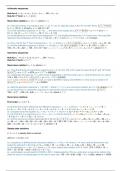
Arithmetic sequences
Rule for d: d = t2 − t1 = t3 − t2 = t4 − t3 = …, OR d = tn − tn−1
Rule for nth term: tn = a + (n-1)d
Recurrence relation: tn+1 = tn + d, where t1 = a
ex. if the first 6 terms of a sequence are 2, 7, 12, 17, 22, 27, state the value of the 10th and 20th terms. tn = a + (n-1)d
t10 = 2 + (10-1)5 = 47 and t20 = 2 + (20-1)5 = 97
ex. for the arithmetic sequence 54, 51, 48, …, find which term equals zero. tn = a + (n-1)d → tn = 54 + (n-1)-3 →
0 = 54 + (n-1)-3 → 54 ÷ 3 = n-1 → 18 + 1 = n → n = 19
ex. the temperature at a ski resort was displayed as 3°C, but steadily decreased by 0.6°C every hour. how long after
opening is the temperature at 0°C? tn = a + (n-1)d → 0 = 3 + (n-1)-0.6 → 3 ÷ 0.6 = n-1 → n = 6 hours
ex. find a rule for the nth term of sequence tn+1 = tn - 8, where t1 = 4. tn = a + (n-1)d → tn = 4 – 8 (n-1) → tn = 12 – 9n
ex. find the arithmetic sequence in which t10 = 14 and t25 = 105. tn = a + (n-1)d → 14 = a + 9d, 105 = a + 22d →
105 = 14 – 9d + 22d → 105 – 14 = -9d + 22d → → d = 7 → a = 14 – 9(7) → a = 49, ∴ tn+1 = tn + 7, where t1 = 49
Geometric sequences
Rule for r: r = t2 / t1 = t3 / t2 = t4 / t3 = …, OR r = tn / tn-1
Rule for nth term: tn = arn-1
Recurrence relation: tn+1 = rtn, where t1 = a
ex. if the first 6 terms of a geometric sequence are 2, 6, 18, 243, 729, 2187, state the value of the 8th and 15th terms.
tn = arn-1 → t8 = 2(3)8-1 = 4374, t15 = 2(3)15-1 = 9565938
ex. a population increases by 11% each month. if population in the first month was 20, what will there be in 2 years?
11% = 100 + 11 = 1.11 → tn = arn-1 → t24 = 20(1.11)24-1 = 220.525
ex. in 1 year, $25000 is raised for a club. in 2 years, $20000 is raised, and $16000 in 3. How much is raised in 5?
tn = arn-1 → t5 = 25000(0.8)5-1 → t5 = $10240
ex. state the geometric sequence tn = 4(0.25)n-1, where n = 1, 2, 3, as a recurrence relation. tn+1 = 0.25tn, where t1 = 16
ex. the fourth term in a geometric sequence is 128 and the common ration is two; find the first term. tn = arn-1
128 = a(2)4-1 →128 ÷ 8 = a(8) → a = 16, ∴ tn+1 = 2tn, where t1 = 16
Recurrence relations
First order: tn+1 = rtn + d
ex. find the first 6 terms defined by the difference equation tn+1 = tn – 4, where t1 = 12. t2 = t1 – 4, ∴ 12 – 4 = 8 →
t3 = t2 – 4, ∴ 8 – 4 = 4 → t4 = t3 – 4, ∴ 4 – 4 = 0 → t5 = t4 – 4, ∴ 0 – 4 = -4 → t6 = t5 – 4, ∴ -4 – 4 = -8
ex. a sequence has the equation wn+1 = 3wn – 4. if w3 = -1, find w = 5. w4 = 3(-1)-4 = -7 → w5 = 3(-7)-4 = -25
ex. the third term in a sequence is 24. if un+1 = 2un + 6, find the first term, u1. 24 = 2u2 + 6 → 24 – 6 = 2u2 → 9 = u2
∴ 9 = 2u1 + 6 → 9 – 6 = 2u1 → 3 ÷ 2 = u1
ex. find the recurrence relation generated by 8, 26, 80. tn+1 = rtn + d → t2 = rt1 + d → 26 = r8 + d → 80 = r26 + d →
d = 26 – r8 → 80 = r26 + 26 – r8 → 80 – 26 = r26 – r8 → 54 = 18r → 54 ÷ 18 = r → r = 3 → d = 26 – r8 → d = 26 –
3(8) → d = 26 – 24 → d = 2 ∴ tn+1 = 3tn + 2, where t1 = 8
Steady state solutions
if -1 < r < 1, a steady state is reached.
with tn+1 = tn, let x = tn
ex. a sequence is defined by the recurrence relation t n+1 = 0.4tn + 18, where t1 = 4. what value do the terms in this
sequence approach in the long run? tn+1 = 0.4tn + 18 → x = 0.4x + 18 → x – 0.4x = 18 → 0.6x = 18 → x = 30
ex. the sequence un+1 = kun + 12, where u1 = 10, has a steady state solution of 37.5. find k. 37.5 = 37.5k + 12 →
37.5 – 12 = 37.5k → 25.5 ÷ 37.5 = k → k = 17/25
ex. a photocopier is purchased for $10000 in 2014. it depreciated by 18% p.a. write down a recurrence relation that
gives the value of the photocopier at the start of each year. 100 – 18 = 0.82 = 0.82 → tn+1 = 0.82tn, where t1 = 10000.
Rule for d: d = t2 − t1 = t3 − t2 = t4 − t3 = …, OR d = tn − tn−1
Rule for nth term: tn = a + (n-1)d
Recurrence relation: tn+1 = tn + d, where t1 = a
ex. if the first 6 terms of a sequence are 2, 7, 12, 17, 22, 27, state the value of the 10th and 20th terms. tn = a + (n-1)d
t10 = 2 + (10-1)5 = 47 and t20 = 2 + (20-1)5 = 97
ex. for the arithmetic sequence 54, 51, 48, …, find which term equals zero. tn = a + (n-1)d → tn = 54 + (n-1)-3 →
0 = 54 + (n-1)-3 → 54 ÷ 3 = n-1 → 18 + 1 = n → n = 19
ex. the temperature at a ski resort was displayed as 3°C, but steadily decreased by 0.6°C every hour. how long after
opening is the temperature at 0°C? tn = a + (n-1)d → 0 = 3 + (n-1)-0.6 → 3 ÷ 0.6 = n-1 → n = 6 hours
ex. find a rule for the nth term of sequence tn+1 = tn - 8, where t1 = 4. tn = a + (n-1)d → tn = 4 – 8 (n-1) → tn = 12 – 9n
ex. find the arithmetic sequence in which t10 = 14 and t25 = 105. tn = a + (n-1)d → 14 = a + 9d, 105 = a + 22d →
105 = 14 – 9d + 22d → 105 – 14 = -9d + 22d → → d = 7 → a = 14 – 9(7) → a = 49, ∴ tn+1 = tn + 7, where t1 = 49
Geometric sequences
Rule for r: r = t2 / t1 = t3 / t2 = t4 / t3 = …, OR r = tn / tn-1
Rule for nth term: tn = arn-1
Recurrence relation: tn+1 = rtn, where t1 = a
ex. if the first 6 terms of a geometric sequence are 2, 6, 18, 243, 729, 2187, state the value of the 8th and 15th terms.
tn = arn-1 → t8 = 2(3)8-1 = 4374, t15 = 2(3)15-1 = 9565938
ex. a population increases by 11% each month. if population in the first month was 20, what will there be in 2 years?
11% = 100 + 11 = 1.11 → tn = arn-1 → t24 = 20(1.11)24-1 = 220.525
ex. in 1 year, $25000 is raised for a club. in 2 years, $20000 is raised, and $16000 in 3. How much is raised in 5?
tn = arn-1 → t5 = 25000(0.8)5-1 → t5 = $10240
ex. state the geometric sequence tn = 4(0.25)n-1, where n = 1, 2, 3, as a recurrence relation. tn+1 = 0.25tn, where t1 = 16
ex. the fourth term in a geometric sequence is 128 and the common ration is two; find the first term. tn = arn-1
128 = a(2)4-1 →128 ÷ 8 = a(8) → a = 16, ∴ tn+1 = 2tn, where t1 = 16
Recurrence relations
First order: tn+1 = rtn + d
ex. find the first 6 terms defined by the difference equation tn+1 = tn – 4, where t1 = 12. t2 = t1 – 4, ∴ 12 – 4 = 8 →
t3 = t2 – 4, ∴ 8 – 4 = 4 → t4 = t3 – 4, ∴ 4 – 4 = 0 → t5 = t4 – 4, ∴ 0 – 4 = -4 → t6 = t5 – 4, ∴ -4 – 4 = -8
ex. a sequence has the equation wn+1 = 3wn – 4. if w3 = -1, find w = 5. w4 = 3(-1)-4 = -7 → w5 = 3(-7)-4 = -25
ex. the third term in a sequence is 24. if un+1 = 2un + 6, find the first term, u1. 24 = 2u2 + 6 → 24 – 6 = 2u2 → 9 = u2
∴ 9 = 2u1 + 6 → 9 – 6 = 2u1 → 3 ÷ 2 = u1
ex. find the recurrence relation generated by 8, 26, 80. tn+1 = rtn + d → t2 = rt1 + d → 26 = r8 + d → 80 = r26 + d →
d = 26 – r8 → 80 = r26 + 26 – r8 → 80 – 26 = r26 – r8 → 54 = 18r → 54 ÷ 18 = r → r = 3 → d = 26 – r8 → d = 26 –
3(8) → d = 26 – 24 → d = 2 ∴ tn+1 = 3tn + 2, where t1 = 8
Steady state solutions
if -1 < r < 1, a steady state is reached.
with tn+1 = tn, let x = tn
ex. a sequence is defined by the recurrence relation t n+1 = 0.4tn + 18, where t1 = 4. what value do the terms in this
sequence approach in the long run? tn+1 = 0.4tn + 18 → x = 0.4x + 18 → x – 0.4x = 18 → 0.6x = 18 → x = 30
ex. the sequence un+1 = kun + 12, where u1 = 10, has a steady state solution of 37.5. find k. 37.5 = 37.5k + 12 →
37.5 – 12 = 37.5k → 25.5 ÷ 37.5 = k → k = 17/25
ex. a photocopier is purchased for $10000 in 2014. it depreciated by 18% p.a. write down a recurrence relation that
gives the value of the photocopier at the start of each year. 100 – 18 = 0.82 = 0.82 → tn+1 = 0.82tn, where t1 = 10000.